Tags: algorithm primitive simulation
Simulating the time evolution of a quantum system is one of the canonical applications of a quantum computer. When the Hamiltonian splits into non-commuting pieces with , the naive factorisation is wrong; the standard fix is Trotter–Suzuki product formulas, which interleave short evolutions of each piece. The error decreases as we take smaller steps (Lie–Trotter, first order), symmetrise the step (Strang, second order), or nest the symmetric step recursively via Suzuki’s construction (any even order).
This article builds these approximations end-to-end in Qamomile on a
one-qubit Rabi Hamiltonian so the Trotter error is measurable. We start
with and , then write the full Suzuki fractal recursion as a
self-recursive @qkernel that takes the target order as a UInt
parameter — the transpiler resolves the recursion by iterating
inline + partial-evaluation under a concrete order binding, so the emitted
circuit is flat regardless of how deep the recursion went. Finally, we
verify the textbook convergence rates (’s fidelity error scales as
) against the exact 2x2 propagator.
# Install the latest Qamomile through pip!
# !pip install "qamomile[qiskit]"
import os
from typing import Any
import matplotlib.pyplot as plt
import numpy as np
from qiskit import QuantumCircuit, transpile as qk_transpile
from qiskit_aer import AerSimulator
from scipy.linalg import expm
import qamomile.circuit as qmc
import qamomile.observable as qm_o
from qamomile.circuit.algorithm import trotterized_time_evolution
from qamomile.qiskit import QiskitTranspiler
docs_test_mode = os.environ.get("QAMOMILE_DOCS_TEST") == "1"The Rabi Hamiltonian
A single two-level system driven on resonance is governed by
Because , splitting into and introduces a Trotter error that is easy to see even on a single qubit. Starting from , the excitation probability oscillates as with .
In Qamomile we build and as two separate Observables and pack
them into a Python list. A @qkernel declares that list as
Vector[Observable]; binding the list at transpile time expands any
iteration over Hs.shape[0] into per-term pauli_evolve calls.
omega = 1.2
Omega = 0.8
T = 1.5

Hz = 0.5 * omega * qm_o.Z(0)
Hx = 0.5 * Omega * qm_o.X(0)
Hs = [Hz, Hx]
Verifying 
Trotter approximations only matter because and do not commute.
qamomile.observable.commutator(a, b) computes the commutator
on Hamiltonians directly. Internally it iterates over
the Pauli-string pairs once and uses the qubit-parity rule — two Pauli
strings anticommute iff the number of qubits on which they carry different
non-identity Paulis is odd — to drop every commuting pair before any
product is built. This is cheaper than expanding Hz * Hx - Hx * Hz and
cancelling, and the result is a fully simplified Hamiltonian that we can
inspect or compare against an analytic value.
For the Rabi Hamiltonian the textbook value is
which commutator reproduces exactly:
comm_zx = qm_o.commutator(Hz, Hx)
print(comm_zx)

expected = 1j * 0.5 * omega * Omega * qm_o.Y(0)
assert comm_zx == expected
Hamiltonian((Y0,): 0.48j)
Exact reference state
A 2x2 matrix exponential gives the exact state , which each Trotter approximation is judged against via the fidelity error .
X_mat = np.array([[0, 1], [1, 0]], dtype=complex)
Z_mat = np.array([[1, 0], [0, -1]], dtype=complex)
H_mat = 0.5 * omega * Z_mat + 0.5 * Omega * X_mat
sv_exact = expm(-1j * T * H_mat) @ np.array([1.0, 0.0], dtype=complex)
def statevector(circuit) -> np.ndarray:
"""Strip measurements, lower PauliEvolutionGate, and read out the state.
The default ``pauli_evolve`` emitter produces a ``PauliEvolutionGate``, which
is not in AerSimulator's native basis. We run a shallow Qiskit transpile
pass to expand it into elementary rotations before simulating.
"""
stripped = QuantumCircuit(*circuit.qregs)
for instr in circuit.data:
if instr.operation.name not in ("measure", "save_statevector"):
stripped.append(instr)
stripped = qk_transpile(
stripped,
basis_gates=["u", "cx", "rx", "ry", "rz", "h", "p", "sx", "x", "y", "z"],
)
# ``save_statevector`` is a qiskit-aer monkey-patch on ``QuantumCircuit``
# that base qiskit's typeshed does not know about.
stripped.save_statevector() # type: ignore[attr-defined]
sim = AerSimulator(method="statevector")
return np.asarray(sim.run(stripped).result().get_statevector()): First-order Suzuki–Trotter decomposition (Lie–Trotter)
The simplest split is
applied times for a total evolution time . Per step the local error is ; integrated over steps the global state-norm error is .
We write one step as a small helper @qkernel: the qubit register is threaded
through, evolved under and then . The outer kernel rabi_s1
repeats that step times, where n_steps is a UInt parameter so the
same kernel transpiles for any at bind-time.
@qmc.qkernel
def s1_step(
    q: qmc.Vector[qmc.Qubit], Hs: qmc.Vector[qmc.Observable], dt: qmc.Float
) -> qmc.Vector[qmc.Qubit]:
    q = qmc.pauli_evolve(q, Hs[0], dt)
    q = qmc.pauli_evolve(q, Hs[1], dt)
    return q
@qmc.qkernel
def rabi_s1(
Hs: qmc.Vector[qmc.Observable], dt: qmc.Float, n_steps: qmc.UInt
) -> qmc.Vector[qmc.Bit]:
q = qmc.qubit_array(1, "q")
for _ in qmc.range(n_steps):
q = s1_step(q, Hs, dt)
return qmc.measure(q): Second-order Suzuki–Trotter decomposition (Strang splitting)
Symmetrising the step around the middle term cancels the leading error:
The local error drops to and the global state-norm error to
. The step kernel is just three pauli_evolve calls.
@qmc.qkernel
def s2_step(
    q: qmc.Vector[qmc.Qubit], Hs: qmc.Vector[qmc.Observable], dt: qmc.Float
) -> qmc.Vector[qmc.Qubit]:
    q = qmc.pauli_evolve(q, Hs[0], 0.5 * dt)
    q = qmc.pauli_evolve(q, Hs[1], dt)
    q = qmc.pauli_evolve(q, Hs[0], 0.5 * dt)
    return q
@qmc.qkernel
def rabi_s2(
Hs: qmc.Vector[qmc.Observable], dt: qmc.Float, n_steps: qmc.UInt
) -> qmc.Vector[qmc.Bit]:
q = qmc.qubit_array(1, "q")
for _ in qmc.range(n_steps):
q = s2_step(q, Hs, dt)
return qmc.measure(q)Higher-order Suzuki–Trotter decomposition: the fractal recursion
Masuo Suzuki showed that an arbitrary even-order Trotter approximation can be built recursively from by nesting five rescaled copies at each level:
with the level-specific coefficient
is chosen so that the -th-order error of the lower formula cancels, leaving a local error of per step — the coefficient must be recomputed at every level. Concretely:
(4th order): ,
(6th order): ,
(8th order): .
Reusing at every level leaves a non-zero -th-order error term, so the resulting formula is no better than — a classic trap when implementing Suzuki-Trotter by hand.
Writing the recursion as a self-recursive @qkernel
The mathematical recursion translates directly into a @qkernel that takes
the target order as a UInt parameter and calls itself with order - 2 in
the recursive branch. The base case at order == 2 hands off to s2_step;
otherwise five nested calls produce the Suzuki fractal.
Qamomile’s transpiler resolves a self-recursive kernel by running an
inline + partial-evaluation fixed-point loop under the concrete
order binding: each iteration unrolls one layer of CallBlockOp and folds
the base-case if using the current value of order. The emitted circuit
is flat regardless of how many recursive levels were involved, so you can
bind order=8 at transpile time and get a concrete 8th-order Suzuki
circuit without generating the formula by hand.
Two caveats to know up front:
ordermust be concrete at transpile time. Without a binding the base-caseifnever folds and the unroll loop has nothing to terminate on; the transpiler leaves the self-call in the IR and engine emit rejects it.Non-terminating recursion is caught. If the body calls itself with
order + 2instead oforder - 2, or never reaches the base case, the unroll loop raisesFrontendTransformErrorafter it runs out of depth budget (the classicalRecursionErroranalogue).
@qmc.qkernel
def suzuki_trotter(
    order: qmc.UInt,
    q: qmc.Vector[qmc.Qubit],
    Hs: qmc.Vector[qmc.Observable],
    dt: qmc.Float,
) -> qmc.Vector[qmc.Qubit]:
    if order == 2:
        q = s2_step(q, Hs, dt)
    else:
        p = 1.0 / (4.0 - 4.0 ** (1.0 / (order - 1)))
        w = 1.0 - 4.0 * p
        q = suzuki_trotter(order - 2, q, Hs, p * dt)
        q = suzuki_trotter(order - 2, q, Hs, p * dt)
        q = suzuki_trotter(order - 2, q, Hs, w * dt)
        q = suzuki_trotter(order - 2, q, Hs, p * dt)
        q = suzuki_trotter(order - 2, q, Hs, p * dt)
    return q
@qmc.qkernel
def rabi_suzuki(
order: qmc.UInt,
Hs: qmc.Vector[qmc.Observable],
dt: qmc.Float,
n_steps: qmc.UInt,
) -> qmc.Vector[qmc.Bit]:
q = qmc.qubit_array(1, "q")
for _ in qmc.range(n_steps):
q = suzuki_trotter(order, q, Hs, dt)
return qmc.measure(q)rabi_suzuki is a single kernel that produces , , , , …
just by choosing the order binding at transpile time — there is no
separate kernel per order.
Shortcut: trotterized_time_evolution in qamomile.circuit.algorithm
Writing out s1_step / s2_step / suzuki_trotter and the outer step loop
by hand was useful for seeing the recursion in action, but for day-to-day
use Qamomile ships the same construction as a ready-made helper in
qamomile.circuit.algorithm.trotter:
@qmc.qkernel
def rabi_from_algorithm(
    Hs: qmc.Vector[qmc.Observable],
    gamma: qmc.Float,
    order: qmc.UInt,
    step: qmc.UInt,
) -> qmc.Vector[qmc.Bit]:
    q = qmc.qubit_array(1, name="q")
    q = trotterized_time_evolution(q, Hs, order, gamma, step)
    return qmc.measure(q)
The helper accepts order = 1 or any positive even integer and applies
step Trotter slices of size gamma / step, so the rest of this article’s
plots could be reproduced by binding order and step on this single
kernel. Use it when you do not need to customise the splitting and fall
back to the explicit form above when you want to see (or tweak) the
per-term gate schedule.
Quick sanity check at 
Before the convergence sweep, transpile each kernel once and confirm the
statevectors land in the right ball park. and use their own
dedicated kernels; and come from rabi_suzuki with the
corresponding order bindings.
tr = QiskitTranspiler()
N_demo = 8
s1_s2_kernels = {"S1": rabi_s1, "S2": rabi_s2}
suzuki_orders = {"S4": 4, "S6": 6}

for name, ker in s1_s2_kernels.items():
    exe = tr.transpile(ker, bindings={"Hs": Hs, "dt": T / N_demo, "n_steps": N_demo})
    sv = statevector(exe.compiled_quantum[0].circuit)
    err = 1.0 - abs(np.vdot(sv_exact, sv))
    print(f"{name} at N={N_demo}: fidelity error = {err:.3e}")

for name, order in suzuki_orders.items():
    exe = tr.transpile(
        rabi_suzuki,
        bindings={"order": order, "Hs": Hs, "dt": T / N_demo, "n_steps": N_demo},
    )
    sv = statevector(exe.compiled_quantum[0].circuit)
    err = 1.0 - abs(np.vdot(sv_exact, sv))
    print(f"{name} at N={N_demo}: fidelity error = {err:.3e}")
S1 at N=8: fidelity error = 1.183e-03
S2 at N=8: fidelity error = 1.059e-06
S4 at N=8: fidelity error = 1.468e-13
S6 at N=8: fidelity error = -2.220e-16
Convergence sweep
We now sweep the number of Trotter steps and plot the fidelity error against the step size on a log-log axis. The expected slopes are:
| Formula | Local error | Global norm error | Fidelity error ( overlap) |
|---|---|---|---|
The fidelity error is the square of the state-norm error (to leading order): when the two vectors are close, so the plot below shows slopes of rather than .
Ns = np.array([2, 4, 8] if docs_test_mode else [2, 4, 8, 16, 32, 64])
all_names = ["S1", "S2", "S4", "S6"]
errors: dict[str, Any] = {name: [] for name in all_names}

for N in Ns:
    for name, ker in s1_s2_kernels.items():
        exe = tr.transpile(
            ker, bindings={"Hs": Hs, "dt": T / int(N), "n_steps": int(N)}
        )
        sv = statevector(exe.compiled_quantum[0].circuit)
        errors[name].append(1.0 - abs(np.vdot(sv_exact, sv)))
    for name, order in suzuki_orders.items():
        exe = tr.transpile(
            rabi_suzuki,
            bindings={"order": order, "Hs": Hs, "dt": T / int(N), "n_steps": int(N)},
        )
        sv = statevector(exe.compiled_quantum[0].circuit)
        errors[name].append(1.0 - abs(np.vdot(sv_exact, sv)))

errors = {k: np.asarray(v) for k, v in errors.items()}
dts = T / Ns
def fit_slope(dts, errs, n_points):
return np.polyfit(np.log(dts[:n_points]), np.log(errs[:n_points]), 1)[0]slope_s1 = fit_slope(dts, errors["S1"], len(Ns))
slope_s2 = fit_slope(dts, errors["S2"], len(Ns))
slope_s4 = fit_slope(dts, errors["S4"], 3)
print(f"Fitted slopes: S1 = {slope_s1:.2f} S2 = {slope_s2:.2f} S4 = {slope_s4:.2f}")
print(f"S6 fidelity error at largest dt: {errors['S6'][0]:.3e}")
# Guard the expected orders so doc-tests catch regressions in pauli_evolve.
assert 1.7 < slope_s1 < 2.3, slope_s1
assert 3.7 < slope_s2 < 4.3, slope_s2
assert 7.0 < slope_s4 < 9.0, slope_s4
# S6 sits at the float64 floor on this 1-qubit problem; just check it is nowhere
# near S4's leading-error magnitude at the same dt.
assert abs(errors["S6"][0]) < 1e-10, errors["S6"][0]Fitted slopes: S1 = 2.03 S2 = 4.01 S4 = 8.05
S6 fidelity error at largest dt: 8.105e-15
fig, ax = plt.subplots(figsize=(6, 4))
markers = {"S1": "o", "S2": "s", "S4": "^", "S6": "D"}
for name in all_names:
    ax.loglog(dts, errors[name], marker=markers[name], label=name)
ax.axhline(1e-15, color="grey", linestyle=":", linewidth=0.8, label="float64 floor")
ax.set_xlabel(r"step size $\Delta t = T / N$")
ax.set_ylabel(
    r"fidelity error $1 - |\langle \psi_{\rm exact} | \psi_{\rm trotter} \rangle|$"
)
ax.set_title("Trotter convergence on Rabi oscillation")
ax.grid(True, which="both", linewidth=0.3)
ax.legend()
fig.tight_layout()
plt.show()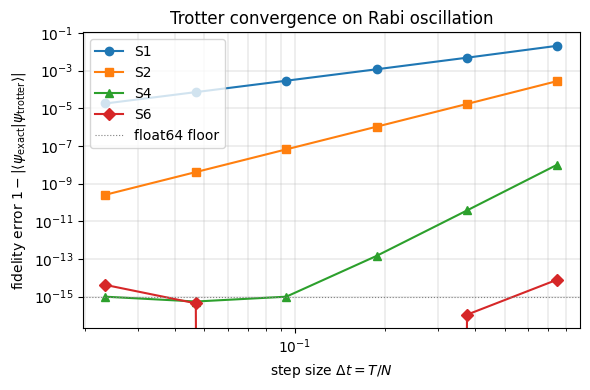
The lines on the plot have slopes , matching the fidelity-error orders in the table above. hits the float64 floor already at ; is at the floor across the entire sweep, so its line appears flat (the expected slope is not resolvable on this 1-qubit problem in double precision).
Summary
Model: a single-qubit Rabi Hamiltonian whose non-zero commutator makes Trotter error measurable.
Vector[Observable]+pauli_evolve: the natural primitive for time-stepping; binding the Hamiltonian list at transpile time expands any iteration overHs.shape[0]into per-term evolutions.Suzuki–Trotter fractal: is built by nesting five rescaled copies of using the level-specific coefficient . Reusing one constant across levels is a common trap and does not produce the fractal.
Recursion: write the math directly as a self-recursive
@qkernelwithorder: UInt. The transpiler iterates inline + partial-eval under a concreteorderbinding and emits a flat circuit. Without a binding the self-call survives in the IR; non-terminating recursion raisesFrontendTransformError.Convergence: fidelity-error slopes of on log-log match textbook Trotter orders, and the symbolic
dt/n_stepsparameters let you sweep step sizes without rebuilding the circuit structure.