Tags: algorithm encoding primitive
This notebook prepares real and complex amplitude vectors with Qamomile’s explicit Möttönen construction, verifies the resulting states and gate counts, and shows when to choose the method-specific API instead of generic amplitude encoding.
# Install the latest Qamomile through pip!
# !pip install qamomile
import os
import numpy as np
from qiskit.quantum_info import Statevector
import qamomile.circuit as qmc
import qamomile.observable as qm_o
from qamomile.circuit.stdlib import (
amplitude_encoding,
mottonen_amplitude_encoding,
mottonen_amplitude_encoding_from_angles,
)
from qamomile.linalg import (
compute_mottonen_amplitude_encoding_ry_angles,
compute_mottonen_amplitude_encoding_rz_angles,
)
from qamomile.qiskit import QiskitTranspiler
docs_test_mode = os.environ.get("QAMOMILE_DOCS_TEST") == "1"Background
Amplitude encoding prepares an -qubit state from a unit-norm complex vector :
Möttönen amplitude encoding is one algorithm that realizes this state-preparation map. Other algorithms can realize the same map, so Qamomile provides one API that explicitly requests Möttönen’s method and another that requests state preparation without prescribing the method:
mottonen_amplitude_encoding(...)explicitly requests Qamomile’s Möttönen construction. Use it when the decomposition, resource counts, or synthesis method are part of the program’s intent.amplitude_encoding(...)expresses only the target state. An engine may use its native state-preparation operation. Qamomile currently uses the Möttönen construction as the portable fallback, but that fallback is not a method guarantee of the generic API.
The explicit implementation follows the uniformly controlled rotation construction of Möttönen, Vartiainen, Bergholm, and Salomaa Mottonen et al., 2004. The paper treats the more general arbitrary-state transformation ; Qamomile implements the state-preparation half with the input fixed to .
Problem Settings
We use two qubits and compare the prepared statevector with three normalized targets:
a positive real vector ,
a signed real vector , and
a complex vector .
State fidelity is phase-invariant, so it verifies the intended physical state even if an engine chooses a different global phase.
transpiler = QiskitTranspiler()
executor = transpiler.executor()

ATOL_STATEVECTOR = 1e-8
ATOL_SHOT = 0.05


def fidelity(prepared: np.ndarray, target: np.ndarray) -> float:
    """Return the phase-invariant fidelity between two statevectors."""
    return float(np.abs(np.vdot(prepared, target)) ** 2)


def normalize(amplitudes: list[float] | list[complex]) -> np.ndarray:
    """Return a unit-norm copy of an amplitude vector."""
    if any(isinstance(value, complex) for value in amplitudes):
        array = np.asarray(amplitudes, dtype=complex)
    else:
        array = np.asarray(amplitudes, dtype=float)
    return array / np.linalg.norm(array)


def statevector_of(kernel: qmc.QKernel, **bindings) -> np.ndarray:
    """Transpile a kernel and return its final statevector."""
    circuit = transpiler.to_circuit(kernel, bindings=bindings or None)
    stripped = circuit.remove_final_measurements(inplace=False)
    assert stripped is not None
    return Statevector.from_instruction(stripped).data


amps_real = [1.0, 2.0, 3.0, 4.0]
amps_signed = [1.0, -1.0, 1.0, -1.0]
amps_complex = [1 + 0j, 1 + 1j, 1 - 1j, 0 + 2j]Algorithm
The Möttönen state-preparation construction has two cascades:
Uniformly controlled rotations distribute the magnitudes across computational-basis states. For real vectors, signed rotation angles also encode negative amplitudes.
Uniformly controlled rotations restore relative phases. Qamomile omits this cascade when every amplitude has zero imaginary part.
Each uniformly controlled rotation is decomposed into elementary rotations and
CNOT gates with the Gray-code construction. For Qamomile’s
specialization, the resulting counts
are:
| Input | Rotations | CNOT gates |
|---|---|---|
| Real | ||
| Complex |
A -controlled uniformly controlled rotation costs elementary
rotations and CNOT gates. Summing the stages for
gives the formulas above; the uncontrolled stage is
CNOT-free. The larger counts quoted in the paper’s abstract apply to the
full arbitrary-input transformation , rather than the
state-preparation half implemented here. Qamomile also retains the plain
per-stage decomposition instead of applying inter-cascade CNOT
cancellation.
Implementation
Bind amplitudes at transpile time
A real or signed-real amplitude vector can be declared as a qkernel
Vector[Float] argument. When concrete values are supplied through
bindings at transpile time, Qamomile automatically normalizes the
amplitudes and generates the Möttönen angles and gate sequence.
@qmc.qkernel
def prepare_from_amplitudes(
    amplitudes: qmc.Vector[qmc.Float],
) -> qmc.Vector[qmc.Bit]:
    q = qmc.qubit_array(2, "q")
    q = mottonen_amplitude_encoding(q, amplitudes)
    return qmc.measure(q)


prepare_from_amplitudes.draw(fold_loops=False, amplitudes=amps_real)
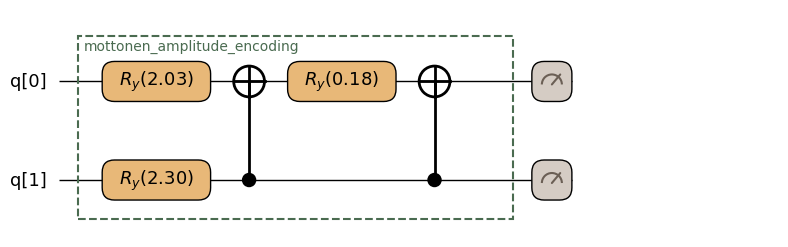
The unexpanded circuit keeps the method-specific operation as one composite
gate. Passing expand_composite=True exposes its elementary , , and
CNOT sequence. The real circuit has no phase cascade.
prepare_from_amplitudes.draw(
    fold_loops=False,
    expand_composite=True,
    amplitudes=amps_real,
)
Because Vector[Float] holds only real values, a complex amplitude vector
cannot be bound directly. For complex input, compute the Möttönen angles
outside the qkernel and pass them to the angle API below as two
Vector[Float] arguments.
Leaving amplitudes in parameters is also invalid because operations
such as atan2(|a_1|, |a_0|) need concrete values during tracing. For a
circuit that can be rebound at runtime, precompute the Möttönen angles and use
the angle API below.
try:
    transpiler.transpile(prepare_from_amplitudes, parameters=["amplitudes"])
except ValueError as exc:
    print(f"ValueError: {exc}")
    raised = True
else:
    raised = False
assert raised, "expected ValueError when amplitudes is a runtime parameter"
ValueError: mottonen_amplitude_encoding received a Vector[Float] handle without concrete values at trace time. Bind it via transpiler.transpile(kernel, bindings={...}) for compile-time amplitudes, or use mottonen_amplitude_encoding_from_angles with parameters=[...] for runtime-parametric angles.
Compile once with runtime-rebindable angles
mottonen_amplitude_encoding_from_angles(...) takes the Möttönen angles
computed by the caller. Because those angles can remain runtime parameters, one
compiled circuit can prepare many amplitude vectors. The function emits the
elementary rotations and CNOT gates directly rather than wrapping them in a
composite operation.
The previous name amplitude_encoding_from_angles(...) remains available as a
compatibility wrapper. New code should use the method-specific name because the
supplied angles and emitted gate sequence are specifically Möttönen’s.
@qmc.qkernel
def prepare_from_angles(
    ry_angles: qmc.Vector[qmc.Float], rz_angles: qmc.Vector[qmc.Float]
) -> qmc.Vector[qmc.Bit]:
    q = qmc.qubit_array(2, "q")
    q = mottonen_amplitude_encoding_from_angles(q, ry_angles, rz_angles)
    return qmc.measure(q)


complex_ry_angles = compute_mottonen_amplitude_encoding_ry_angles(amps_complex).tolist()
complex_rz_angles = compute_mottonen_amplitude_encoding_rz_angles(amps_complex).tolist()

prepare_from_angles.draw(
    fold_loops=False,
    ry_angles=complex_ry_angles,
    rz_angles=complex_rz_angles,
)
Build kernels for resource checks
These helpers create real and complex Möttönen circuits over several register sizes. Using the explicit API ensures that engine-native state preparation cannot change the construction whose resources we are measuring.
def make_real_kernel(n_qubits: int) -> qmc.QKernel:
    """Build a real-input Möttönen state-preparation kernel."""

    @qmc.qkernel
    def kernel(amplitudes: qmc.Vector[qmc.Float]) -> qmc.Vector[qmc.Bit]:
        q = qmc.qubit_array(n_qubits, "q")
        q = mottonen_amplitude_encoding(q, amplitudes)
        return qmc.measure(q)

    return kernel


def make_complex_kernel(n_qubits: int) -> qmc.QKernel:
    """Build a complex-input Möttönen state-preparation kernel."""

    @qmc.qkernel
    def kernel(
        ry_angles: qmc.Vector[qmc.Float],
        rz_angles: qmc.Vector[qmc.Float],
    ) -> qmc.Vector[qmc.Bit]:
        q = qmc.qubit_array(n_qubits, "q")
        q = mottonen_amplitude_encoding_from_angles(q, ry_angles, rz_angles)
        return qmc.measure(q)

return kernelResult
State fidelity
Real and signed-real inputs use amplitude bindings, while the complex
input uses angle bindings. All three reproduce their normalized target up
to global phase.
for label, target_amplitudes in (
    ("real", amps_real),
    ("signed real", amps_signed),
):
    prepared = statevector_of(
        prepare_from_amplitudes,
        amplitudes=target_amplitudes,
    )
    target = normalize(target_amplitudes)
    value = fidelity(prepared, target)
    print(f"{label:>11s} fidelity = {value:.8f}")
    assert np.isclose(value, 1.0, atol=ATOL_STATEVECTOR)

prepared_complex = statevector_of(
    prepare_from_angles,
    ry_angles=complex_ry_angles,
    rz_angles=complex_rz_angles,
)
complex_fidelity = fidelity(prepared_complex, normalize(amps_complex))
print(f"{'complex':>11s} fidelity = {complex_fidelity:.8f}")
assert np.isclose(complex_fidelity, 1.0, atol=ATOL_STATEVECTOR)
real fidelity = 1.00000000
signed real fidelity = 1.00000000
complex fidelity = 1.00000000
Runtime rebinding
The compiled two-qubit complex circuit has six runtime rotation parameters: three angles and three angles. We reuse it for three target vectors and compare the sampled probabilities with .
executable = transpiler.transpile(
    prepare_from_angles, parameters=["ry_angles", "rz_angles"]
)
n_runtime_params = len(executable.compiled_quantum[0].circuit.parameters)
print(f"runtime parameters in compiled circuit: {n_runtime_params}")
assert n_runtime_params == 2 * (2**2 - 1)

shots = 1 if docs_test_mode else 8192
for trial_amplitudes in (
    [1.0, 0.0, 0.0, 1.0],
    [3.0, 4.0, 0.0, 0.0],
    [1 + 0j, 1j, -1 + 0j, -1j],
):
    ry_values = compute_mottonen_amplitude_encoding_ry_angles(trial_amplitudes).tolist()
    rz_values = compute_mottonen_amplitude_encoding_rz_angles(trial_amplitudes).tolist()
    counts = (
        executable.sample(
            executor,
            shots=shots,
            bindings={"ry_angles": ry_values, "rz_angles": rz_values},
        )
        .result()
        .results
    )
    observed = np.zeros(4)
    for bits, count in counts:
        index = sum(int(bit) << i for i, bit in enumerate(bits))
        observed[index] = count / shots
    expected_probabilities = np.abs(normalize(trial_amplitudes)) ** 2
    max_deviation = float(np.max(np.abs(observed - expected_probabilities)))
    print(f"amps={str(trial_amplitudes):<48s} max|p_obs - p_exp| = {max_deviation:.4f}")
    assert sum(count for _, count in counts) == shots
    if not docs_test_mode:
        assert max_deviation < ATOL_SHOT
runtime parameters in compiled circuit: 6
amps=[1.0, 0.0, 0.0, 1.0] max|p_obs - p_exp| = 0.0016
amps=[3.0, 4.0, 0.0, 0.0] max|p_obs - p_exp| = 0.0005
amps=[(1+0j), 1j, (-1+0j), (-0-1j)] max|p_obs - p_exp| = 0.0022
Resource formula
estimate_resources() expands the composite metadata and agrees with the
Möttönen formulas for every tested register size.
print(f"{'n':>3s} | {'real(rot/CNOT)':>16s} | {'complex(rot/CNOT)':>20s}")
print(f"{'---':>3s} | {'---':>16s} | {'---':>20s}")
for n_qubits in (2, 3, 4, 5):
    real_amplitudes = np.ones(2**n_qubits).tolist()
    complex_amplitudes = (np.ones(2**n_qubits) + 1j * np.arange(2**n_qubits)).tolist()
    real_resources = qmc.estimate_resources(
        make_real_kernel(n_qubits).build(amplitudes=real_amplitudes)
    )
    complex_resources = qmc.estimate_resources(
        make_complex_kernel(n_qubits).build(
            ry_angles=compute_mottonen_amplitude_encoding_ry_angles(
                complex_amplitudes
            ).tolist(),
            rz_angles=compute_mottonen_amplitude_encoding_rz_angles(
                complex_amplitudes
            ).tolist(),
        )
    )
    real_rotations = int(real_resources.gates.rotation_gates)
    real_cnots = int(real_resources.gates.two_qubit)
    complex_rotations = int(complex_resources.gates.rotation_gates)
    complex_cnots = int(complex_resources.gates.two_qubit)
    print(
        f"{n_qubits:>3d} | "
        f"{f'{real_rotations} / {real_cnots}':>16s} | "
        f"{f'{complex_rotations} / {complex_cnots}':>20s}"
    )

    assert real_rotations == 2**n_qubits - 1
    assert real_cnots == 2**n_qubits - 2
    assert complex_rotations == 2 * (2**n_qubits - 1)
    assert complex_cnots == 2 * (2**n_qubits - 2)
n | real(rot/CNOT) | complex(rot/CNOT)
--- | --- | ---
2 | 3 / 2 | 6 / 4
3 | 7 / 6 | 14 / 12
  4 |          15 / 14 |              30 / 28
  5 |          31 / 30 |              62 / 60
Both rotation and CNOT counts grow as in the number of qubits.
This exponential circuit cost is an important constraint when choosing
amplitude encoding for larger classical vectors.
Composition with an observable
The explicit state-preparation operation composes with the rest of a qkernel. For in Qamomile’s little-endian ordering,
@qmc.qkernel
def expval_kernel(
    amplitudes: qmc.Vector[qmc.Float],
    observable: qmc.Observable,
) -> qmc.Float:
    q = qmc.qubit_array(2, "q")
    q = mottonen_amplitude_encoding(q, amplitudes)
    return qmc.expval(q, observable)


hamiltonian = qm_o.Z(0) + 0.0 * qm_o.Z(1)
expval_executable = transpiler.transpile(
    expval_kernel,
    bindings={"amplitudes": amps_real, "observable": hamiltonian},
)
expval_result = expval_executable.run(executor).result()
print(f"<Z_0> = {float(expval_result):+.6f}")
assert np.isclose(float(expval_result), -1.0 / 3.0, atol=ATOL_STATEVECTOR)
<Z_0> = -0.333333
Qamomile Built-ins
Qamomile provides both generic and method-specific state-preparation helpers. Choose between them according to whether only the prepared state or also the synthesis method belongs to the program’s contract:
| Goal | API |
|---|---|
| Prepare a target state and allow engine-native synthesis | amplitude_encoding(q, amplitudes) |
| Require Qamomile’s Möttönen construction | mottonen_amplitude_encoding(q, amplitudes) |
| Bind real amplitudes at transpile time while retaining the Möttönen method | mottonen_amplitude_encoding(q, amps) with bindings={"amps": [...]} |
| Reuse one Möttönen circuit with runtime angle bindings | mottonen_amplitude_encoding_from_angles(q, ry, rz) with parameters=[...] |
| Keep existing code working during migration | amplitude_encoding_from_angles(...) (compatibility wrapper) |
The generic and explicit amplitude APIs prepare the same target state, but a engine is free to realize only the generic operation with a different state-preparation synthesis.
@qmc.qkernel
def prepare_generic(
    amplitudes: qmc.Vector[qmc.Float],
) -> qmc.Vector[qmc.Bit]:
    q = qmc.qubit_array(2, "q")
    q = amplitude_encoding(q, amplitudes)
    return qmc.measure(q)


generic_state = statevector_of(prepare_generic, amplitudes=amps_real)
assert np.isclose(
    fidelity(generic_state, normalize(amps_real)), 1.0, atol=ATOL_STATEVECTOR
)Summary
In this notebook, we:
Passed real amplitudes and Möttönen angles as qkernel arguments and checked unit fidelity for real and complex states.
Verified the rotation and
CNOTcounts of Qamomile’s construction.Reused one compiled circuit through the canonical
mottonen_amplitude_encoding_from_angles(...)API.Distinguished method-agnostic
amplitude_encoding(...)from the method-specific APIs used when Möttönen synthesis is part of the intent.
- Mottonen, M., Vartiainen, J. J., Bergholm, V., & Salomaa, M. M. (2004). Transformation of quantum states using uniformly controlled rotations. 10.48550/ARXIV.QUANT-PH/0407010