Tags: algorithm optimization variational
This tutorial demonstrates how to solve the graph partitioning problem using the Quantum Approximate Optimization Algorithm (QAOA) with Qamomile.
The workflow is:
JijModeling problem → problem.eval() → QAOAConverter → transpile → sample → decodeFormulate the problem with JijModeling.
Create an instance with concrete data.
Use
QAOAConverterto build the QAOA circuit and Hamiltonian.Optimize the variational parameters with a classical optimizer.
Sample the optimized circuit and decode the results.
# Install the latest Qamomile through pip!
# !pip install "qamomile[qiskit,visualization]"
Problem Formulation
Given an undirected graph , the goal is to partition the vertices into two groups of equal size while minimizing the number of edges between the two groups.
Objective:
Constraint:
where indicates which partition vertex belongs to.
Define the Problem with JijModeling
import jijmodeling as jm

problem = jm.Problem("Graph Partitioning")


@problem.update
def _(problem: jm.DecoratedProblem):
    V = problem.Dim()
    E = problem.Natural(ndim=2)  # edge list: [[u1,v1], [u2,v2], ...]
    x = problem.BinaryVar(shape=(V,))

    # Objective: minimize edges cut between partitions
    problem += (
        E.rows().map(lambda e: x[e[0]] * (1 - x[e[1]]) + x[e[1]] * (1 - x[e[0]])).sum()
    )

    # Constraint: equal partition sizes
    problem += problem.Constraint("Equal Partition", x.sum() == V / 2)


problemGraph Instance
We use a fixed 8-node graph with 16 edges for reproducibility.
import os

import matplotlib.pyplot as plt
import networkx as nx

num_nodes = 8
edge_list = [
    [0, 2],
    [0, 3],
    [0, 4],
    [1, 2],
    [1, 3],
    [1, 4],
    [1, 5],
    [1, 7],
    [2, 3],
    [2, 6],
    [3, 5],
    [4, 5],
    [4, 6],
    [5, 6],
    [5, 7],
    [6, 7],
]

G = nx.Graph()
G.add_nodes_from(range(num_nodes))
G.add_edges_from(edge_list)
assert G.number_of_nodes() == num_nodes
assert G.number_of_edges() == len(edge_list)

pos = nx.spring_layout(G, seed=1)
plt.figure(figsize=(5, 5))
nx.draw(
    G,
    pos,
    with_labels=True,
    node_color="white",
    node_size=700,
    edgecolors="black",
)
plt.title(f"Graph: {G.number_of_nodes()} nodes, {G.number_of_edges()} edges")
plt.show()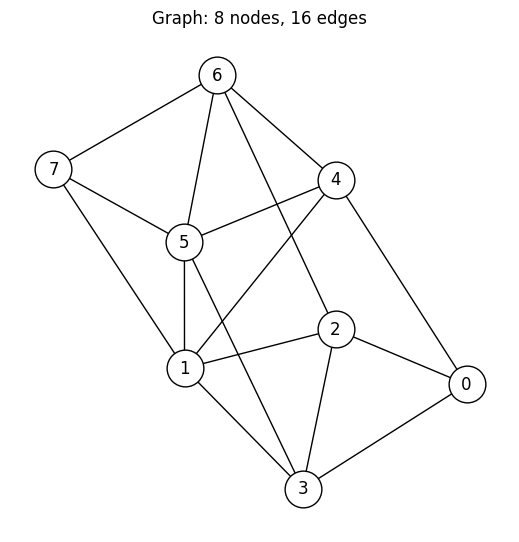
Create the Instance
We extract the edge list from the graph and evaluate the JijModeling problem with the concrete data.
instance_data = {"V": num_nodes, "E": edge_list}
instance = problem.eval(instance_data)
Set Up the QAOAConverter
QAOAConverter takes an OMMX instance and internally:
Converts the problem to a QUBO (Quadratic Unconstrained Binary Optimization) form.
Transforms from BINARY variables to SPIN variables.
Builds the cost Hamiltonian as a sum of Pauli-Z operators.
Because the original problem has a constraint, the QUBO formulation folds it into the objective as a penalty term. This means the energy values from the decoded samples are not the original objective (number of cut edges) — they include the penalty. We will need to check feasibility and compute the true objective separately.
from qamomile.optimization.qaoa import QAOAConverter

converter = QAOAConverter(instance)
converter.spin_model = converter.spin_model.normalize_by_abs_max()
hamiltonian = converter.get_cost_hamiltonian()
print(hamiltonian)
# Structural invariants of the spin model derived from this fixed instance:
# one qubit per vertex, no linear (single-Z) terms, and a fixed quadratic-term
# count once the QUBO simplifies the |V|=8, |E|=16 problem.
assert converter.spin_model.num_bits == num_nodes
assert converter.spin_model.linear == {}
assert len(converter.spin_model.quad) == 12
assert len(hamiltonian.terms) == 12
Hamiltonian((Z0, Z1): 1.0, (Z0, Z5): 1.0, (Z0, Z6): 1.0, (Z0, Z7): 1.0, (Z1, Z6): 1.0, (Z2, Z4): 1.0, (Z2, Z5): 1.0, (Z2, Z7): 1.0, (Z3, Z4): 1.0, (Z3, Z6): 1.0, (Z3, Z7): 1.0, (Z4, Z7): 1.0)
Transpile to an Executable Circuit
converter.transpile() builds a QAOA ansatz circuit with p layers and
compiles it into an ExecutableProgram. The variational parameters
gammas (cost layer) and betas (mixer layer) remain as runtime parameters.
from qamomile.qiskit import QiskitTranspiler

transpiler = QiskitTranspiler()
docs_test_mode = os.environ.get("QAMOMILE_DOCS_TEST") == "1"
p = 1 if docs_test_mode else 5  # number of QAOA layers
executable = converter.transpile(transpiler, p=p)
Visualize the QAOA Circuit
QAOAConverter._transpile_quadratic() internally builds the sampling
qkernel below and feeds it to the transpiler. For visualization we
restate that qkernel verbatim, then trace it through the early
pipeline (Transpiler.to_block to lower it into an IR Block,
Transpiler.inline to expand the sub-qkernel calls) before handing
the resulting Block to MatplotlibDrawer.draw. This renders exactly
the Block structure the converter works with internally, with p=2
for readability.
import qamomile.circuit as qmc
from qamomile.circuit.algorithm.qaoa import qaoa_state
from qamomile.circuit.visualization import MatplotlibDrawer


@qmc.qkernel
def qaoa_sampling(
    p: qmc.UInt,
    quad: qmc.Dict[qmc.Tuple[qmc.UInt, qmc.UInt], qmc.Float],
    linear: qmc.Dict[qmc.UInt, qmc.Float],
    gammas: qmc.Vector[qmc.Float],
    betas: qmc.Vector[qmc.Float],
    n: qmc.UInt,
) -> qmc.Vector[qmc.Bit]:
    q = qaoa_state(p=p, quad=quad, linear=linear, n=n, gammas=gammas, betas=betas)
    return qmc.measure(q)


block = transpiler.to_block(
    qaoa_sampling,
    bindings={
        "linear": converter.spin_model.linear,
        "quad": converter.spin_model.quad,
        "n": converter.spin_model.num_bits,
        "p": 2,
    },
    parameters=["gammas", "betas"],
)
block = transpiler.inline(block)
# `fold_loops=False` unrolls every loop (`for layer`,
# `for (i,j),Jij in quad`, and the per-qubit range loops) so each gate
# is rendered explicitly. `linear` is the empty dict `{}` for graph
# partition (no linear Ising terms), so its ForItems loop has zero
# iterations and is rendered as nothing rather than as a folded box.
# The result is wide; the docs build injects a lightbox script that
# turns each cell-output image into a click-to-zoom modal so the wide
# rendering stays inspectable on ReadTheDocs.
MatplotlibDrawer(block).draw(fold_loops=False)
Inspecting the Building Blocks
Inside qaoa_sampling we call qaoa_state, and qaoa_state itself
is the composition of three smaller qkernels:
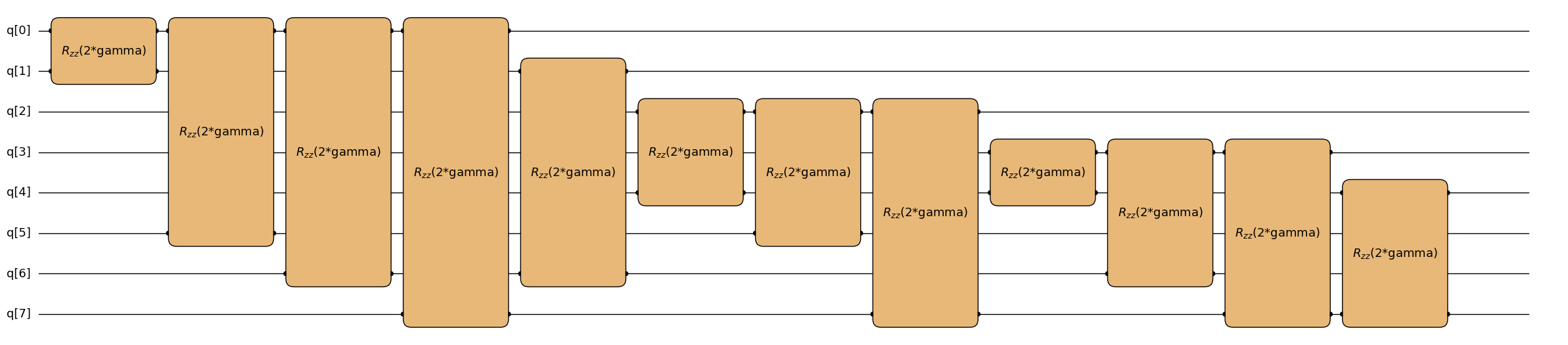
superposition_vector(n)— appliesHto every qubit, preparing the initial state .ising_cost(quad, linear, q, gamma)— the cost layer: oneRZZper quadratic entry inquadand oneRZper linear entry inlinear. The graph-partition spin model has no linear terms (linear={}), so onlyRZZgates appear.x_mixer(q, beta)— the mixer layer: appliesRX(2\beta)to every qubit.
qaoa_layers(p, ...) is just the alternation of ising_cost and
x_mixer, repeated p times. Below we render each piece on its own.
from qamomile.circuit.algorithm.basic import superposition_vector
from qamomile.circuit.algorithm.qaoa import ising_cost, x_mixer

superposition_vector.draw(n=converter.spin_model.num_bits, fold_loops=False)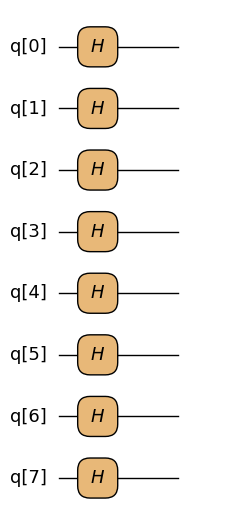
ising_cost.draw(
    q=converter.spin_model.num_bits,
    quad=converter.spin_model.quad,
    linear=converter.spin_model.linear,
    fold_loops=False,
)
x_mixer.draw(q=converter.spin_model.num_bits, fold_loops=False)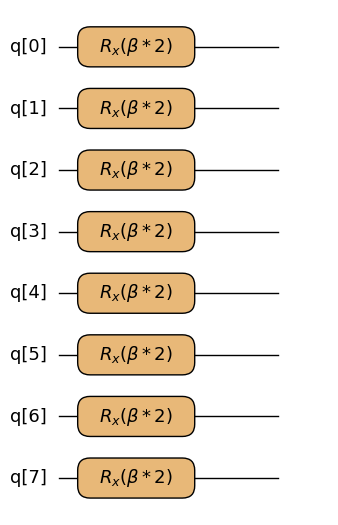
Optimize the QAOA Parameters
We use executable.sample() to evaluate the cost at each iteration of the
classical optimizer. The optimizer explores different gammas and betas
to minimize the mean energy of the sampled bitstrings.
import numpy as np
from qiskit_aer import AerSimulator
from scipy.optimize import minimize

# Seed the simulator so re-executing the notebook reproduces the same
# COBYLA trajectory and final sampling distribution. Without a seed,
# every shot draws fresh randomness, COBYLA sees a noisy cost surface,
# and each notebook run converges to a different (but equivalent) local
# optimum.
executor = transpiler.executor(
    backend=AerSimulator(seed_simulator=901, max_parallel_threads=1)
)
sample_shots = 1 if docs_test_mode else 2048
maxiter = 4 if docs_test_mode else 1000
final_shots = 8 if docs_test_mode else 1000

rng = np.random.default_rng(900)
initial_params = rng.uniform(0, np.pi, 2 * p)
assert initial_params.shape == (2 * p,)

cost_history = []


def cost_fn(params):
    gammas = list(params[:p])
    betas = list(params[p:])
    job = executable.sample(
        executor,
        shots=sample_shots,
        bindings={"gammas": gammas, "betas": betas},
    )
    result = job.result()
    # decode_to_binary_sampleset returns the QUBO-domain BinarySampleSet
    # whose `energy` is the penalized objective — what COBYLA needs to
    # see infeasibility costs. The polymorphic decode() returns an
    # ommx.v1.SampleSet whose `objective` is the un-penalized true
    # objective; using it here would let the optimizer settle on
    # infeasible all-zero / all-one bitstrings.
    decoded = converter.decode_to_binary_sampleset(result)
    energy = decoded.energy_mean()
    cost_history.append(energy)
    return energy


res = minimize(
    cost_fn,
    initial_params,
    method="COBYLA",
    options={"maxiter": maxiter},
)

print(f"Optimized cost: {res.fun:.3f}")
print(f"Optimal params: {[round(v, 4) for v in res.x]}")
print(f"Function evaluations: {res.nfev}")
assert len(cost_history) == res.nfev
assert len(res.x) == 2 * p
if docs_test_mode:
    # In docs test mode COBYLA is truncated at the maxiter budget.
    assert res.nfev == maxiter
Optimized cost: 15.799
Optimal params: [np.float64(0.8478), np.float64(-0.2839), np.float64(3.0681), np.float64(0.4712), np.float64(2.4944), np.float64(1.8724), np.float64(2.516), np.float64(0.743), np.float64(2.8569), np.float64(1.0257)]
Function evaluations: 103
plt.figure(figsize=(8, 4))
plt.plot(cost_history, color="#2696EB")
plt.xlabel("Iteration")
plt.ylabel("Cost (mean energy)")
plt.title("QAOA Optimization Progress")
plt.show()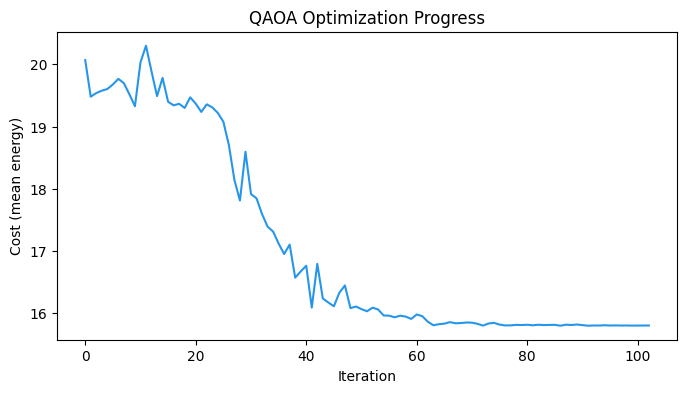
Sample with Optimized Parameters
With the optimized parameters, we sample the circuit to collect candidate solutions as bitstrings.
gammas_opt = list(res.x[:p])
betas_opt = list(res.x[p:])

sample_result = executable.sample(
    executor,
    shots=final_shots,
    bindings={"gammas": gammas_opt, "betas": betas_opt},
).result()

# `decode()` on an OMMX-backed converter returns an `ommx.v1.SampleSet`
# evaluated against the *original* (un-penalized) instance, so
# feasibility, the true objective, and per-constraint diagnostics are
# available through OMMX's own API — no hand-rolled feasibility or
# objective helper is needed.
import ommx.v1

sample_set = converter.decode(sample_result)
assert isinstance(sample_set, ommx.v1.SampleSet)
Analyze the Results
Feasibility Check
QAOA samples are candidate solutions — they are not guaranteed to satisfy the original constraints. The constraint was folded into the QUBO as a penalty, so infeasible bitstrings can still appear in the output.
SampleSet.summary is a DataFrame with one row per shot whose
feasible column already encodes feasibility against the original
constraints, so we can read the feasible-shot count straight off it.
summary = sample_set.summary
total_feasible = int(summary["feasible"].sum())
total_samples = len(summary)
if docs_test_mode:
    assert total_feasible > 0

print(
    f"Feasible samples: {total_feasible} / {total_samples} "
    f"({100 * total_feasible / total_samples:.1f}%)"
)
assert total_samples == final_shots
Feasible samples: 530 / 1000 (53.0%)
Best Feasible Solution
SampleSet.best_feasible returns the feasible sample with the
best (here: smallest) objective. Because the converter was built from
an OMMX Instance, the reported objective is the original
un-penalized one — i.e. the number of cut edges itself — and the
decision-variable values come back keyed by the original variable
IDs in decision_variables_df.
if total_feasible > 0:
    best = sample_set.best_feasible
    best_obj = int(round(best.objective))
    best_sample = {
        i: int(round(best.decision_variables_df.loc[i, "value"]))
        for i in range(num_nodes)
    }
    print(f"Best feasible solution: {best_sample}")
    print(f"Cut edges:             {best_obj}")
    # Any feasible solution must satisfy the equal-partition constraint
    # sum(x_u) == |V|/2 exactly.
    assert sum(best_sample.values()) == num_nodes // 2
    assert best_obj >= 0
else:
    print("No feasible solution found. Try increasing p or maxiter.")
    best_sample = None
    best_obj = None
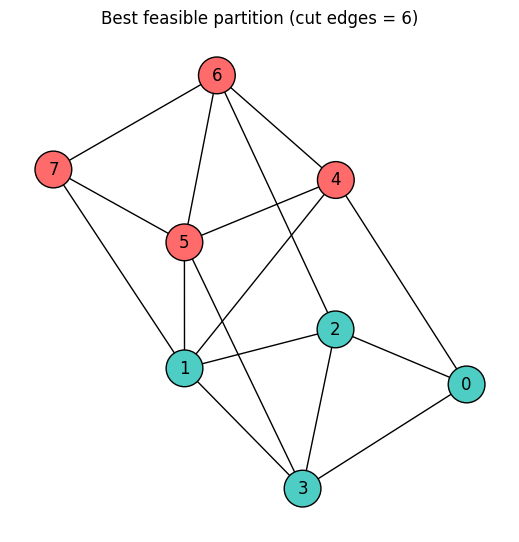
Best feasible solution: {0: 0, 1: 0, 2: 0, 3: 0, 4: 1, 5: 1, 6: 1, 7: 1}
Cut edges: 6
Objective Value Distribution
We plot the distribution of the true objective value (cut edges)
for feasible samples only. summary already has the original
objective per shot, so a value_counts() on the feasible slice
gives the histogram directly.
if total_feasible > 0:
    feasible_objectives = (
        summary.loc[summary["feasible"], "objective"].round().astype(int)
    )
    obj_counts = feasible_objectives.value_counts().sort_index()

    plt.figure(figsize=(8, 4))
    plt.bar([str(o) for o in obj_counts.index], obj_counts.values, color="#2696EB")
    plt.xlabel("Cut edges (objective value)")
    plt.ylabel("Frequency")
    plt.title("Distribution of Feasible Solutions")
    plt.show()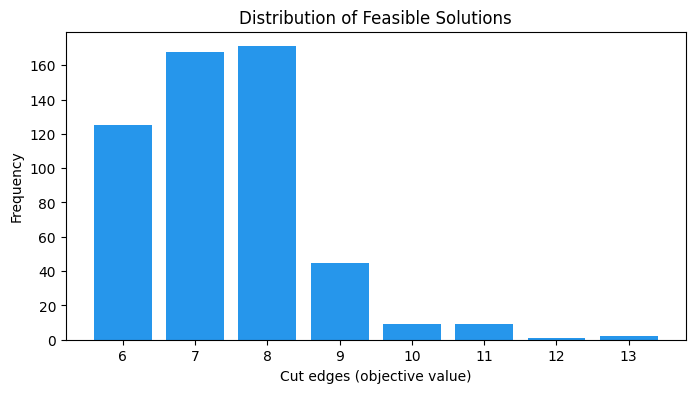
Visualize the Best Partition
We color the graph nodes according to the best feasible partition found by QAOA.
if best_sample is not None:
    color_map = [
        "#FF6B6B" if best_sample.get(i, 0) == 1 else "#4ECDC4" for i in range(num_nodes)
    ]

    plt.figure(figsize=(5, 5))
    nx.draw(
        G,
        pos,
        with_labels=True,
        node_color=color_map,
        node_size=700,
        edgecolors="black",
    )
    plt.title(f"Best feasible partition (cut edges = {best_obj})")
    plt.show()