Tags: algorithm optimization variational
This tutorial walks through the Quantum Approximate Optimization Algorithm
(QAOA) pipeline step by step, using Qamomile’s low-level circuit primitives.
Rather than using the high-level QAOAConverter, we will:
Define a MaxCut problem for a small graph.
Formulate it directly as an Ising model on spin variables.
Write the QAOA circuit step by step using
@qkernel.Optimize variational parameters with a classical optimizer.
Decode and visualize the results.
At the end, we show that qamomile.circuit.algorithm.qaoa_state provides
the same circuit in a single function call.
# Install the latest Qamomile through pip!
# !pip install "qamomile[qiskit,visualization]"
What is MaxCut?
Given an undirected graph , the MaxCut problem asks us to partition the vertices into two sets so that the number of edges crossing between the two sets is maximized.
MaxCut is naturally a spin problem. Assign each vertex a spin indicating which side of the cut it belongs to. An edge is cut exactly when , so the number of cut edges is
Spin-based problems such as MaxCut, spin-glass ground states, and Ising model benchmarks are most cleanly written in the spin domain. We therefore skip the QUBO / binary encoding detour and work directly with spin variables throughout this tutorial.
Create the Graph
We use a small 5-node graph with 6 edges. This is large enough to be non-trivial, yet small enough to brute-force for comparison.
import os

import matplotlib.pyplot as plt
import networkx as nx

G = nx.Graph()
G.add_edges_from([(0, 1), (0, 2), (1, 2), (1, 3), (2, 3), (3, 4)])
num_nodes = G.number_of_nodes()
assert num_nodes == 5
assert G.number_of_edges() == 6

pos = nx.spring_layout(G, seed=42)
plt.figure(figsize=(5, 4))
nx.draw(
    G,
    pos,
    with_labels=True,
    node_color="white",
    node_size=700,
    edgecolors="black",
)
plt.title(f"Graph: {num_nodes} nodes, {G.number_of_edges()} edges")
plt.show()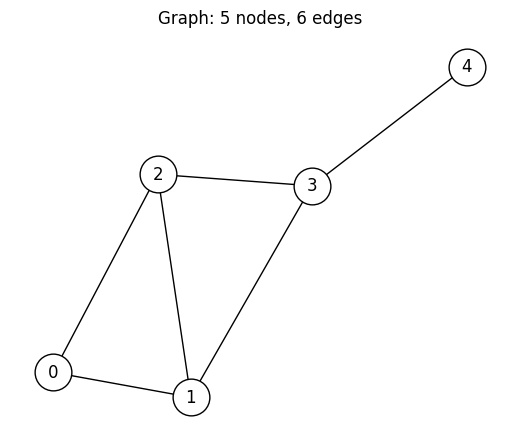
Ising Formulation
Maximizing is equivalent (up to a constant) to minimizing the antiferromagnetic Ising Hamiltonian
Compared to the general Ising form , unweighted MaxCut has:
no linear terms: for every vertex, and
uniform couplings: for every edge .
BinaryModel.from_ising takes the Ising coefficients directly — there is
no need to go through a QUBO and convert variable types.
from qamomile.optimization.binary_model import BinaryModel

ising_quad: dict[tuple[int, int], float] = {
    tuple(sorted((i, j))): 1.0 for i, j in G.edges()
}
ising_linear: dict[int, float] = {}

# For weighted MaxCut or spin-glass instances where the J_{ij} are not all
# of the same magnitude, append `.normalize_by_abs_max()` here to keep the
# cost-landscape scale comparable across runs (helps gradient-free
# optimizers such as COBYLA converge consistently).
spin_model = BinaryModel.from_ising(linear=ising_linear, quad=ising_quad)

print(f"Variable type:          {spin_model.vartype}")
print(f"Linear terms (h_i):     {spin_model.linear}")
print(f"Quadratic terms (J_ij): {spin_model.quad}")
print(f"Constant:               {spin_model.constant}")
# Spin-domain model with no linear field, one J_ij per graph edge, no offset.
assert spin_model.vartype.name == "SPIN"
assert spin_model.linear == {}
assert len(spin_model.quad) == G.number_of_edges()
assert spin_model.constant == 0.0
Variable type: SPIN
Linear terms (h_i): {}
Quadratic terms (J_ij): {(0, 1): 1.0, (0, 2): 1.0, (1, 2): 1.0, (1, 3): 1.0, (2, 3): 1.0, (3, 4): 1.0}
Constant: 0.0
Note:
BinaryModelalso providesfrom_qubo()andfrom_hubo()for problems that are naturally expressed in the binary domain (e.g., assignment problems, constrained problems with penalty terms). See QAOA for Graph Partitioning for a QUBO / JijModeling-based workflow.
Exact Solution (Brute Force)
Before running QAOA, let’s find the optimal partition by trying all spin configurations. This gives us a ground truth to compare against.
import itertools

best_cut = 0
optimal_partitions: list[tuple[int, ...]] = []

for spins in itertools.product([+1, -1], repeat=num_nodes):
    cut = sum(1 for i, j in G.edges() if spins[i] != spins[j])
    if cut > best_cut:
        best_cut = cut
        optimal_partitions = [spins]
    elif cut == best_cut:
        optimal_partitions.append(spins)

print(f"Optimal MaxCut value: {best_cut}")
print(f"Number of optimal partitions: {len(optimal_partitions)}")
for part in optimal_partitions:
    print(f"  {part}")
# The MaxCut of this fixed 5-node, 6-edge graph is 5; it is achieved by
# exactly two spin configurations related by the global flip s -> -s.
assert best_cut == 5
assert len(optimal_partitions) == 2
for part in optimal_partitions:
    assert tuple(-s for s in part) in optimal_partitions
Optimal MaxCut value: 5
Number of optimal partitions: 2
(1, -1, -1, 1, -1)
(-1, 1, 1, -1, 1)
QAOA Circuit: The Idea
The QAOA ansatz prepares a parameterized quantum state:
where:
: uniform superposition (Hadamard on every qubit)
: cost unitary — for the Ising cost , this decomposes into gates for quadratic terms and gates for linear terms (see Steps 2–3 for the gate convention details)
: mixer unitary — with , this becomes on every qubit
: number of layers (depth of the ansatz)
The spin computational-basis correspondence is the standard quantum convention , , so measurement outcome 0 maps to spin +1 and outcome 1 maps to spin -1.
We will now build each component as a @qkernel.
Step 1: Uniform Superposition
Apply a Hadamard gate to every qubit to start from the equal superposition state .
import qamomile.circuit as qmc


@qmc.qkernel
def superposition(n: qmc.UInt) -> qmc.Vector[qmc.Qubit]:
    q = qmc.qubit_array(n, name="q")
    for i in qmc.range(n):
        q[i] = qmc.h(q[i])
    return q
Step 2: Cost Layer
Apply the cost unitary .
Qamomile’s rotation gates include a factor:
and
.
To match exactly, we therefore pass
to rzz and to rz.
We keep the linear argument even though it is empty for unweighted
MaxCut — this makes the kernel immediately reusable for weighted MaxCut
and generic spin-glass Hamiltonians, which do include linear terms.
@qmc.qkernel
def cost_layer(
    quad: qmc.Dict[qmc.Tuple[qmc.UInt, qmc.UInt], qmc.Float],
    linear: qmc.Dict[qmc.UInt, qmc.Float],
    q: qmc.Vector[qmc.Qubit],
    gamma: qmc.Float,
) -> qmc.Vector[qmc.Qubit]:
    for (i, j), Jij in quad.items():
        q[i], q[j] = qmc.rzz(q[i], q[j], angle=2.0 * Jij * gamma)
    for i, hi in linear.items():
        q[i] = qmc.rz(q[i], angle=2.0 * hi * gamma)
    return q
Step 3: Mixer Layer
Apply the mixer unitary where . Since , we need to implement on each qubit.
@qmc.qkernel
def mixer_layer(
    q: qmc.Vector[qmc.Qubit],
    beta: qmc.Float,
) -> qmc.Vector[qmc.Qubit]:
    n = q.shape[0]
    for i in qmc.range(n):
        q[i] = qmc.rx(q[i], angle=2.0 * beta)
    return q
Step 4: Full QAOA Ansatz
Compose the three pieces: superposition, then rounds of cost + mixer, and finally measurement.
@qmc.qkernel
def qaoa_ansatz(
    p: qmc.UInt,
    quad: qmc.Dict[qmc.Tuple[qmc.UInt, qmc.UInt], qmc.Float],
    linear: qmc.Dict[qmc.UInt, qmc.Float],
    n: qmc.UInt,
    gammas: qmc.Vector[qmc.Float],
    betas: qmc.Vector[qmc.Float],
) -> qmc.Vector[qmc.Bit]:
    q = superposition(n)
    for layer in qmc.range(p):
        q = cost_layer(quad, linear, q, gammas[layer])
        q = mixer_layer(q, betas[layer])
    return qmc.measure(q)
Transpile and Optimize
We transpile the kernel, binding the problem structure (Ising coefficients,
number of qubits, number of layers) while keeping gammas and betas
as runtime parameters that the optimizer will tune.
from qamomile.qiskit import QiskitTranspiler

transpiler = QiskitTranspiler()
docs_test_mode = os.environ.get("QAMOMILE_DOCS_TEST") == "1"
p = 1 if docs_test_mode else 3  # number of QAOA layers

executable = transpiler.transpile(
    qaoa_ansatz,
    bindings={
        "p": p,
        "quad": spin_model.quad,
        "linear": spin_model.linear,
        "n": num_nodes,
    },
    parameters=["gammas", "betas"],
)
We use scipy.optimize.minimize with the COBYLA method. At each
iteration, the optimizer samples the circuit and evaluates the mean
energy.
To make the tutorial reproducible we (i) pass seed_simulator=SEED to
AerSimulator so the per-shot pseudo-random sampling is deterministic,
(ii) seed the NumPy generator with the same value so initial
variational parameters are stable, and (iii) set
max_parallel_threads=1 so the simulator does not interleave random
draws across threads. The single-thread setting trades a little
performance for fully reproducible runs; in production code you can
drop it (or only enable it in tests / docs builds).
import numpy as np
from qiskit_aer import AerSimulator
from scipy.optimize import minimize

SEED = 42


def make_seeded_backend() -> AerSimulator:
    """Fresh AerSimulator with deterministic sampling for this tutorial."""
    return AerSimulator(seed_simulator=SEED, max_parallel_threads=1)


executor = transpiler.executor(backend=make_seeded_backend())
sample_shots = 1 if docs_test_mode else 2048
maxiter = 4 if docs_test_mode else 500
cost_history: list[float] = []


def cost_fn(params):
    gammas = list(params[:p])
    betas = list(params[p:])
    result = executable.sample(
        executor,
        shots=sample_shots,
        bindings={"gammas": gammas, "betas": betas},
    ).result()
    decoded = spin_model.decode_from_sampleresult(result)
    energy = decoded.energy_mean()
    cost_history.append(energy)
    return energy


rng = np.random.default_rng(SEED)
initial_params = rng.uniform(-np.pi / 2, np.pi / 2, 2 * p)
assert initial_params.shape == (2 * p,)

res = minimize(cost_fn, initial_params, method="COBYLA", options={"maxiter": maxiter})

print(f"Optimized cost: {res.fun:.4f}")
print(f"Optimal params: {[round(v, 4) for v in res.x]}")
assert len(cost_history) == res.nfev
assert len(res.x) == 2 * p
if docs_test_mode:
    # In docs test mode COBYLA is truncated at the maxiter budget.
    assert res.nfev == maxiter
Optimized cost: -0.8203
Optimal params: [np.float64(0.8871), np.float64(-0.1645), np.float64(2.0864), np.float64(0.7465), np.float64(-1.292), np.float64(1.4783)]
plt.figure(figsize=(8, 4))
plt.plot(cost_history, color="#2696EB")
plt.xlabel("Iteration")
plt.ylabel("Cost (mean energy)")
plt.title("QAOA Optimization Progress")
plt.show()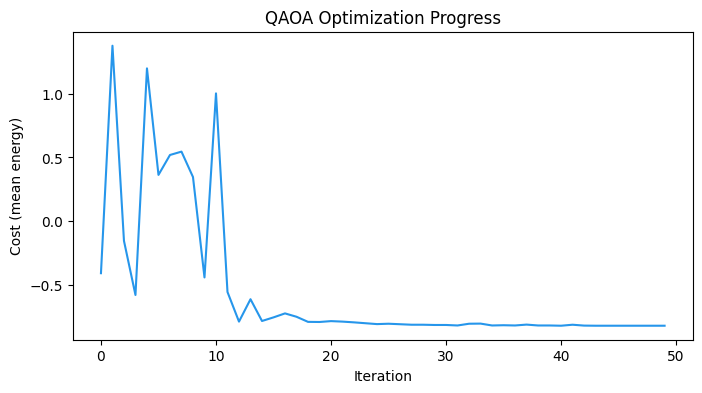
Decode and Analyze Results
We sample the circuit with the optimized parameters and interpret the
measurement outcomes. decode_from_sampleresult returns samples already
in the spin domain (+1 / -1), so we can count cut edges directly —
no binary conversion needed.
gammas_opt = list(res.x[:p])
betas_opt = list(res.x[p:])

final_result = executable.sample(
    executor,
    shots=sample_shots,
    bindings={"gammas": gammas_opt, "betas": betas_opt},
).result()

decoded = spin_model.decode_from_sampleresult(final_result)
from collections import Counter
cut_distribution: Counter[int] = Counter()
best_qaoa_cut = 0
best_qaoa_sample = None
for sample, _energy, occ in zip(
decoded.samples, decoded.energy, decoded.num_occurrences
):
# sample is a dict {vertex_index: spin_value (+1 or -1)}
spins = [sample[i] for i in range(num_nodes)]
cut = sum(1 for i, j in G.edges() if spins[i] != spins[j])
cut_distribution[cut] += occ
if cut > best_qaoa_cut:
best_qaoa_cut = cut
best_qaoa_sample = spins
print(f"Best QAOA cut: {best_qaoa_cut} (optimal: {best_cut})")
print(f"Best partition (spins): {best_qaoa_sample}")
# QAOA cannot exceed the brute-force optimum, and the distribution must
# account for every shot of the final sample.
assert best_qaoa_cut <= best_cut
assert sum(cut_distribution.values()) == sample_shotsBest QAOA cut: 5 (optimal: 5)
Best partition (spins): [1, -1, -1, 1, -1]
cuts = sorted(cut_distribution.keys())
counts = [cut_distribution[c] for c in cuts]

plt.figure(figsize=(8, 4))
plt.bar([str(c) for c in cuts], counts, color="#2696EB")
plt.xlabel("Cut size")
plt.ylabel("Frequency")
plt.title("Distribution of MaxCut Values from QAOA")
plt.show()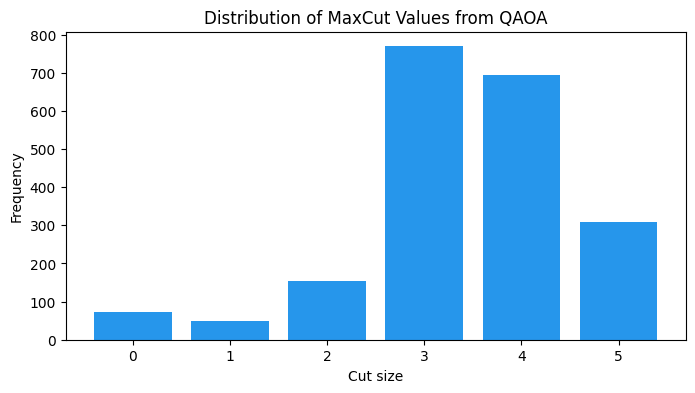
if best_qaoa_sample is not None:
    color_map = [
        "#FF6B6B" if best_qaoa_sample[i] == +1 else "#4ECDC4" for i in range(num_nodes)
    ]
    plt.figure(figsize=(5, 4))
    nx.draw(
        G,
        pos,
        with_labels=True,
        node_color=color_map,
        node_size=700,
        edgecolors="black",
    )
    plt.title(f"QAOA partition (cut = {best_qaoa_cut})")
    plt.show()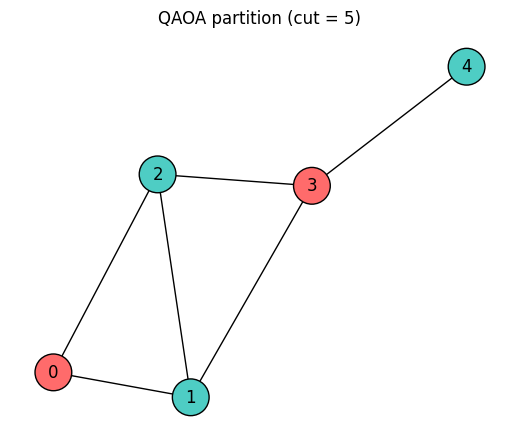
Using the Built-in qaoa_state
Everything we implemented above — superposition, cost layer, mixer layer,
and the layered loop — is already provided by
qamomile.circuit.algorithm.qaoa_state. It accepts exactly the same
Ising coefficients (quad, linear) and variational parameters
(gammas, betas).
Let’s build the same circuit using the built-in function to confirm
that it implements the same structure. Each executor below is
instantiated with the same seed_simulator=SEED. Under a fixed seed,
identical circuits yield identical samples and therefore identical
mean energies. With finite shots the per-circuit estimate still
carries shot-noise — that does not vanish under seeding — so if the
two printed mean energies do differ, it indicates that the manual
and built-in routes did not emit bit-identical circuits (e.g., a gate
ordering or compilation difference), not residual sampling noise.
from qamomile.circuit.algorithm import qaoa_state


@qmc.qkernel
def qaoa_builtin(
    p: qmc.UInt,
    quad: qmc.Dict[qmc.Tuple[qmc.UInt, qmc.UInt], qmc.Float],
    linear: qmc.Dict[qmc.UInt, qmc.Float],
    n: qmc.UInt,
    gammas: qmc.Vector[qmc.Float],
    betas: qmc.Vector[qmc.Float],
) -> qmc.Vector[qmc.Bit]:
    q = qaoa_state(p=p, quad=quad, linear=linear, n=n, gammas=gammas, betas=betas)
    return qmc.measure(q)
We transpile and sample with the same optimized parameters.
exe_builtin = transpiler.transpile(
    qaoa_builtin,
    bindings={
        "p": p,
        "quad": spin_model.quad,
        "linear": spin_model.linear,
        "n": num_nodes,
    },
    parameters=["gammas", "betas"],
)

executor_manual = transpiler.executor(backend=make_seeded_backend())
executor_builtin = transpiler.executor(backend=make_seeded_backend())

result_manual = executable.sample(
    executor_manual,
    shots=sample_shots,
    bindings={"gammas": gammas_opt, "betas": betas_opt},
).result()

result_builtin = exe_builtin.sample(
    executor_builtin,
    shots=sample_shots,
    bindings={"gammas": gammas_opt, "betas": betas_opt},
).result()

decoded_manual = spin_model.decode_from_sampleresult(result_manual)
decoded_builtin = spin_model.decode_from_sampleresult(result_builtin)
print(f"Manual   mean energy: {decoded_manual.energy_mean():.4f}")
print(f"Built-in mean energy: {decoded_builtin.energy_mean():.4f}")
# Same seed + bit-identical circuit ⇒ identical samples ⇒ identical mean.
# Any divergence here means the manual and built-in paths emitted different
# circuits (gate ordering, compilation difference) — not shot noise.
assert decoded_manual.energy_mean() == decoded_builtin.energy_mean()
Manual mean energy: -0.8203
Built-in mean energy: -0.8203
Summary
In this tutorial we:
Defined a MaxCut problem and wrote it directly as an Ising Hamiltonian on spin variables — no QUBO / binary-variable detour.
Built the spin-domain
BinaryModelwithBinaryModel.from_ising.Built every component of the QAOA circuit as a
@qkernel— superposition, cost layer, mixer layer, and the full ansatz.Ran a classical optimization loop and decoded the spin-domain results.
Verified that
qamomile.circuit.algorithm.qaoa_stateprovides the same circuit with a single function call.
The same spin-first recipe applies to any Ising-like problem —
spin-glass ground-state search, weighted MaxCut, Sherrington–Kirkpatrick
model, and so on: plug the and coefficients into
BinaryModel.from_ising and reuse the circuit components above.
Next steps:
For problems that are naturally expressed with binary variables or that require constraints (penalty terms), see QAOA for Graph Partitioning, which uses the higher-level
QAOAConvertertogether with JijModeling.