Tags: algorithm sample-based
QSCI is a hybrid quantum–classical algorithm that uses bitstrings sampled from a quantum state to build a small effective Hamiltonian and then diagonalizes it exactly on a classical computer. The advantage over plain VQE is that the result inherits a strict variational guarantee: even on noisy hardware,
The four-step recipe introduced by Kanno et al. Kanno et al., 2023 is:
Prepare an input state on the quantum computer (typically a roughly optimised VQE state).
Measure in the computational basis many times.
Pick the top- most-frequent bitstrings as a discrete subspace .
Build the effective Hamiltonian and diagonalize it classically.
This tutorial walks through the full flow on a four-qubit transverse-
field Ising model. The quantum state preparation and sampling run on
the QURI Parts integration (Qulacs simulator); the subspace
construction and diagonalization use
qamomile.linalg.solve_subspace, which internally calls the
vectorised Z-basis routine subspace_hamiltonian (XOR / parity, no
matrix products).
import os

import matplotlib.pyplot as plt
import numpy as np
from scipy.optimize import minimize

import qamomile.circuit as qmc
import qamomile.observable as qm_o
from qamomile.circuit.algorithm.basic import cx_entangling_layer, ry_layer
from qamomile.linalg import solve_subspace
from qamomile.quri_parts import QuriPartsExecutor, QuriPartsTranspiler

docs_test_mode = os.environ.get("QAMOMILE_DOCS_TEST") == "1"
A small test Hamiltonian
We use the four-qubit transverse-field Ising model on an open chain:
The 16-dimensional Hilbert space is small enough that we can compute the exact ground-state energy directly with NumPy and use it as the QSCI reference.
n_qubits = 4
J = 1.0
h_field = 0.7

H = qm_o.Hamiltonian(num_qubits=n_qubits)
for i in range(n_qubits - 1):
    H += qm_o.Z(i) * qm_o.Z(i + 1) * (-J)
for i in range(n_qubits):
    H += qm_o.X(i) * (-h_field)

exact_eigvals = np.linalg.eigvalsh(H.to_numpy())
E_exact = float(exact_eigvals[0])
print(f"Exact ground state energy: {E_exact:.6f}")
# eigvalsh returns ascending eigenvalues, so exact_eigvals[0] is the ground
# state. The 4-qubit TFIM Hilbert space is 2^n_qubits-dimensional.
assert H.num_qubits == n_qubits
assert exact_eigvals.shape == (2**n_qubits,)
assert E_exact == float(exact_eigvals.min())
Exact ground state energy: -3.872983
Hardware-efficient ansatz
A simple alternating-layer ansatz: each layer applies to every qubit followed by a linear chain of CX gates, plus a final layer. We define three helper kernels:
ansatz_statebuilds the qubit register;ansatz_energyreturns for VQE;ansatz_measuremeasures the state in the computational basis for QSCI sampling.
@qmc.qkernel
def ansatz_state(
    n: qmc.UInt,
    reps: qmc.UInt,
    thetas: qmc.Vector[qmc.Float],
) -> qmc.Vector[qmc.Qubit]:
    q = qmc.qubit_array(n, name="q")
    for r in qmc.range(reps):
        q = ry_layer(q, thetas, r * n)
        q = cx_entangling_layer(q)
    final_base = reps * n
    q = ry_layer(q, thetas, final_base)
    return q


@qmc.qkernel
def ansatz_energy(
    n: qmc.UInt,
    reps: qmc.UInt,
    thetas: qmc.Vector[qmc.Float],
    H: qmc.Observable,
) -> qmc.Float:
    q = ansatz_state(n, reps, thetas)
    return qmc.expval(q, H)


@qmc.qkernel
def ansatz_measure(
    n: qmc.UInt,
    reps: qmc.UInt,
    thetas: qmc.Vector[qmc.Float],
) -> qmc.Vector[qmc.Bit]:
    q = ansatz_state(n, reps, thetas)
    return qmc.measure(q)
Compile both kernels with QURI Parts
transpiler = QuriPartsTranspiler()
executor = QuriPartsExecutor()

reps = 2
n_params = (reps + 1) * n_qubits

energy_exec = transpiler.transpile(
    ansatz_energy,
    bindings={"n": n_qubits, "reps": reps, "H": H},
    parameters=["thetas"],
)
sample_exec = transpiler.transpile(
    ansatz_measure,
    bindings={"n": n_qubits, "reps": reps},
    parameters=["thetas"],
)
Step 1: Prepare via a quick VQE
QSCI is robust to a poorly optimised input state — even random parameters give a meaningful subspace — but a short VQE run concentrates the sampling distribution on the bitstrings that dominate the true ground state, making the subspace much more informative for a given . We run only a handful of COBYLA iterations.
def cost_fn(params: np.ndarray) -> float:
    return energy_exec.run(executor, bindings={"thetas": list(params)}).result()


rng = np.random.default_rng(0)
init_params = rng.uniform(0, 2 * np.pi, n_params)
assert init_params.shape == (n_params,)

maxiter = max(n_params + 2, 5 if docs_test_mode else 80)
result = minimize(
    cost_fn,
    init_params,
    method="COBYLA",
    options={"maxiter": maxiter, "rhobeg": 0.5},
)
opt_params = result.x
print(f"VQE energy = {result.fun:+.6f}   (gap to E_exact: {result.fun - E_exact:.4e})")
# Variational principle: any VQE energy is an upper bound on E_exact, no
# matter how short the COBYLA budget.
assert result.fun >= E_exact - 1e-9
assert opt_params.shape == (n_params,)
VQE energy = -3.719549 (gap to E_exact: 1.5343e-01)
Step 2: Sample bitstrings in the Z basis
Each sample is a tuple (b_0, ..., b_{n-1}) whose -th entry is
the Z-eigenvalue index of qubit — exactly the format
subspace_hamiltonian expects.
shots = 1 if docs_test_mode else 4000
sample_results = (
    sample_exec.sample(executor, bindings={"thetas": list(opt_params)}, shots=shots)
    .result()
    .results
)
sample_results.sort(key=lambda bc: bc[1], reverse=True)
print(f"Distinct bitstrings sampled: {len(sample_results)}")
for bits, c in sample_results[:5]:
    print(f"  {bits}  count={c}")
# Distinct bitstrings cannot exceed the dimension of the Hilbert space,
# every shot is accounted for, and each bitstring is n_qubits long.
assert len(sample_results) <= 2**n_qubits
assert sum(c for _, c in sample_results) == shots
assert all(len(bits) == n_qubits for bits, _ in sample_results)
Distinct bitstrings sampled: 14
(1, 1, 1, 1) count=2848
(1, 1, 1, 0) count=411
(0, 1, 1, 1) count=316
(1, 0, 1, 1) count=114
(1, 1, 0, 1) count=107
Step 3 + 4: Build the QSCI subspace and diagonalize
For each subspace size we feed the most-frequent bitstrings
to solve_subspace, which builds
via a vectorised
XOR / parity routine and runs numpy.linalg.eigh. The lowest
returned eigenvalue is the QSCI energy estimate, and the variational
principle guarantees
for every .
unique_bitstrings = [bits for bits, _ in sample_results]
K_max = len(unique_bitstrings)
ks = sorted({k for k in (1, 2, 4, 8, 16, K_max) if k <= K_max})

energies = [float(solve_subspace(unique_bitstrings[:K], H)[0][0]) for K in ks]

for K, E in zip(ks, energies):
    print(f"K = {K:3d}   E_QSCI = {E:+.6f}   gap = {E - E_exact:+.3e}")

assert all(E >= E_exact - 1e-9 for E in energies), "variational bound violated"
# Cauchy interlacing: enlarging the subspace can only lower (or keep) the
# minimum eigenvalue, so QSCI energies are monotonically non-increasing in K.
assert all(energies[i] >= energies[i + 1] - 1e-9 for i in range(len(energies) - 1))
assert len(energies) == len(ks)
K = 1 E_QSCI = -3.000000 gap = +8.730e-01
K = 2 E_QSCI = -3.220656 gap = +6.523e-01
K = 4 E_QSCI = -3.500753 gap = +3.722e-01
K = 8 E_QSCI = -3.682559 gap = +1.904e-01
K = 14 E_QSCI = -3.750479 gap = +1.225e-01
fig, ax = plt.subplots(figsize=(6, 4))
ax.plot(ks, energies, "-o", label=r"$E_{\mathrm{QSCI}}$")
ax.axhline(E_exact, color="black", linestyle="--", label=r"$E_{\mathrm{exact}}$")
ax.set_xlabel("Subspace size $K$")
ax.set_ylabel("Energy")
ax.set_title("QSCI convergence — 4-qubit TFIM ($J{=}1,\\;h{=}0.7$)")
ax.legend()
ax.grid(True, alpha=0.3)
plt.tight_layout()
plt.show()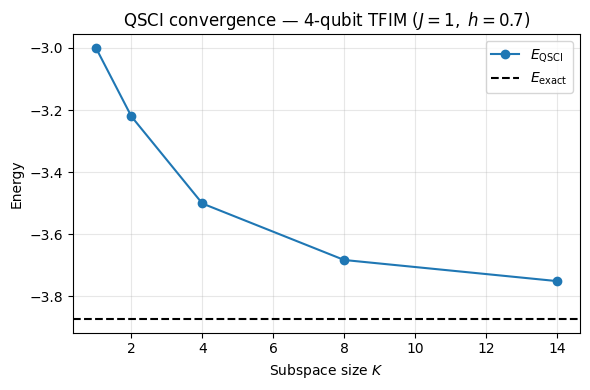
Notes
The Z-basis fast path (
subspace_hamiltonian) used insidesolve_subspacerequires no matrix multiplication: each Pauli term contributes a single XOR mask and parity sign, vectorised across all sample pairs.Duplicate sampled bitstrings drop out of the unique-bitstring list above; the resulting subspace is well-conditioned and
solve_subspacereturns an ordinary Hermitian eigendecomposition.
- Kanno, K., Kohda, M., Imai, R., Koh, S., Mitarai, K., Mizukami, W., & Nakagawa, Y. O. (2023). Quantum-Selected Configuration Interaction: classical diagonalization of Hamiltonians in subspaces selected by quantum computers. arXiv. 10.48550/ARXIV.2302.11320