Tags: tutorial
Qamomile provides two execution methods depending on what your qkernel returns:
| Qkernel returns | Use | You get back |
|---|---|---|
Bit, Vector[Bit], tuple[Bit, ...] | sample() | SampleResult — counted outcomes |
Float (from expval) | run() | float — expectation value |
This chapter explains both methods and introduces observables for expectation-value computation.
# Install the latest Qamomile through pip!
# !pip install "qamomile[qiskit,visualization]"
import math
import os
import qamomile.circuit as qmc
import qamomile.observable as qmo
from qamomile.qiskit import QiskitTranspiler
transpiler = QiskitTranspiler()
docs_test_mode = os.environ.get("QAMOMILE_DOCS_TEST") == "1"
sample_shots = 1 if docs_test_mode else 256Multi-Qubit sample()
In Tutorial 01 we sampled a single Bit. When a qkernel returns multiple bits, each outcome is a tuple of integer values (0 or 1).
@qmc.qkernel
def parity_probe(theta: qmc.Float) -> tuple[qmc.Bit, qmc.Bit]:
    q0 = qmc.qubit(name="q0")
    q1 = qmc.qubit(name="q1")

    q0 = qmc.h(q0)
    q1 = qmc.ry(q1, theta)
    q0, q1 = qmc.cx(q0, q1)

    return qmc.measure(q0), qmc.measure(q1)
parity_probe.draw(theta=0.7)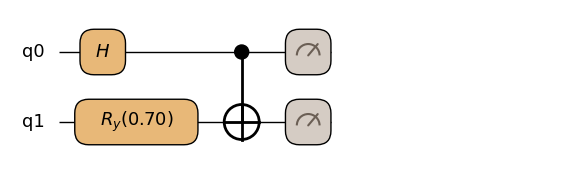
exe_sample = transpiler.transpile(parity_probe, parameters=["theta"])
sample_result = exe_sample.sample(
    transpiler.executor(),
    shots=sample_shots,
    bindings={"theta": 0.7},
).result()

for outcome, count in sample_result.results:
    print(f"  outcome={outcome}, count={count}")
assert sample_result.shots == sample_shots
assert sum(count for _, count in sample_result.results) == sample_shots
# parity_probe returns tuple[Bit, Bit] -> each outcome is a 2-element tuple.
assert all(
    isinstance(outcome, tuple) and len(outcome) == 2
    for outcome, _ in sample_result.results
)
outcome=(1, 0), count=11
outcome=(0, 1), count=15
outcome=(1, 1), count=102
outcome=(0, 0), count=128
Each outcome is a tuple like (0, 1) or (1, 0). The first element corresponds to q0, the second to q1, matching the order in the return statement.
Measurement Result Ordering
When Qamomile measures qubits, each outcome returned by sample() is a tuple of bits in the order specified by the qkernel’s return statement. When measuring qs: Vector[Qubit] directly with measure(qs), each outcome is ordered as bits = (measure(qs[0]), measure(qs[1]), measure(qs[2]), ...). When interpreting a bit tuple as one bitstring, treat bits[0] as the least-significant bit.
When You Need Expectation Values
Sometimes you don’t want individual measurement outcomes — you want the average value of a quantum observable. This is common in:
VQE (Variational Quantum Eigensolver): minimize
QAOA: evaluate cost function expectation values
Any optimization loop over quantum parameters
For this, Qamomile provides expval() and the run() execution method.
The Observable Type
There are two related things to understand:
qmc.Observable— a handle type used in qkernel signatures. Likeqmc.Float, you use it in type annotations for qkernel arguments and return values.qamomile.observablemodule — where you build concrete observable values that you pass via bindings. For example:
import qamomile.observable as qmo

H = qmo.Z(0)                        # Pauli Z on qubit 0
H = qmo.Z(0) * qmo.Z(1)             # ZZ interaction
H = 0.5 * qmo.X(0) + 0.3 * qmo.Y(1) # Linear combinationexpval(): Measuring an Observable
expval(qubit, hamiltonian) computes the expectation value ( represents qubit and represents hamiltonian ) and returns a qmc.Float. A qkernel that returns Float from expval should be executed with run().
@qmc.qkernel
def z_expectation(theta: qmc.Float, hamiltonian: qmc.Observable) -> qmc.Float:
    q = qmc.qubit(name="q")
    q = qmc.ry(q, theta)
    return qmc.expval(q, hamiltonian)


H = qmo.Z(0)
z_expectation.draw(theta=0.7, hamiltonian=H)
Running with run()
For expectation-value qkernels, use run() instead of sample(). The observable is bound at transpile time (it affects the measurement circuit), while theta remains a sweepable runtime parameter.
exe_run = transpiler.transpile(
    z_expectation,
    bindings={"hamiltonian": H},  # Observable bound at transpile time
    parameters=["theta"],  # theta remains sweepable
)

run_result = exe_run.run(
    transpiler.executor(),
    bindings={"theta": 0.7},
).result()

print("expectation value:", run_result)
print("python type:", type(run_result))
assert isinstance(run_result, float)
# Ry(theta)|0> has <Z> = cos(theta) exactly; the statevector estimator
# returns it to floating-point precision.
assert math.isclose(run_result, math.cos(0.7), abs_tol=1e-10)
expectation value: 0.7648421872844884
python type: <class 'float'>
run().result() returns a plain float — the estimated value. For , the RY gate rotates the qubit as
so the Z expectation is .
sample() vs run()
| Qkernel returns | Execution method | .result() returns |
|---|---|---|
Bit | sample() | SampleResult with .results: list[tuple[int, int]] |
tuple[Bit, Bit] | sample() | SampleResult with .results: list[tuple[tuple[int, int], int]] |
Vector[Bit] | sample() | SampleResult with .results: list[tuple[tuple[int, ...], int]] |
Float (from expval) | run() | float |
Rule of thumb: if your qkernel ends with measure(), use sample(). If it ends with expval(), use run().
Summary
sample()is for qkernels returning measured bits — you get a distribution of outcomes with counts.run()is for qkernels returningFloatviaexpval()— you get a single expectation value.qmc.Observableis the handle type;qamomile.observable.Z(0)etc. are the concrete values. Bind observables at transpile time.Bit ordering is big-endian: position in the return tuple matches qubit order.
Next: Classical Flow Patterns — loops with qmc.range, sparse data with qmc.items, and conditional branching.