Tags: tutorial
Quantum circuits often have structure that depends on classical control flow: iterating over qubits, applying gates based on a graph’s edges, or choosing between gate sequences. Qamomile supports these patterns through qmc.range, qmc.items, if branching, and while loops.
This chapter covers:
qmc.range()for loopsqmc.items()for iterating over dictionariesd[key]subscript lookup on dictionariesifandwhileon measurement results for mid-circuit branching
# Install the latest Qamomile through pip!
# !pip install "qamomile[qiskit,visualization]"
import os
import qamomile.circuit as qmc
from qamomile.qiskit import QiskitTranspiler
transpiler = QiskitTranspiler()
docs_test_mode = os.environ.get("QAMOMILE_DOCS_TEST") == "1"
sample_shots = 1 if docs_test_mode else 100qmc.range Loops
qmc.range may take start, stop, and step arguments. Here we create a qkernel that applies H to every other qubit and then entangles adjacent pairs with CX.
@qmc.qkernel
def hadamard_chain(n: qmc.UInt) -> qmc.Vector[qmc.Bit]:
    q = qmc.qubit_array(n, name="q")

    # Apply H to every other qubit
    q[0::2] = qmc.h(q[0::2])

    # Entangle adjacent pairs
    for i in qmc.range(n - 1):
        q[i], q[i + 1] = qmc.cx(q[i], q[i + 1])

    return qmc.measure(q)
hadamard_chain.draw(n=5, fold_loops=False)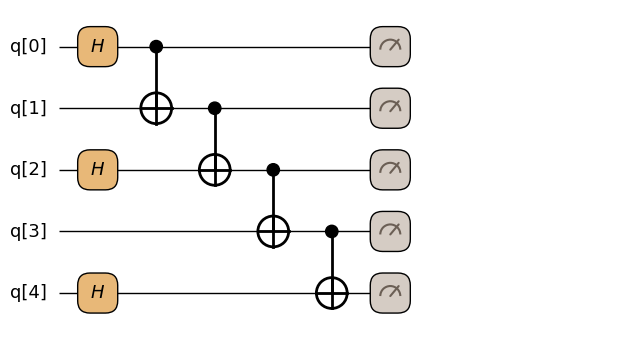
qmc.items for Sparse Interaction Data
Many variational algorithms apply gates only on specific pairs of qubits, determined by a graph or interaction map. Rather than looping over all pairs, you can pass a dictionary of interactions and iterate with qmc.items().
The dictionary type uses Qamomile’s symbolic types: qmc.Dict[qmc.Tuple[qmc.UInt, qmc.UInt], qmc.Float] — keys are qubit index pairs, values are interaction weights.
@qmc.qkernel
def sparse_coupling(
    n: qmc.UInt,
    edges: qmc.Dict[qmc.Tuple[qmc.UInt, qmc.UInt], qmc.Float],
    gamma: qmc.Float,
) -> qmc.Vector[qmc.Bit]:
    q = qmc.qubit_array(n, name="q")

    # Initial superposition
    for i in qmc.range(n):
        q[i] = qmc.h(q[i])

    # Apply RZZ interactions only on specified edges
    for (i, j), weight in qmc.items(edges):
        q[i], q[j] = qmc.rzz(q[i], q[j], gamma * weight)

return qmc.measure(q)Dict Subscript Lookup (d[key])
Besides iterating with qmc.items(), a qmc.Dict can be indexed directly with d[key]. The most useful pattern is indexing one dict with the iteration keys of another: iterate over sparse interaction terms in one dict while looking up per-edge scale factors in a second dict.
@qmc.qkernel
def per_edge_angles(
    n: qmc.UInt,
    edges: qmc.Dict[qmc.Tuple[qmc.UInt, qmc.UInt], qmc.Float],
    gammas: qmc.Dict[qmc.Tuple[qmc.UInt, qmc.UInt], qmc.Float],
) -> qmc.Vector[qmc.Bit]:
    q = qmc.qubit_array(n, name="q")

    for i in qmc.range(n):
        q[i] = qmc.h(q[i])

    # Each edge gets its own angle, looked up by the same (i, j) key
    for (i, j), weight in qmc.items(edges):
        q[i], q[j] = qmc.rzz(q[i], q[j], weight * gammas[(i, j)])

    return qmc.measure(q)
edge_data = {(0, 1): 1.0, (1, 2): -0.7}
gamma_data = {(0, 1): 0.3, (1, 2): 0.5}
circuit = transpiler.to_circuit(
per_edge_angles,
bindings={"n": 3, "edges": edge_data, "gammas": gamma_data},
)
_rzz_angles = sorted(
float(_instr.operation.params[0])
for _instr in circuit.data
if _instr.operation.name == "rzz"
)
# Each RZZ angle is weight * gamma for its own edge.
assert _rzz_angles == sorted([1.0 * 0.3, -0.7 * 0.5])Inspecting with transpiler.to_circuit()
draw() does not yet support all patterns (particularly items with complex types, if, and while). In such cases, use transpiler.to_circuit() to see the concrete transpiled circuit after all parameters are bound.
edge_data = {(0, 1): 1.0, (1, 2): -0.7, (0, 2): 0.3}

circuit = transpiler.to_circuit(
    sparse_coupling,
    bindings={"n": 3, "edges": edge_data, "gamma": 0.4},
)
print(circuit)
assert circuit.num_qubits == 3
# n=3 -> 3 initial H + 3 measurements; len(edge_data)=3 -> exactly 3 RZZ.
_ops = {}
for _instr in circuit.data:
    _ops[_instr.operation.name] = _ops.get(_instr.operation.name, 0) + 1
assert _ops == {"h": 3, "rzz": 3, "measure": 3}
┌───┐ ┌─┐
q_0: ┤ H ├─■─────────────────────■────────────┤M├───
├───┤ │ZZ(0.4) │ ┌─┐└╥┘
q_1: ┤ H ├─■─────────■───────────┼─────────┤M├─╫────
├───┤ │ZZ(-0.28) │ZZ(0.12) └╥┘ ║ ┌─┐
q_2: ┤ H ├───────────■───────────■──────────╫──╫─┤M├
└───┘ ║ ║ └╥┘
c: 3/═══════════════════════════════════════╩══╩══╩═
1 0 2
Only the three edges in edge_data produce RZZ gates — no wasted operations.
if Branching and while Loops
Qamomile supports mid-circuit measurement followed by classical branching. The condition must be a measurement result (Bit), not an argument of qkernels.
This maps directly to hardware-level conditional execution: measure a qubit, then decide what to do next based on the outcome.
if on a measurement result
A common pattern: measure one qubit and conditionally apply a gate to another qubit based on the outcome.
@qmc.qkernel
def conditional_flip() -> qmc.Bit:
    q0 = qmc.qubit("q0")
    q1 = qmc.qubit("q1")

    q0 = qmc.x(q0)  # Prepare |1⟩
    bit = qmc.measure(q0)

    # Conditionally flip q1 based on q0's measurement
    if bit:
        q1 = qmc.x(q1)
    else:
        pass

    return qmc.measure(q1)
This transpiles to a Qiskit if_else instruction and can be executed:
exe = transpiler.transpile(conditional_flip)
executor = transpiler.executor()
job = exe.sample(executor, bindings={}, shots=sample_shots)
result = job.result()
for value, count in result.results:
    print(f"  bit={value}: {count} shots")
# q0 prepared as |1>; the if-branch flips q1 to |1> on every shot.
assert result.shots == sample_shots
assert result.results == [(1, sample_shots)]
bit=1: 100 shots
Since q0 is prepared as |1⟩, the measurement always yields 1, so q1 always gets flipped — every shot should return 1.
while on a measurement result
A while loop repeats until the measurement condition becomes false. This is useful for repeat-until-success protocols.
@qmc.qkernel
def repeat_until_zero() -> qmc.Bit:
    q = qmc.qubit("q")
    q = qmc.h(q)  # 50/50 chance of |0⟩ or |1⟩
    bit = qmc.measure(q)

    while bit:
        # Re-prepare and re-measure until we get 0. The register is a
        # body-local name: rebinding the outer `q` to a register
        # allocated in the body is rejected, because the runtime loop
        # re-executes its body on one persistent register without reset.
        q2 = qmc.qubit("q2")
        q2 = qmc.h(q2)
        bit = qmc.measure(q2)

    return bit
This transpiles to a Qiskit while_loop instruction. We can inspect the generated circuit structure:
exe_while = transpiler.transpile(repeat_until_zero)
qc_while = exe_while.compiled_quantum[0].circuit
print(qc_while)
assert qc_while.num_qubits == 2
# The `while bit:` lowers to a Qiskit `while_loop` instruction.
assert "while_loop" in {instr.operation.name for instr in qc_while.data}
┌───┐┌─┐
q_0: ┤ H ├┤M├──────────────────────────────────
└───┘└╥┘┌───────── ┌───┐┌─┐ ───────┐
q_1: ──────╫─┤ While-0 ─|0>─┤ H ├┤M├ End-0 ├─
║ └────╥──── └───┘└╥┘ ───────┘
║ ┌────╨────┐ ║
c: 1/══════╩═╡ c_0=0x1 ╞═══════════╩═══════════
0 └─────────┘ 0
Combining if and while
You can combine both patterns. Here is a protocol that repeatedly measures and conditionally applies a correction gate:
@qmc.qkernel
def measure_and_correct() -> qmc.Bit:
    q0 = qmc.qubit("q0")
    q1 = qmc.qubit("q1")

    q0 = qmc.h(q0)
    bit = qmc.measure(q0)

    while bit:
        # If bit is 1, apply correction to q1
        if bit:
            q1 = qmc.x(q1)
        else:
            q1 = q1
        # Re-prepare and re-measure (body-local register name, as above)
        q0_retry = qmc.qubit("q0_retry")
        q0_retry = qmc.h(q0_retry)
        bit = qmc.measure(q0_retry)

    return qmc.measure(q1)
exe_combined = transpiler.transpile(measure_and_correct)
qc_combined = exe_combined.compiled_quantum[0].circuit
print(qc_combined)
assert qc_combined.num_qubits == 3
assert "while_loop" in {instr.operation.name for instr in qc_combined.data} ┌───┐┌─┐ »
q_0: ┤ H ├┤M├────────────────────────────────────────────────────────────»
└───┘└╥┘┌───────── ┌────── ┌───┐┌──────── ───────┐ »
q_1: ──────╫─┤ ───────┤ If-1 ─┤ X ├┤ Else-1 End-1 ├─────────»
║ │ While-0 └──╥─── └───┘└──────── ───────┘ ┌───┐┌─┐»
q_2: ──────╫─┤ ─|0>──────╫──────────────────────────────┤ H ├┤M├»
║ └────╥──── ║ └───┘└╥┘»
║ ┌────╨────┐ ┌────╨────┐ ║ »
c: 2/══════╩═╡ c_0=0x1 ╞═════╡ c_0=0x1 ╞═══════════════════════════════╩═»
0 └─────────┘ └─────────┘ 0 »
«
«q_0: ─────────────
« ───────┐ ┌─┐
«q_1: ├─┤M├
« End-0 │ └╥┘
«q_2: ├──╫─
« ───────┘ ║
«c: 2/═══════════╩═
« 1
Summary
qmc.range(n)for looping over symbolic ranges.qmc.items(dict)for iterating over sparse key-value data (edges, weights).d[key]for looking up one dict by the iteration keys of another (per-edge coefficients or calibration scales).if bit:andwhile bit:for branching on measurement results. Both branches must handle the same qubit handles (affine rule).These control flow patterns transpile to native quantum SDK instructions (e.g., Qiskit
if_elseandwhile_loop).
Next: Reuse Patterns — helper qkernels, composite gates, and stub gates for top-down design.