Tags: tutorial
In Tutorial 01 we built qkernels with a fixed number of qubits. Qamomile allows you to treat values that determine circuit structure — such as the number of qubits and layers — as symbolic parameters. For instance, you can write a qkernel that contains n qubits and applies H gates to all of them, or one that applies a certain sequence of gates for p iterations. In Qamomile, parameters for circuit structure and those for rotation angles are required to be bound at different times: structure parameters must be bound at transpile time, while rotation angles must be bound at runtime.
This chapter teaches:
The typical roles of
UIntandFloatin qkernel inputsqubit_array()andqmc.range()for parameterized circuitsThe bind/sweep pattern: transpile once, execute many times
# Install the latest Qamomile through pip!
# !pip install "qamomile[qiskit,visualization]"
Typical Roles of UInt and Float
Qkernel parameters typically come in two flavors:
| Type | Typical role |
|---|---|
qmc.UInt | Circuit structure (qubit count, number of iterations) |
qmc.Float | Gate parameters (rotation angles, weights) |
In practice, UInt values that control qubit_array size or qmc.range bounds must be bound at transpile time, because the target quantum SDK needs a fixed circuit structure. Float values can stay as sweepable parameters.
The common pattern is: bind structure at transpile time, sweep gate parameters at execution time.
import os

import qamomile.circuit as qmc
from qamomile.qiskit import QiskitTranspiler

transpiler = QiskitTranspiler()
docs_test_mode = os.environ.get("QAMOMILE_DOCS_TEST") == "1"
sample_shots = 1 if docs_test_mode else 128
qubit_array and qmc.range
When the number of qubits depends on a parameter n, use qubit_array(n). To loop over the array, use qmc.range(n) instead of Python’s built-in range(). qmc.range takes start, stop, and step arguments just like Python’s range(). For instance, if you want to apply a gate to every other qubit, you can write for i in qmc.range(0, n, 2): ....
Why not Python
range()?: At trace time,nis a symbol, not a Python integer — the qkernel body is traced to build an IR, and Python’srange()cannot iterate over a symbol.qmc.range()emits a loop node in the IR that the transpiler expands whennis bound to a concrete value.
@qmc.qkernel
def rotation_layer(n: qmc.UInt, theta: qmc.Float) -> qmc.Vector[qmc.Bit]:
    q = qmc.qubit_array(n, name="q")

    for i in qmc.range(n):
        q[i] = qmc.h(q[i])
        q[i] = qmc.ry(q[i], theta)

    return qmc.measure(q)
draw() accepts keyword arguments that bind parameters to concrete values for visualization. Here n=4 fixes the circuit to 4 qubits and theta=0.3 provides a placeholder angle.
rotation_layer.draw(n=4, theta=0.3, fold_loops=False)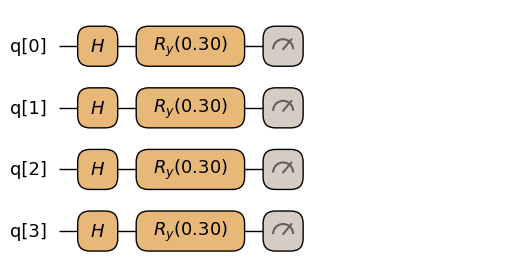
Index-Based Updates
Notice the pattern: q[i] = qmc.h(q[i]). Qamomile treats quantum handles as affine — the accessed qubit is consumed, and the updated handle must be stored back in the same place.
Anti-pattern: iterating directly over the array. We intentionally raise an error for the for qi in q: pattern because it is incompatible with Qamomile’s affine enforcement.
try:

    @qmc.qkernel
    def bad_iteration(n: qmc.UInt) -> qmc.Vector[qmc.Qubit]:
        q = qmc.qubit_array(n, name="q")
        for qi in q:  # Direct iteration — bad!
            qi = qmc.h(qi)
        return q

    bad_iteration.draw(n=4)
except Exception as e:
    print(f"Error type: {type(e).__name__}")
    print(f"Error message: {e}")
    assert type(e).__name__ == "SyntaxError"
Error type: SyntaxError
Error message: Direct iteration over sequences is not supported in @qkernel functions.
Line 6: 'for qi in q:'
Direct iteration cannot modify elements in-place, leading to silent bugs.
Use explicit index-based iteration instead:
# Incorrect (current code):
for qi in q:
qi = qmc.operation(qi)
# Correct:
n = q.shape[0]
for i in qmc.range(n):
q[i] = qmc.operation(q[i])
Always use index-based access: for i in qmc.range(n): q[i] = qmc.h(q[i]).
Broadcasting Single-Qubit Gates Over an Array
When the same single-qubit gate is applied to every qubit in a register, you
can pass the array directly instead of writing the index loop. This is
equivalent to the explicit for i in qmc.range(n): q[i] = qmc.gate(q[i])
pattern — under the hood it emits the same IR loop, so resource estimation,
transpilation, and visualization see no difference. For rotation gates the
same scalar angle is shared across every qubit; per-qubit angles still need
an explicit loop indexing into a parameter vector.
@qmc.qkernel
def rotation_layer_broadcast(n: qmc.UInt, theta: qmc.Float) -> qmc.Vector[qmc.Bit]:
    q = qmc.qubit_array(n, name="q")
    q = qmc.h(q)
    q = qmc.ry(q, theta)
    return qmc.measure(q)


rotation_layer_broadcast.draw(n=4, theta=0.3, fold_loops=False)
Both rotation_layer (above) and rotation_layer_broadcast produce the
same circuit. The broadcast form is the idiomatic choice for whole-register
layers; reach for the explicit loop when each qubit needs a different angle
(for example, indexing into Vector[Float]) or when only a slice of the
register is touched.
The Bind/Sweep Pattern
This is the central workflow pattern for parameterized qkernels:
Transpile once: bind structure parameters (
n) and declare runtime parameters (theta) as sweepable.Execute many times: reuse the same transpiled executable with different runtime bindings.
This avoids re-transpiling the circuit for every parameter value.
# Transpile: fix n=4, keep theta as a sweepable parameter
exe = transpiler.transpile(
    rotation_layer,
    bindings={"n": 4},
    parameters=["theta"],
)

# Sweep: run the same executable with different theta values
for theta in [0.1, 0.5, 1.0]:
    result = exe.sample(
        transpiler.executor(),
        shots=sample_shots,
        bindings={"theta": theta},
    ).result()
    print(f"theta={theta:.1f} -> {result.results}")
    assert result.shots == sample_shots
    assert sum(count for _, count in result.results) == sample_shots
    # Measuring n=4 qubits -> each outcome is a 4-element bit tuple.
    assert all(len(outcome) == 4 for outcome, _ in result.results)
theta=0.1 -> [((0, 0, 0, 0), 5), ((0, 0, 1, 0), 4), ((0, 0, 1, 1), 8), ((0, 1, 0, 1), 8), ((1, 0, 0, 1), 11), ((0, 1, 0, 0), 5), ((1, 1, 0, 1), 8), ((1, 0, 1, 1), 11), ((1, 1, 1, 1), 13), ((1, 0, 0, 0), 8), ((1, 1, 0, 0), 7), ((1, 1, 1, 0), 10), ((0, 1, 1, 1), 7), ((0, 0, 0, 1), 4), ((1, 0, 1, 0), 7), ((0, 1, 1, 0), 12)]
theta=0.5 -> [((0, 1, 0, 0), 2), ((1, 0, 1, 0), 4), ((1, 1, 0, 0), 7), ((1, 0, 0, 0), 2), ((1, 0, 0, 1), 2), ((0, 0, 0, 0), 2), ((0, 1, 1, 0), 1), ((0, 1, 0, 1), 6), ((0, 0, 1, 1), 6), ((0, 1, 1, 1), 15), ((0, 0, 0, 1), 3), ((1, 1, 1, 1), 47), ((1, 0, 1, 1), 12), ((1, 1, 0, 1), 10), ((1, 1, 1, 0), 9)]
theta=1.0 -> [((0, 1, 0, 1), 1), ((1, 0, 0, 1), 1), ((1, 0, 1, 1), 5), ((1, 1, 1, 1), 88), ((1, 1, 1, 0), 12), ((1, 1, 0, 1), 17), ((0, 1, 1, 1), 4)]
The transpiled executable is reused across all three runs — only the runtime binding {"theta": theta} changes.
To recap:
bindings={"n": 4}at transpile time: fixes the circuit structure.parameters=["theta"]at transpile time: declaresthetaas sweepable.bindings={"theta": ...}at execution time: provides the concrete value.
Summary
qmc.UIntvalues that control circuit structure (qubit count, loop bounds) typically need to be bound at transpile time.qmc.Floatvalues (rotation angles) are natural candidates for runtime sweeping.Use
qmc.qubit_array(n)andqmc.range(n)for parameterized circuits. Always use index-based updates:q[i] = qmc.gate(q[i]).The bind/sweep pattern —
transpile(bindings=..., parameters=...)then loop — transpiles once and executes many times.
Next: Vector Slicing — VectorView, slice assignment, nested slices, and passing views to helper kernels.