This tutorial walks through the Quantum Approximate Optimization Algorithm
(QAOA) pipeline step by step, using Qamomile’s low-level circuit primitives.
Rather than using the high-level QAOAConverter, we will:
Define a MaxCut problem for a small graph.
Formulate it as a QUBO, then convert to an Ising model.
Write the QAOA circuit step by step using
@qkernel.Optimize variational parameters with a classical optimizer.
Decode and visualize the results.
At the end, we show that qamomile.circuit.algorithm.qaoa_state provides
the same circuit in a single function call.
# Install the latest Qamomile through pip!
# !pip install qamomile
What is MaxCut?
Given an undirected graph , the MaxCut problem asks us to partition the vertices into two sets and so that the number of edges between the two sets is maximized:
where indicates which set vertex belongs to.
Create the Graph
We use a small 5-node graph with 6 edges. This is large enough to be non-trivial, yet small enough to brute-force for comparison.
import matplotlib.pyplot as plt
import networkx as nx

G = nx.Graph()
G.add_edges_from([(0, 1), (0, 2), (1, 2), (1, 3), (2, 3), (3, 4)])
num_nodes = G.number_of_nodes()

pos = nx.spring_layout(G, seed=42)
plt.figure(figsize=(5, 4))
nx.draw(
    G,
    pos,
    with_labels=True,
    node_color="white",
    node_size=700,
    edgecolors="black",
)
plt.title(f"Graph: {num_nodes} nodes, {G.number_of_edges()} edges")
plt.show()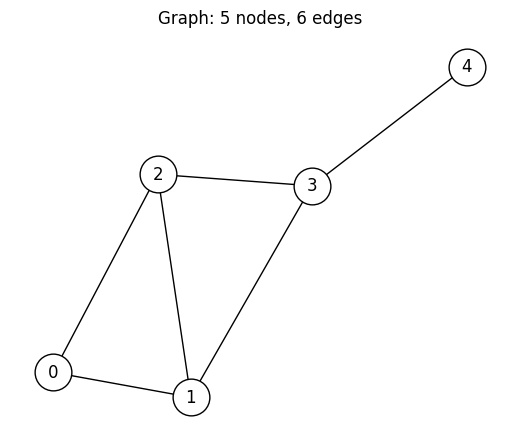
QUBO Formulation
To minimize with QAOA, we negate the MaxCut objective:
This maps to a QUBO dictionary where each edge contributes:
, (diagonal)
(off-diagonal)
from qamomile.optimization.binary_model import BinaryModel, VarType

# Build QUBO dictionary from graph edges
qubo: dict[tuple[int, int], float] = {}
for i, j in G.edges():
    qubo[(i, i)] = qubo.get((i, i), 0.0) - 1.0
    qubo[(j, j)] = qubo.get((j, j), 0.0) - 1.0
    qubo[(i, j)] = qubo.get((i, j), 0.0) + 2.0

print("QUBO coefficients:")
for key, val in sorted(qubo.items()):
    print(f"  {key}: {val}")

model = BinaryModel.from_qubo(qubo)
print(f"\nNumber of variables: {model.num_bits}")
print(f"Variable type: {model.vartype}")
QUBO coefficients:
(0, 0): -2.0
(0, 1): 2.0
(0, 2): 2.0
(1, 1): -3.0
(1, 2): 2.0
(1, 3): 2.0
(2, 2): -3.0
(2, 3): 2.0
(3, 3): -3.0
(3, 4): 2.0
(4, 4): -1.0
Number of variables: 5
Variable type: BINARY
Note:
BinaryModelalso providesfrom_ising()andfrom_hubo()constructors for other input formats. Usechange_vartype()to convert between binary and spin representations.
From QUBO to Ising Model
QAOA operates in the spin domain (), not the binary domain (). The conversion is:
This matches the quantum convention , , so binary 0 maps to spin +1 and binary 1 maps to spin -1.
Substituting into the QUBO yields an Ising Hamiltonian:
spin_model = model.change_vartype(VarType.SPIN).normalize_by_abs_max()

print(f"Variable type: {spin_model.vartype}")
print(f"Linear terms (h_i):     {spin_model.linear}")
print(f"Quadratic terms (J_ij): {spin_model.quad}")
print(f"Constant:               {spin_model.constant}")
Variable type: SPIN
Linear terms (h_i): {}
Quadratic terms (J_ij): {(0, 1): 1.0, (0, 2): 1.0, (1, 2): 1.0, (1, 3): 1.0, (2, 3): 1.0, (3, 4): 1.0}
Constant: -6.0
Exact Solution (Brute Force)
Before running QAOA, let’s find the optimal solution by trying all partitions. This gives us a ground truth to compare against.
import itertools

best_cut = 0
optimal_partitions: list[tuple[int, ...]] = []

for bits in itertools.product([0, 1], repeat=num_nodes):
    cut = sum(1 for i, j in G.edges() if bits[i] != bits[j])
    if cut > best_cut:
        best_cut = cut
        optimal_partitions = [bits]
    elif cut == best_cut:
        optimal_partitions.append(bits)

print(f"Optimal MaxCut value: {best_cut}")
print(f"Number of optimal partitions: {len(optimal_partitions)}")
for part in optimal_partitions:
    print(f"  {part}")
Optimal MaxCut value: 5
Number of optimal partitions: 2
(0, 1, 1, 0, 1)
(1, 0, 0, 1, 0)
QAOA Circuit: The Idea
The QAOA ansatz prepares a parameterized quantum state:
where:
: uniform superposition (Hadamard on every qubit)
: cost unitary — for an Ising cost, this decomposes into and gates (see Steps 2–3 for the gate convention details)
: mixer unitary — with , this becomes on every qubit
: number of layers (depth of the ansatz)
We will now build each component as a @qkernel.
Step 1: Uniform Superposition
Apply a Hadamard gate to every qubit to start from the equal superposition state .
import qamomile.circuit as qmc


@qmc.qkernel
def superposition(n: qmc.UInt) -> qmc.Vector[qmc.Qubit]:
    q = qmc.qubit_array(n, name="q")
    for i in qmc.range(n):
        q[i] = qmc.h(q[i])
    return q
Step 2: Cost Layer
Apply the cost unitary .
Qamomile’s rotation gates include a factor: and . To match exactly one would pass as the angle. However, since is a variational parameter that the classical optimizer tunes freely, this constant factor is simply absorbed into the optimal values. We therefore pass (and ) directly:
@qmc.qkernel
def cost_layer(
    quad: qmc.Dict[qmc.Tuple[qmc.UInt, qmc.UInt], qmc.Float],
    linear: qmc.Dict[qmc.UInt, qmc.Float],
    q: qmc.Vector[qmc.Qubit],
    gamma: qmc.Float,
) -> qmc.Vector[qmc.Qubit]:
    for (i, j), Jij in quad.items():
        q[i], q[j] = qmc.rzz(q[i], q[j], angle=Jij * gamma)
    for i, hi in linear.items():
        q[i] = qmc.rz(q[i], angle=hi * gamma)
    return q
Step 3: Mixer Layer
Apply the mixer unitary where . Since , we need to implement on each qubit.
@qmc.qkernel
def mixer_layer(
    q: qmc.Vector[qmc.Qubit],
    beta: qmc.Float,
) -> qmc.Vector[qmc.Qubit]:
    n = q.shape[0]
    for i in qmc.range(n):
        q[i] = qmc.rx(q[i], angle=2.0 * beta)
    return q
Step 4: Full QAOA Ansatz
Compose the three pieces: superposition, then rounds of cost + mixer, and finally measurement.
@qmc.qkernel
def qaoa_ansatz(
    p: qmc.UInt,
    quad: qmc.Dict[qmc.Tuple[qmc.UInt, qmc.UInt], qmc.Float],
    linear: qmc.Dict[qmc.UInt, qmc.Float],
    n: qmc.UInt,
    gammas: qmc.Vector[qmc.Float],
    betas: qmc.Vector[qmc.Float],
) -> qmc.Vector[qmc.Bit]:
    q = superposition(n)
    for layer in qmc.range(p):
        q = cost_layer(quad, linear, q, gammas[layer])
        q = mixer_layer(q, betas[layer])
    return qmc.measure(q)
Transpile and Optimize
We transpile the kernel, binding the problem structure (graph coefficients,
number of qubits, number of layers) while keeping gammas and betas
as runtime parameters that the optimizer will tune.
from qamomile.qiskit import QiskitTranspiler

transpiler = QiskitTranspiler()
p = 3  # number of QAOA layers

executable = transpiler.transpile(
    qaoa_ansatz,
    bindings={
        "p": p,
        "quad": spin_model.quad,
        "linear": spin_model.linear,
        "n": num_nodes,
    },
    parameters=["gammas", "betas"],
)
We use scipy.optimize.minimize with the COBYLA method. At each
iteration, the optimizer samples the circuit and evaluates the mean
energy.
import numpy as np
from qiskit_aer import AerSimulator
from scipy.optimize import minimize

executor = transpiler.executor(backend=AerSimulator(seed_simulator=7))
cost_history: list[float] = []


def cost_fn(params):
    gammas = list(params[:p])
    betas = list(params[p:])
    result = executable.sample(
        executor,
        shots=2048,
        bindings={"gammas": gammas, "betas": betas},
    ).result()
    decoded = spin_model.decode_from_sampleresult(result)
    energy = decoded.energy_mean()
    cost_history.append(energy)
    return energy


rng = np.random.default_rng(42)
initial_params = rng.uniform(-np.pi / 2, np.pi / 2, 2 * p)

res = minimize(cost_fn, initial_params, method="COBYLA", options={"maxiter": 500})

print(f"Optimized cost: {res.fun:.4f}")
print(f"Optimal params: {[round(v, 4) for v in res.x]}")
Optimized cost: -8.8896
Optimal params: [np.float64(0.8252), np.float64(-0.2989), np.float64(1.4505), np.float64(0.4523), np.float64(-0.8443), np.float64(2.9848)]
plt.figure(figsize=(8, 4))
plt.plot(cost_history, color="#2696EB")
plt.xlabel("Iteration")
plt.ylabel("Cost (mean energy)")
plt.title("QAOA Optimization Progress")
plt.show()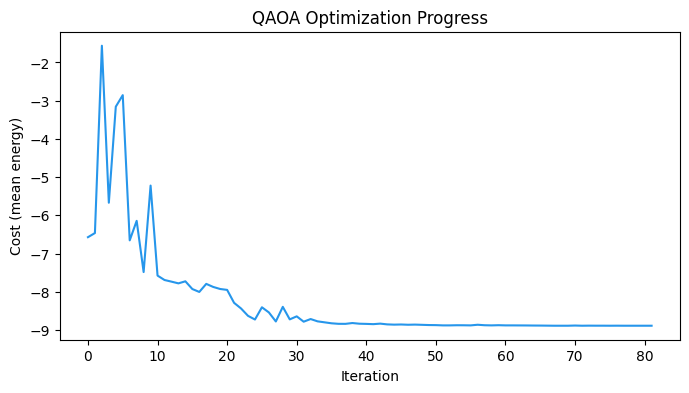
Decode and Analyze Results
We sample the circuit with the optimized parameters and interpret the measurement outcomes. For MaxCut every bitstring is a valid partition, so there is no feasibility check needed — we simply count the cut edges for each sample.
gammas_opt = list(res.x[:p])
betas_opt = list(res.x[p:])

final_result = executable.sample(
    executor,
    shots=2048,
    bindings={"gammas": gammas_opt, "betas": betas_opt},
).result()

decoded = spin_model.decode_from_sampleresult(final_result)
from collections import Counter
cut_distribution: Counter[int] = Counter()
best_qaoa_cut = 0
best_qaoa_sample = None
for sample, energy, occ in zip(
decoded.samples, decoded.energy, decoded.num_occurrences
):
# Convert spin (+1/-1) back to binary (0/1): x = (1 - s) / 2
binary = {idx: (1 - s) // 2 for idx, s in sample.items()}
bits = [binary[i] for i in range(num_nodes)]
cut = sum(1 for i, j in G.edges() if bits[i] != bits[j])
cut_distribution[cut] += occ
if cut > best_qaoa_cut:
best_qaoa_cut = cut
best_qaoa_sample = bits
print(f"Best QAOA cut: {best_qaoa_cut} (optimal: {best_cut})")
print(f"Best partition: {best_qaoa_sample}")Best QAOA cut: 5 (optimal: 5)
Best partition: [0, 1, 1, 0, 1]
cuts = sorted(cut_distribution.keys())
counts = [cut_distribution[c] for c in cuts]

plt.figure(figsize=(8, 4))
plt.bar([str(c) for c in cuts], counts, color="#2696EB")
plt.xlabel("Cut size")
plt.ylabel("Frequency")
plt.title("Distribution of MaxCut Values from QAOA")
plt.show()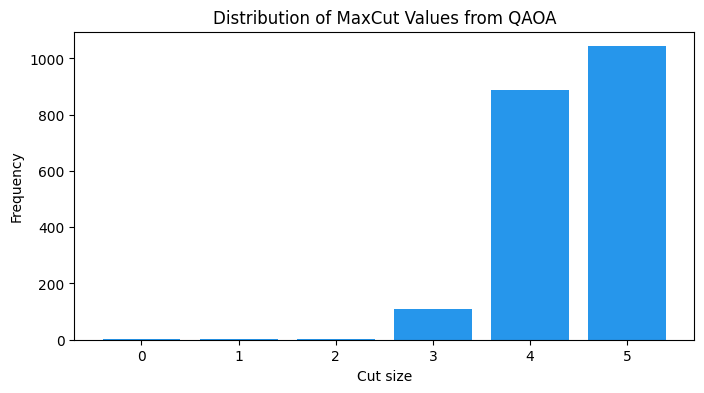
if best_qaoa_sample is not None:
    color_map = [
        "#FF6B6B" if best_qaoa_sample[i] == 1 else "#4ECDC4" for i in range(num_nodes)
    ]
    plt.figure(figsize=(5, 4))
    nx.draw(
        G,
        pos,
        with_labels=True,
        node_color=color_map,
        node_size=700,
        edgecolors="black",
    )
    plt.title(f"QAOA partition (cut = {best_qaoa_cut})")
    plt.show()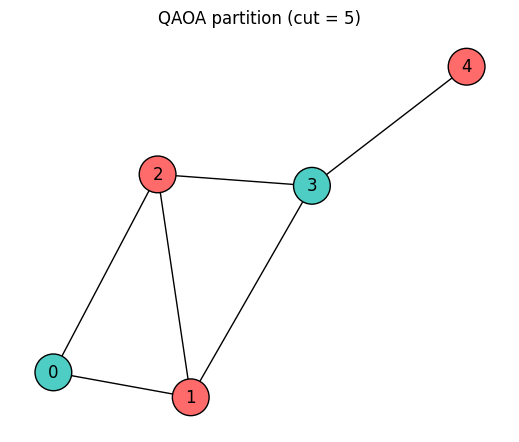
Using the Built-in qaoa_state
Everything we implemented above — superposition, cost layer, mixer layer,
and the layered loop — is already provided by
qamomile.circuit.algorithm.qaoa_state. It accepts exactly the same
Ising coefficients (quad, linear) and variational parameters
(gammas, betas).
Let’s build the same circuit using the built-in function to confirm that it implements the same structure. By using a seeded simulator, we can verify that both circuits produce identical results.
from qamomile.circuit.algorithm import qaoa_state


@qmc.qkernel
def qaoa_builtin(
    p: qmc.UInt,
    quad: qmc.Dict[qmc.Tuple[qmc.UInt, qmc.UInt], qmc.Float],
    linear: qmc.Dict[qmc.UInt, qmc.Float],
    n: qmc.UInt,
    gammas: qmc.Vector[qmc.Float],
    betas: qmc.Vector[qmc.Float],
) -> qmc.Vector[qmc.Bit]:
    q = qaoa_state(p=p, quad=quad, linear=linear, n=n, gammas=gammas, betas=betas)
    return qmc.measure(q)
We transpile and sample with the same optimized parameters.
Using a seeded AerSimulator gives deterministic results for
identical circuits.
from qiskit_aer import AerSimulator

exe_builtin = transpiler.transpile(
    qaoa_builtin,
    bindings={
        "p": p,
        "quad": spin_model.quad,
        "linear": spin_model.linear,
        "n": num_nodes,
    },
    parameters=["gammas", "betas"],
)

seeded_executor_manual = transpiler.executor(
    backend=AerSimulator(seed_simulator=0),
)
seeded_executor_builtin = transpiler.executor(
    backend=AerSimulator(seed_simulator=0),
)

result_manual = executable.sample(
    seeded_executor_manual,
    shots=2048,
    bindings={"gammas": gammas_opt, "betas": betas_opt},
).result()

result_builtin = exe_builtin.sample(
    seeded_executor_builtin,
    shots=2048,
    bindings={"gammas": gammas_opt, "betas": betas_opt},
).result()

decoded_manual = spin_model.decode_from_sampleresult(result_manual)
decoded_builtin = spin_model.decode_from_sampleresult(result_builtin)
print(f"Manual   mean energy: {decoded_manual.energy_mean():.4f}")
print(f"Built-in mean energy: {decoded_builtin.energy_mean():.4f}")
Manual mean energy: -8.8838
Built-in mean energy: -8.8838
Summary
In this tutorial we:
Defined a MaxCut problem and built its QUBO formulation from a NetworkX graph.
Converted the QUBO to an Ising model using
BinaryModel.Built every component of the QAOA circuit as a
@qkernel— superposition, cost layer, mixer layer, and the full ansatz.Ran a classical optimization loop and decoded the results.
Verified that
qamomile.circuit.algorithm.qaoa_stateprovides the same circuit with a single function call.
Next steps:
For constrained optimization problems (where penalty terms are needed), see QAOA for Graph Partitioning which uses the higher-level
QAOAConvertertogether with JijModeling.