タグ: tutorial
Qamomileは量子カーネルの戻り値に応じて2つの実行メソッドを提供します:
| 量子カーネルの戻り値 | 使用メソッド | 返される結果 |
|---|---|---|
Bit, Vector[Bit], tuple[Bit, ...] | sample() | SampleResult — カウント付き測定結果 |
Float (expvalから) | run() | float — 期待値 |
この章では両方のメソッドを説明し、期待値計算のためのオブザーバブルを紹介します。
# 最新のQamomileをpipからインストールします!
# !pip install "qamomile[qiskit,visualization]"
import math
import os
import qamomile.circuit as qmc
import qamomile.observable as qmo
from qamomile.qiskit import QiskitTranspiler
transpiler = QiskitTranspiler()
docs_test_mode = os.environ.get("QAMOMILE_DOCS_TEST") == "1"
sample_shots = 1 if docs_test_mode else 256複数量子ビットのsample()
チュートリアル01では単一のBitをサンプリングしました。量子カーネルが複数ビットを返す場合、各測定結果は整数値(0または1)のタプルになります。
@qmc.qkernel
def parity_probe(theta: qmc.Float) -> tuple[qmc.Bit, qmc.Bit]:
    q0 = qmc.qubit(name="q0")
    q1 = qmc.qubit(name="q1")

    q0 = qmc.h(q0)
    q1 = qmc.ry(q1, theta)
    q0, q1 = qmc.cx(q0, q1)

    return qmc.measure(q0), qmc.measure(q1)
parity_probe.draw(theta=0.7)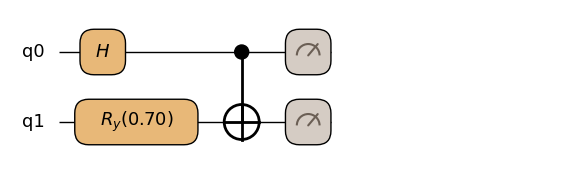
exe_sample = transpiler.transpile(parity_probe, parameters=["theta"])
sample_result = exe_sample.sample(
    transpiler.executor(),
    shots=sample_shots,
    bindings={"theta": 0.7},
).result()

for outcome, count in sample_result.results:
    print(f"  outcome={outcome}, count={count}")
assert sample_result.shots == sample_shots
assert sum(count for _, count in sample_result.results) == sample_shots
# parity_probe は tuple[Bit, Bit] を返す → 各 outcome は 2 要素 tuple。
assert all(
    isinstance(outcome, tuple) and len(outcome) == 2
    for outcome, _ in sample_result.results
)
outcome=(1, 0), count=17
outcome=(0, 1), count=21
outcome=(1, 1), count=105
outcome=(0, 0), count=113
各outcomeは(0, 1)や(1, 0)のようなタプルです。最初の要素はq0に、2番目の要素はq1に対応し、return文での順序と一致します。
測定の返り値順序
Qamomileで測定したとき、sample()の各測定結果は、量子カーネルのreturnで指定した順序のビットのタプルとして返ります。qs: Vector[Qubit]をそのまま測定(measure(qs))した場合、その測定結果はbits = (measure(qs[0]), measure(qs[1]), measure(qs[2]), ...)に対応する順序で返ります。ビットのタプルを1つのビット列として解釈する場合、bits[0]を最下位ビットとして扱います。
期待値が必要な場合
個々の測定結果ではなく、量子オブザーバブルの期待値(平均値)が必要な場面があります。例えば:
VQE(変分量子固有値ソルバー):の最小化
QAOA:コスト関数の期待値の評価
量子パラメータに対するあらゆる最適化ループ
このためにQamomileはexpval()とrun()を提供しています。
Observable型
関連する2つの概念があります:
qmc.Observable— 量子カーネルのシグネチャで使用するハンドル型です。qmc.Floatと同様に、量子カーネルの引数や戻り値の型アノテーションで使用します。qamomile.observableモジュール — バインディングで渡す具体的なオブザーバブル値を構築する場所です。例えば
import qamomile.observable as qmo

H = qmo.Z(0)                        # 量子ビット0のパウリZ
H = qmo.Z(0) * qmo.Z(1)             # ZZ相互作用
H = 0.5 * qmo.X(0) + 0.3 * qmo.Y(1) # 線形結合expval():オブザーバブルの測定
expval(qubit, hamiltonian)は期待値(はqubitを表し、はhamiltonianに対応)を計算し、qmc.Floatを返します。expvalからFloatを返す量子カーネルはrun()で実行する必要があります。
@qmc.qkernel
def z_expectation(theta: qmc.Float, hamiltonian: qmc.Observable) -> qmc.Float:
    q = qmc.qubit(name="q")
    q = qmc.ry(q, theta)
    return qmc.expval(q, hamiltonian)


H = qmo.Z(0)
z_expectation.draw(theta=0.7, hamiltonian=H)
run()による実行
期待値を返す量子カーネルにはsample()の代わりにrun()を使います。オブザーバブルはトランスパイル時にバインドし(測定回路に影響するため)、thetaはスイープ可能なパラメータとして残します。
exe_run = transpiler.transpile(
    z_expectation,
    bindings={"hamiltonian": H},  # Observable bound at transpile time
    parameters=["theta"],  # theta remains sweepable
)

run_result = exe_run.run(
    transpiler.executor(),
    bindings={"theta": 0.7},
).result()

print("expectation value:", run_result)
print("python type:", type(run_result))
assert isinstance(run_result, float)
# Ry(theta)|0> の <Z> は厳密に cos(theta)。statevector estimator は
# 浮動小数点精度で返す。
assert math.isclose(run_result, math.cos(0.7), abs_tol=1e-10)
expectation value: 0.7648421872844884
python type: <class 'float'>
sample()とrun()
| 量子カーネルの戻り値 | 実行メソッド | .result()の返り値 |
|---|---|---|
Bit | sample() | SampleResult (.results: list[tuple[int, int]]) |
tuple[Bit, Bit] | sample() | SampleResult (.results: list[tuple[tuple[int, int], int]]) |
Vector[Bit] | sample() | SampleResult (.results: list[tuple[tuple[int, ...], int]]) |
Float (expvalから) | run() | float |
使い分け:量子カーネルがmeasure()で終わる場合はsample()を使用します。expval()で終わる場合はrun()を使用します。