Tags: integration optimization variational
This tutorial shows how to run a Qamomile quantum algorithm on a problem from a public benchmark dataset and compare its solution quality with a classical solver in the same workflow.
Goal. Build a QAOA solver in Qamomile, run it on a
Low Autocorrelation Binary Sequences (LABS) instance loaded from the
OMMX Quantum Benchmarks
dataset, and compare the result with the classical SCIP solver
accessed through the ommx-pyscipopt-adapter.
Because both the QAOA path and the SCIP path consume the same
ommx.v1.Instance, the main difference is the algorithm itself. This
makes the comparison direct.
# Install the additional packages used in this tutorial.
# !pip install "qamomile[qiskit]" ommx-quantum-benchmarks ommx-pyscipopt-adapter
import os
import time
# `ommx-quantum-benchmarks` uses `minto` internally and, by default,
# `minto` prints a host-environment dump (Python version, virtualenv
# path, etc.) at experiment start. Suppress it so the rendered
# notebook outputs do not leak local-machine details.
os.environ["MINTO_TESTING"] = "true"
import matplotlib.pyplot as plt
import numpy as np
import ommx.v1
import ommx_pyscipopt_adapter
from ommx_quantum_benchmarks.qoblib import Labs
from qiskit_aer import AerSimulator
from qiskit_aer.primitives import EstimatorV2
from scipy.optimize import minimize
import qamomile.circuit as qmc
import qamomile.observable as qm_o
from qamomile.optimization.binary_model import BinaryModel, VarType
from qamomile.qiskit import QiskitTranspiler
from qamomile.qiskit.transpiler import QiskitExecutorWhat is OMMX Quantum Benchmarks?
OMMX (Open Mathematical prograMming eXchange)
is a data format for exchanging mathematical optimization problems across
tools. Its ommx.v1.Instance stores the objective, constraints, and
decision-variable metadata.
OMMX Quantum Benchmarks is a curated collection of optimization
benchmark instances distributed in this ommx.v1.Instance format. The
first dataset shipped is QOBLIB (Quantum Optimization Benchmarking
Library) arXiv:2504.03832, which
contains nine problem families used in the recent quantum-optimization
literature, including LABS, Market Split, Independent Set, and
Steiner-tree packing.
Because each benchmark instance is represented as an ommx.v1.Instance,
any Qamomile workflow that accepts ommx.v1.Instance, including
QAOAConverter, can consume these problems without writing any extra code.
In addition, a reference solution is provided in the ommx.v1.Solution
format and can be used to evaluate benchmark results.
The same Instance can also be passed to classical OMMX adapters such
as ommx-pyscipopt-adapter, so one problem definition can support both
quantum and classical workflows.
Problem: Low Autocorrelation Binary Sequences (LABS)
LABS asks for a binary sequence whose off-diagonal autocorrelations
are as close to zero as possible. The benchmark objective is the sum of squared autocorrelations
which we want to minimize. LABS is NP-hard and has long served as a stress test for both classical and quantum heuristics.
Loading a LABS instance
Labs exposes two models: "integer" (uses integer decision variables
for plus the constraints that tie them to ) and
"quadratic_unconstrained" (a QUBO reformulation that introduces
auxiliary binary variables encoding the products
via a quadratic penalty). The QUBO form is the natural
target for QAOA, so we use it here.
dataset = Labs()
print(f"Dataset:           {dataset.name}")
print(f"Available models:  {dataset.model_names}")
print(f"Instance count:    {len(dataset.available_instances['quadratic_unconstrained'])}")
print(f"First 5 instances: {dataset.available_instances['quadratic_unconstrained'][:5]}")
Dataset: 02_labs
Available models: ['integer', 'quadratic_unconstrained']
Instance count: 99
First 5 instances: ['labs002', 'labs003', 'labs004', 'labs005', 'labs006']
We pick labs005, the instance. The QUBO reformulation
uses binary variables (5 sequence bits
plus auxiliary bits). After
Instance.to_qubo() folds the penalty terms into the objective
and inactive variables are pruned, this becomes a 15-qubit problem:
small enough to simulate locally, but large enough that QAOA is
non-trivial.
instance, reference_solution = dataset("quadratic_unconstrained", "labs005")
n = 5

print(f"OMMX variables:    {instance.num_variables}")
print(f"OMMX constraints:  {instance.num_constraints}")
print(f"Reference E(s):    {reference_solution.objective}")
print(f"Reference feasible: {reference_solution.feasible}")
OMMX variables: 25
OMMX constraints: 0
Reference E(s): 2.0
Reference feasible: True
The bundled reference solution gives the known optimum for . We will compare both QAOA and SCIP against this value.
Algorithm: QAOA
Rather than use the high-level QAOAConverter, we build the
QAOA workflow from scratch with @qkernel, following the recipe in
QAOA for MaxCut: Building the Circuit from Scratch.
Refer to that tutorial for the gate-by-gate derivation; here we
focus on the implementation.
Spin model from the OMMX instance
Instance.to_qubo() converts the penalty-form ommx.v1.Instance into
a QUBO. We then wrap it in a BinaryModel and switch to the spin
(-1/+1) domain, which is what the QAOA cost layer expects. We also
normalize the coefficients so the energy scale stays comparable across
runs.
# `Instance.to_qubo()` mutates the instance (it absorbs constraints into
# the objective via the penalty method). Round-trip through bytes to keep
# the caller's instance untouched.
instance_for_qubo = ommx.v1.Instance.from_bytes(instance.to_bytes())
qubo, qubo_constant = instance_for_qubo.to_qubo()
spin_model = (
    BinaryModel.from_qubo(qubo, qubo_constant)
    .change_vartype(VarType.SPIN)
    .normalize_by_abs_max()
)
print(f"QAOA qubits: {spin_model.num_bits}")
QAOA qubits: 15
Cost Hamiltonian
To use the exact expectation value rather than a shot estimate for the optimization, we build the Ising cost Hamiltonian directly from the spin-model coefficients: terms for the linear part and terms for the quadratic part.
cost_hamiltonian = qm_o.Hamiltonian()
for i, hi in spin_model.linear.items():
    if abs(hi) > 1e-12:
        cost_hamiltonian.add_term((qm_o.PauliOperator(qm_o.Pauli.Z, i),), hi)
for (i, j), Jij in spin_model.quad.items():
    if abs(Jij) > 1e-12:
        cost_hamiltonian.add_term(
            (qm_o.PauliOperator(qm_o.Pauli.Z, i), qm_o.PauliOperator(qm_o.Pauli.Z, j)),
            Jij,
        )
cost_hamiltonian.constant = spin_model.constant
QAOA qkernels
The ansatz uses three small qkernels: a uniform superposition, a cost
layer, and a mixer layer. We compose them into a state-preparation
qkernel qaoa_state, then wrap it twice: once with qmc.expval to
get an expectation-value qkernel for the optimizer, and once with
qmc.measure to get a sampling qkernel for the final shot histogram.
@qmc.qkernel
def superposition(n: qmc.UInt) -> qmc.Vector[qmc.Qubit]:
    q = qmc.qubit_array(n, name="q")
    for i in qmc.range(n):
        q[i] = qmc.h(q[i])
    return q


@qmc.qkernel
def cost_layer(
    quad: qmc.Dict[qmc.Tuple[qmc.UInt, qmc.UInt], qmc.Float],
    linear: qmc.Dict[qmc.UInt, qmc.Float],
    q: qmc.Vector[qmc.Qubit],
    gamma: qmc.Float,
) -> qmc.Vector[qmc.Qubit]:
    for (i, j), Jij in quad.items():
        q[i], q[j] = qmc.rzz(q[i], q[j], angle=Jij * gamma)
    for i, hi in linear.items():
        q[i] = qmc.rz(q[i], angle=hi * gamma)
    return q


@qmc.qkernel
def mixer_layer(
    q: qmc.Vector[qmc.Qubit],
    beta: qmc.Float,
) -> qmc.Vector[qmc.Qubit]:
    n = q.shape[0]
    for i in qmc.range(n):
        q[i] = qmc.rx(q[i], angle=2.0 * beta)
    return q


@qmc.qkernel
def qaoa_state(
    p: qmc.UInt,
    quad: qmc.Dict[qmc.Tuple[qmc.UInt, qmc.UInt], qmc.Float],
    linear: qmc.Dict[qmc.UInt, qmc.Float],
    n: qmc.UInt,
    gammas: qmc.Vector[qmc.Float],
    betas: qmc.Vector[qmc.Float],
) -> qmc.Vector[qmc.Qubit]:
    q = superposition(n)
    for layer in qmc.range(p):
        q = cost_layer(quad, linear, q, gammas[layer])
        q = mixer_layer(q, betas[layer])
    return q


@qmc.qkernel
def qaoa_expval(
    p: qmc.UInt,
    quad: qmc.Dict[qmc.Tuple[qmc.UInt, qmc.UInt], qmc.Float],
    linear: qmc.Dict[qmc.UInt, qmc.Float],
    n: qmc.UInt,
    gammas: qmc.Vector[qmc.Float],
    betas: qmc.Vector[qmc.Float],
    H: qmc.Observable,
) -> qmc.Float:
    q = qaoa_state(p, quad, linear, n, gammas, betas)
    return qmc.expval(q, H)


@qmc.qkernel
def qaoa_sampling(
    p: qmc.UInt,
    quad: qmc.Dict[qmc.Tuple[qmc.UInt, qmc.UInt], qmc.Float],
    linear: qmc.Dict[qmc.UInt, qmc.Float],
    n: qmc.UInt,
    gammas: qmc.Vector[qmc.Float],
    betas: qmc.Vector[qmc.Float],
) -> qmc.Vector[qmc.Bit]:
    q = qaoa_state(p, quad, linear, n, gammas, betas)
    return qmc.measure(q)
Transpile and optimize
Transpile both kernels with . The expectation-value
executable is used for the optimization; the sampling executable is
used later for the final shot histogram. We feed the optimizer the
exact expectation value of the cost Hamiltonian via Aer’s
EstimatorV2 primitive, which keeps the BFGS finite-difference
gradient free of sampling noise. We seed NumPy so the parameter
trajectory is reproducible.
p = 3
transpiler = QiskitTranspiler()
expval_executable = transpiler.transpile(
    qaoa_expval,
    bindings={
        "p": p,
        "quad": spin_model.quad,
        "linear": spin_model.linear,
        "n": spin_model.num_bits,
        "H": cost_hamiltonian,
    },
    parameters=["gammas", "betas"],
)
sampling_executable = transpiler.transpile(
    qaoa_sampling,
    bindings={
        "p": p,
        "quad": spin_model.quad,
        "linear": spin_model.linear,
        "n": spin_model.num_bits,
    },
    parameters=["gammas", "betas"],
)

SEED = 42
executor = QiskitExecutor(
    backend=AerSimulator(seed_simulator=SEED, max_parallel_threads=1),
    estimator=EstimatorV2(),
)

docs_test_mode = os.environ.get("QAMOMILE_DOCS_TEST") == "1"
maxiter = 1 if docs_test_mode else 50

rng = np.random.default_rng(SEED)
initial_params = rng.uniform(0, np.pi, 2 * p)

cost_history: list[float] = []


def cost_fn(params: np.ndarray) -> float:
    """Return the exact expectation value of the cost Hamiltonian at `params`."""
    gammas = list(params[:p])
    betas = list(params[p:])
    job = expval_executable.run(
        executor,
        bindings={"gammas": gammas, "betas": betas},
    )
    energy = job.result()
    cost_history.append(energy)
    return energy


t0 = time.perf_counter()
res = minimize(
    cost_fn,
    initial_params,
    method="BFGS",
    options={"maxiter": maxiter},
)
qaoa_optimize_time = time.perf_counter() - t0

print(f"Optimized expectation value (normalized): {res.fun:.4f}")
print(f"Function evaluations:                     {res.nfev}")
print(f"Wall time:                                {qaoa_optimize_time:.2f} s")
Optimized expectation value (normalized): 1.9622
Function evaluations: 385
Wall time: 9.34 s
plt.figure(figsize=(8, 4))
plt.plot(cost_history, color="#2696EB")
plt.xlabel("Iteration")
plt.ylabel("Expectation value (normalized)")
plt.title("QAOA Optimization Progress (LABS, n=5)")
plt.show()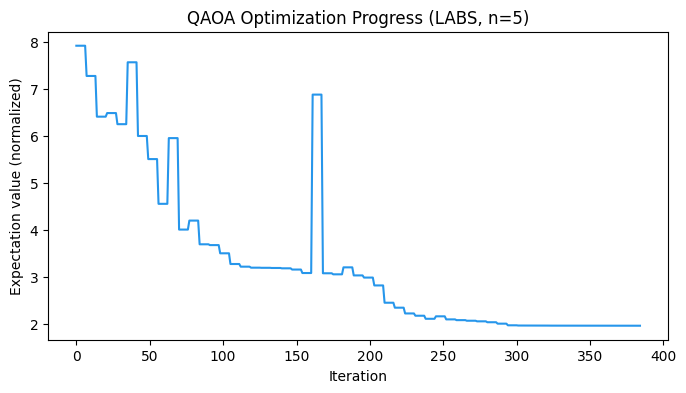
Final sampling
We sample once more with the optimized parameters and a larger shot
count. Then we decode against the original ommx.v1.Instance, so the
returned ommx.v1.SampleSet reports the original QUBO objective
directly. In this QUBO formulation, samples whose auxiliary
variables correctly encode the products incur no
penalty, and the objective equals the LABS energy
. Samples that violate the
implicit relation incur an additive penalty.
def evaluate_with_ommx(
    sample_result, spin_model: BinaryModel, ommx_instance: ommx.v1.Instance
) -> ommx.v1.SampleSet:
    """Decode SPIN samples, flip to BINARY, and evaluate against the OMMX instance."""
    spin_ss = spin_model.decode_from_sampleresult(sample_result)
    ommx_samples = ommx.v1.Samples({})
    next_id = 0
    for sample, occ in zip(spin_ss.samples, spin_ss.num_occurrences):
        if occ <= 0:
            continue
        # SPIN (+/-1) -> BINARY (0/1): x = (1 - s) / 2
        binary_state = {idx: (1 - val) // 2 for idx, val in sample.items()}
        sample_ids = list(range(next_id, next_id + occ))
        next_id += occ
        ommx_samples.append(
            sample_ids,
            ommx.v1.State({idx: float(val) for idx, val in binary_state.items()}),
        )
    return ommx_instance.evaluate_samples(ommx_samples)


gammas_opt = list(res.x[:p])
betas_opt = list(res.x[p:])
final_shots = 1 if docs_test_mode else 4096

final_result = sampling_executable.sample(
    executor,
    shots=final_shots,
    bindings={"gammas": gammas_opt, "betas": betas_opt},
).result()
qaoa_sample_set = evaluate_with_ommx(final_result, spin_model, instance)

qaoa_summary = qaoa_sample_set.summary
qaoa_best = qaoa_sample_set.best_feasible
qaoa_best_E = int(round(qaoa_best.objective))
ref_E = int(reference_solution.objective)

print(f"Shots:                {len(qaoa_summary)}")
print(f"QAOA best objective:  {qaoa_best_E}")
print(f"Reference E*:         {ref_E}")
Shots: 4096
QAOA best objective: 2
Reference E*: 2
Distribution of objective values
QAOA returns a distribution over bitstrings, not a single answer. The histogram below shows the QUBO objective of every shot at the optimized parameters. The red dashed line marks the reference optimum . Samples on, or just to the right of, that line have values that minimize the LABS sum and values that correctly encode the products. Samples far to the right pay a penalty for inconsistent values.
objectives = qaoa_summary["objective"].to_numpy()

plt.figure(figsize=(8, 4))
plt.hist(objectives, bins=40, color="#2696EB", edgecolor="white")
plt.axvline(
    ref_E,
    color="red",
    linestyle="--",
    label=f"Reference $E^\\star$ = {ref_E}",
)
plt.xlabel("Objective value (QUBO energy)")
plt.ylabel("Frequency")
plt.title(f"QAOA Output Distribution (p={p}, shots={final_shots})")
plt.legend()
plt.show()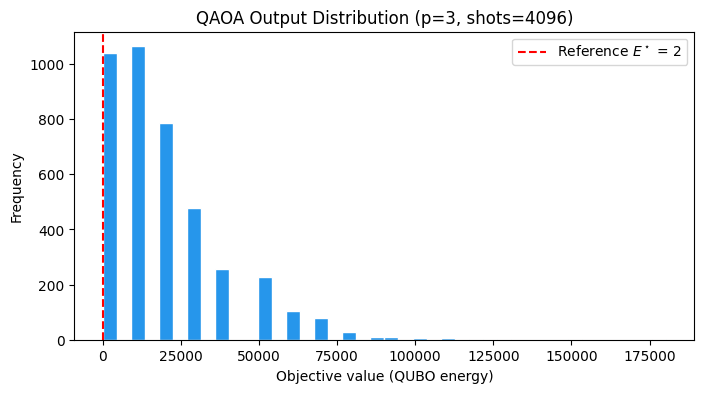
Classical baseline: SCIP via the OMMX adapter
SCIP is a branch-and-bound-based MILP/QUBO solver that can find the
exact optimal solution. The same ommx.v1.Instance
is consumed by
ommx_pyscipopt_adapter.OMMXPySCIPOptAdapter.solve, which hands the
problem to SCIP via PySCIPOpt and returns an ommx.v1.Solution
evaluated against the original instance. Its .objective is
therefore directly comparable to QAOA’s.
t0 = time.perf_counter()
scip_solution = ommx_pyscipopt_adapter.OMMXPySCIPOptAdapter.solve(instance)
scip_solve_time = time.perf_counter() - t0

scip_E = int(round(scip_solution.objective))
print(f"SCIP E(s):    {scip_E}")
print(f"SCIP feasible: {scip_solution.feasible}")
print(f"Wall time:    {scip_solve_time:.3f} s")
SCIP E(s): 2
SCIP feasible: True
Wall time: 0.177 s
Results comparison
SCIP returns a single optimum deterministically, while QAOA returns a distribution over bitstrings. We report QAOA’s best shot (the lowest-objective bitstring seen across all samples) and its hit rate on the reference optimum (the fraction of shots that achieved ).
# Hit rate: fraction of shots that achieved the reference optimum.
hit_rate = float((qaoa_summary["objective"].round().astype(int) == ref_E).mean())

print(f"{'Solver':<22} {'E(s)':>8} {'Time (s)':>12}")
print("-" * 46)
print(f"{'Reference (bundled)':<22} {ref_E:>8} {'-':>12}")
print(f"{'SCIP (classical)':<22} {scip_E:>8} {scip_solve_time:>12.3f}")
print(f"{'QAOA (best shot)':<22} {qaoa_best_E:>8} {qaoa_optimize_time:>12.2f}")
print()
print(f"QAOA hit rate on E* = {ref_E}: {hit_rate:.1%}  ({final_shots} shots)")
Solver E(s) Time (s)
----------------------------------------------
Reference (bundled) 2 -
SCIP (classical) 2 0.177
QAOA (best shot) 2 9.34
QAOA hit rate on E* = 2: 4.6% (4096 shots)
Two observations make this benchmark meaningful:
Optimum. Both SCIP and the best QAOA shot reach the reference optimum , so QAOA is capable of finding the optimal sequence at with only .
Concentration. QAOA’s value lies in concentrating sampling probability on low-energy bitstrings. The hit rate above, together with the left tail of the histogram, is the quantitative version of that statement.
Note that the wall-time figures are only indicative. SCIP’s timing is just the solver’s runtime on the CPU, while the QAOA timing covers the full classical-quantum optimization loop on a state-vector simulator; both depend on the execution environment. A genuinely fair comparison would therefore require a more careful methodology. Either way, combining Qamomile with datasets like OMMX Quantum Benchmarks makes it easy to compare quantum algorithms and classical solvers across a variety of metrics.
Summary
In this tutorial we:
Loaded a LABS instance straight from the OMMX Quantum Benchmarks dataset as an
ommx.v1.Instance.Extracted the QUBO with
Instance.to_qubo(), wrapped it in aBinaryModel, switched to the spin domain, and ran a hand-written QAOA ansatz (using@qkernel) against it throughQiskitTranspiler+AerSimulator.Compared the QAOA output (best shot, hit rate, sampling distribution) against SCIP via
ommx_pyscipopt_adapter.OMMXPySCIPOptAdapter.solveon the same instance, plus the reference optimum bundled with the benchmark.
The pattern generalizes: any other QOBLIB dataset
(Marketsplit, IndependentSet, Network, …) plugs into the same
pipeline: load with the corresponding dataset class, extract the
QUBO via Instance.to_qubo(), and reuse the same BinaryModel +
QAOA ansatz + transpile loop. Larger instances will
eventually outgrow local simulators, at which point the same
executable can be re-targeted to other Qamomile quantum SDK integrations
(QuriPartsTranspiler, CudaqTranspiler, …) or real hardware.