Tags: integration optimization variational
This page shows how to use Qamomile’s Qiskit quantum SDK integration through a concrete optimization problem.
Qiskit support is optional. Install the qiskit extra to use QiskitTranspiler and QiskitExecutor.
In this tutorial, we use QAOA optimization for a small MaxCut instance as an example. We transpile a Qamomile qkernel to a Qiskit circuit, then run sampling and expectation-value evaluation on a Qiskit simulator.
Along the way, we also look at advanced Qiskit features and IBM Quantum execution with the same QiskitExecutor API.
# Install the latest Qamomile through pip.
# Install the Qiskit engine and circuit-visualization dependencies used below.
# !pip install "qamomile[qiskit,visualization]"
import os
import matplotlib.pyplot as plt
import networkx as nx
import numpy as np
from qiskit_aer import AerSimulator
from qiskit_aer.noise import NoiseModel, depolarizing_error
from scipy.optimize import minimize
import qamomile.circuit as qmc
import qamomile.observable as qm_o
from qamomile.optimization.binary_model import BinaryModel
from qamomile.qiskit import QiskitTranspilerThe MaxCut problem
We use the same small 5-node graph from the QAOA for MaxCut tutorial so the focus stays on the Qiskit integration.
Maximizing is equivalent, up to a constant, to minimizing the antiferromagnetic Ising Hamiltonian .
For unweighted MaxCut, every and every , so we pass these coefficients directly to BinaryModel.from_ising.
# Build the MaxCut graph and convert it to an Ising BinaryModel.
G = nx.Graph()
G.add_edges_from([(0, 1), (0, 2), (1, 2), (1, 3), (2, 3), (3, 4)])
num_nodes = G.number_of_nodes()

ising_quad: dict[tuple[int, int], float] = {
    tuple(sorted((i, j))): 1.0 for i, j in G.edges()
}
ising_linear: dict[int, float] = {}
spin_model = BinaryModel.from_ising(linear=ising_linear, quad=ising_quad)
# The problem structure is fully determined by the graph: one quad term per edge
# and no linear terms for unweighted MaxCut.
assert len(spin_model.quad) == G.number_of_edges()
assert len(spin_model.linear) == 0

pos = nx.spring_layout(G, seed=42)
plt.figure(figsize=(5, 4))
nx.draw(
    G,
    pos,
    with_labels=True,
    node_color="white",
    node_size=700,
    edgecolors="black",
)
plt.title(f"MaxCut graph: {num_nodes} nodes, {G.number_of_edges()} edges")
plt.show()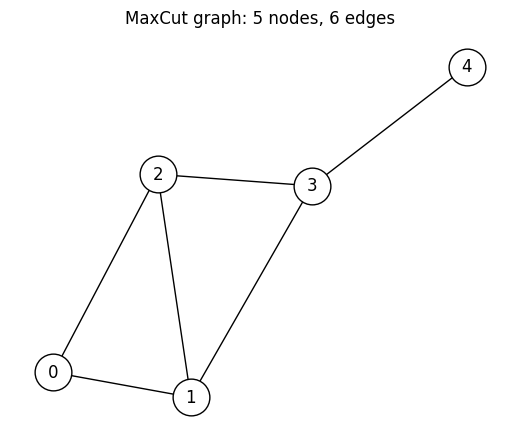
Building the QAOA ansatz with @qkernel
We write the QAOA quantum circuit for solving MaxCut as a @qkernel.
The recipe is the same as in the QAOA for MaxCut tutorial.
After preparing a uniform superposition in the computational basis, we alternately apply cost and mixer layers times, then measure in the computational basis.
The expectation-value qkernel is introduced later in the run() section so the circuit diagram below shows the sampling ansatz directly rather than a wrapper around a state-preparation helper.
# Prepare a uniform superposition over all graph nodes.
@qmc.qkernel
def superposition(n: qmc.UInt) -> qmc.Vector[qmc.Qubit]:
    q = qmc.qubit_array(n, name="q")
    for i in qmc.range(n):
        q[i] = qmc.h(q[i])
    return q


@qmc.qkernel
def cost_layer(
    quad: qmc.Dict[qmc.Tuple[qmc.UInt, qmc.UInt], qmc.Float],
    linear: qmc.Dict[qmc.UInt, qmc.Float],
    q: qmc.Vector[qmc.Qubit],
    gamma: qmc.Float,
) -> qmc.Vector[qmc.Qubit]:
    for (i, j), Jij in quad.items():
        q[i], q[j] = qmc.rzz(q[i], q[j], angle=Jij * gamma)
    for i, hi in linear.items():
        q[i] = qmc.rz(q[i], angle=hi * gamma)
    return q


@qmc.qkernel
def mixer_layer(
    q: qmc.Vector[qmc.Qubit],
    beta: qmc.Float,
) -> qmc.Vector[qmc.Qubit]:
    n = q.shape[0]
    for i in qmc.range(n):
        q[i] = qmc.rx(q[i], angle=2.0 * beta)
    return q


@qmc.qkernel
def qaoa_ansatz(
    p: qmc.UInt,
    quad: qmc.Dict[qmc.Tuple[qmc.UInt, qmc.UInt], qmc.Float],
    linear: qmc.Dict[qmc.UInt, qmc.Float],
    n: qmc.UInt,
    gammas: qmc.Vector[qmc.Float],
    betas: qmc.Vector[qmc.Float],
) -> qmc.Vector[qmc.Bit]:
    q = superposition(n)
    for layer in qmc.range(p):
        q = cost_layer(quad, linear, q, gammas[layer])
        q = mixer_layer(q, betas[layer])
    return qmc.measure(q)
qaoa_ansatz.draw(...) renders the Qamomile circuit diagram.
We pass values for the arguments that determine the problem structure (p, quad, linear, n) so the number of layers and graph structure are reflected in the diagram.
Meanwhile, gammas / betas are left as parameters whose values are supplied later.
docs_test_mode = os.environ.get("QAMOMILE_DOCS_TEST") == "1"
p = 1 if docs_test_mode else 3  # number of QAOA layers
qaoa_ansatz.draw(
    p=p,
    quad=spin_model.quad,
    linear=spin_model.linear,
    n=num_nodes,
)
Transpile to Qiskit
A quantum circuit defined as a Qamomile qkernel can be converted to a Qiskit QuantumCircuit with QiskitTranspiler.
You call QiskitTranspiler.transpile() the same way as with any other quantum SDK.
We bind the arguments that determine the problem structure and keep gammas / betas as runtime parameters.
For reproducible tutorial output, we specify an AerSimulator execution target with a fixed seed and max_parallel_threads=1.
SEED = 42


def make_seeded_backend() -> AerSimulator:
    return AerSimulator(seed_simulator=SEED, max_parallel_threads=1)


transpiler = QiskitTranspiler()

executable = transpiler.transpile(
    qaoa_ansatz,
    bindings={
        "p": p,
        "quad": spin_model.quad,
        "linear": spin_model.linear,
        "n": num_nodes,
    },
    parameters=["gammas", "betas"],
)
executable.get_first_circuit() returns the generated Qiskit QuantumCircuit.
The QAOA angles (gammas[0..p-1], betas[0..p-1]) remain as Qiskit Parameter objects until execution time.
Here we inspect the circuit transpiled into a Qiskit QuantumCircuit with Qiskit’s text drawer.
# Inspect the generated circuit and verify that the parameters are still unbound.
qiskit_circuit = executable.get_first_circuit()
assert qiskit_circuit is not None
# QAOA uses one qubit and one final classical bit per graph node.
# The runtime parameters are one gamma and one beta per layer.
assert qiskit_circuit.num_qubits == num_nodes
assert qiskit_circuit.num_clbits == num_nodes
assert qiskit_circuit.num_parameters == 2 * p
assert set(executable.parameter_names) == {
    *(f"gammas[{i}]" for i in range(p)),
    *(f"betas[{i}]" for i in range(p)),
}
print(type(qiskit_circuit).__name__)
print("num_qubits    :", qiskit_circuit.num_qubits)
print("num_clbits    :", qiskit_circuit.num_clbits)
print("num_parameters:", qiskit_circuit.num_parameters)
print("parameters    :", sorted(str(param) for param in qiskit_circuit.parameters))

print(qiskit_circuit.draw(output="text", fold=120))
QuantumCircuit
num_qubits : 5
num_clbits : 5
num_parameters: 6
parameters : ['betas[0]', 'betas[1]', 'betas[2]', 'gammas[0]', 'gammas[1]', 'gammas[2]']
┌───┐ ┌────────────────┐ »
q_0: ┤ H ├─■───────────────■──────────────┤ Rx(2*betas[0]) ├────────────────────────────────────■───────────────»
├───┤ │ZZ(gammas[0]) │ └────────────────┘ ┌────────────────┐ │ZZ(gammas[1]) »
q_1: ┤ H ├─■───────────────┼────────────────■────────────────■──────────────┤ Rx(2*betas[0]) ├──■───────────────»
├───┤ │ZZ(gammas[0]) │ZZ(gammas[0]) │ └────────────────┘┌────────────────┐»
q_2: ┤ H ├─────────────────■────────────────■────────────────┼────────────────■───────────────┤ Rx(2*betas[0]) ├»
├───┤ │ZZ(gammas[0]) │ZZ(gammas[0]) └────────────────┘»
q_3: ┤ H ├───────────────────────────────────────────────────■────────────────■─────────────────■───────────────»
├───┤ │ZZ(gammas[0]) »
q_4: ┤ H ├──────────────────────────────────────────────────────────────────────────────────────■───────────────»
└───┘ »
c: 5/═══════════════════════════════════════════════════════════════════════════════════════════════════════════»
»
« ┌────────────────┐ »
«q_0: ──■───────────────┤ Rx(2*betas[1]) ├────────────────────────────────────■─────────────────■───────────────»
« │ └────────────────┘ ┌────────────────┐ │ZZ(gammas[2]) │ »
«q_1: ──┼─────────────────■────────────────■──────────────┤ Rx(2*betas[1]) ├──■─────────────────┼───────────────»
« │ZZ(gammas[1]) │ZZ(gammas[1]) │ └────────────────┘┌────────────────┐ │ZZ(gammas[2]) »
«q_2: ──■─────────────────■────────────────┼────────────────■───────────────┤ Rx(2*betas[1]) ├──■───────────────»
« ┌────────────────┐ │ZZ(gammas[1]) │ZZ(gammas[1]) └────────────────┘┌────────────────┐»
«q_3: ┤ Rx(2*betas[0]) ├───────────────────■────────────────■─────────────────■───────────────┤ Rx(2*betas[1]) ├»
« ├────────────────┤ │ZZ(gammas[1]) ├────────────────┤»
«q_4: ┤ Rx(2*betas[0]) ├──────────────────────────────────────────────────────■───────────────┤ Rx(2*betas[1]) ├»
« └────────────────┘ └────────────────┘»
«c: 5/══════════════════════════════════════════════════════════════════════════════════════════════════════════»
« »
« ┌────────────────┐ ┌─┐
«q_0: ┤ Rx(2*betas[2]) ├────────────────┤M├──────────────────────────────────────────────────────────────────
« └────────────────┘ └╥┘┌────────────────┐ ┌─┐
«q_1: ──■────────────────■───────────────╫─┤ Rx(2*betas[2]) ├──────────────────┤M├───────────────────────────
« │ZZ(gammas[2]) │ ║ └────────────────┘┌────────────────┐└╥┘ ┌─┐
«q_2: ──■────────────────┼───────────────╫───■───────────────┤ Rx(2*betas[2]) ├─╫───────────────────┤M├──────
« │ZZ(gammas[2]) ║ │ZZ(gammas[2]) └────────────────┘ ║ ┌────────────────┐└╥┘┌─┐
«q_3: ───────────────────■───────────────╫───■─────────────────■────────────────╫─┤ Rx(2*betas[2]) ├─╫─┤M├───
« ║ │ZZ(gammas[2]) ║ ├────────────────┤ ║ └╥┘┌─┐
«q_4: ───────────────────────────────────╫─────────────────────■────────────────╫─┤ Rx(2*betas[2]) ├─╫──╫─┤M├
« ║ ║ └────────────────┘ ║ ║ └╥┘
«c: 5/═══════════════════════════════════╩══════════════════════════════════════╩════════════════════╩══╩══╩═
« 0 1 2 3 4
Each runtime parameter remains unbound until execution time.
Binding gammas / betas is handled by ExecutableProgram.sample(...) and ExecutableProgram.run(...) through Qiskit’s assign_parameters, so the Qiskit circuit can be created once and reused across many parameter vectors.
The problem structure, such as the Ising coefficients, qubit count, and number of layers, is fixed when the circuit is transpiled, leaving only the variational angles as runtime inputs.
Sampling QAOA with QiskitExecutor
executable.sample(executor, bindings=..., shots=...) returns a SampleJob.
Calling .result() gives a SampleResult, which BinaryModel.decode_from_sampleresult decodes into a BinarySampleSet of spin variables .
This lets us count cut edges without any additional conversion.
QiskitExecutor() runs against AerSimulator by default when qiskit-aer is installed; here we use the seeded simulator from above.
rng = np.random.default_rng(SEED)
init_params = rng.uniform(-np.pi / 2, np.pi / 2, 2 * p)
init_gammas = list(init_params[:p])
init_betas = list(init_params[p:])
sample_shots = 1 if docs_test_mode else 2000
maxiter = 4 if docs_test_mode else 100

# Sample the parameterized executable and decode bitstrings to Ising energies.
executor = transpiler.executor(backend=make_seeded_backend())
sample_result = executable.sample(
    executor,
    bindings={"gammas": init_gammas, "betas": init_betas},
    shots=sample_shots,
).result()

decoded = spin_model.decode_from_sampleresult(sample_result)
print(f"Mean energy at random init: {decoded.energy_mean():+.4f}")
assert sample_result.shots == sample_shots
Mean energy at random init: -0.6840
Optimizing the QAOA parameters
A QAOA optimization loop reuses the same executable across many (gammas, betas) vectors.
Call transpiler.transpile() once, then call executable.sample() many times.
In this example, we define the sampling and decoding work as cost_fn() and optimize it with SciPy’s minimize function.
The classical optimization routine updates (gammas, betas) while lowering the mean sampled Ising energy.
Each iteration reuses the same executable and QiskitExecutor.
# Reuse one executable inside the classical objective function.
cost_history: list[float] = []


def cost_fn(params: np.ndarray) -> float:
    result = executable.sample(
        executor,
        bindings={"gammas": list(params[:p]), "betas": list(params[p:])},
        shots=sample_shots,
    ).result()
    energy = spin_model.decode_from_sampleresult(result).energy_mean()
    cost_history.append(energy)
    return energy


# Optimize the sampled mean energy with COBYLA.
res = minimize(cost_fn, init_params, method="COBYLA", options={"maxiter": maxiter})

opt_gammas = list(res.x[:p])
opt_betas = list(res.x[p:])
print(f"Optimized mean energy: {res.fun:+.4f}")
print(f"Optimal gammas       : {[round(float(v), 4) for v in opt_gammas]}")
print(f"Optimal betas        : {[round(float(v), 4) for v in opt_betas]}")
assert cost_history
Optimized mean energy: -2.8810
Optimal gammas : [0.8678, -0.4364, 1.562]
Optimal betas : [0.4086, -0.8709, 2.9557]
# Plot how the objective value changes during optimization.
plt.figure(figsize=(8, 4))
plt.plot(cost_history, color="#2696EB")
plt.xlabel("Iteration")
plt.ylabel("Cost (mean Ising energy)")
plt.title("QAOA optimization on Aer via `QiskitExecutor`")
plt.tight_layout()
plt.show()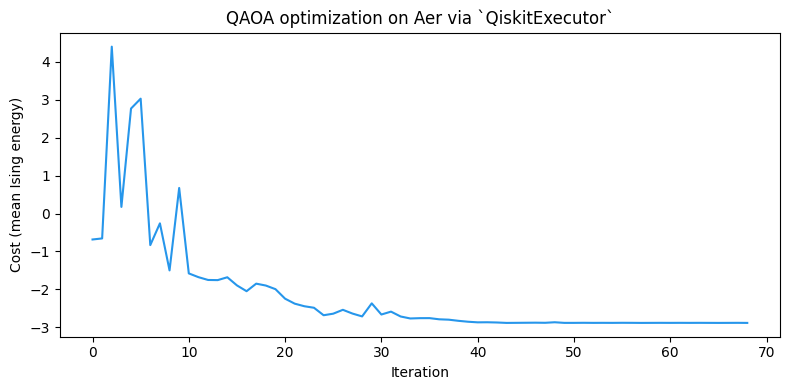
Because the AerSimulator above was constructed with a fixed seed_simulator, re-running this page yields a reproducible sampling stream for the same sequence of circuits.
The optimizer should converge close to the ground-state energy of on this 5-node graph.
The optimized parameters from this run (opt_gammas, opt_betas) are reused throughout the rest of this page.
Expectation values with run()
In Qamomile, you write expectation values in a qkernel with qmc.expval(...).
When this is transpiled to Qiskit, it becomes an executable object that can be called with ExecutableProgram.run(executor, bindings=...).
run() uses Qamomile’s recorded parameter information to bind runtime parameters before calling Qiskit’s estimator.
First build a Qamomile Hamiltonian for .
Then transpile the expectation-value qkernel and evaluate it at the optimized QAOA parameters.
# Build the Qamomile Hamiltonian that matches the MaxCut Ising cost.
cost_hamiltonian = qm_o.Hamiltonian()
for (i, j), Jij in spin_model.quad.items():
    cost_hamiltonian.add_term(
        (qm_o.PauliOperator(qm_o.Pauli.Z, i), qm_o.PauliOperator(qm_o.Pauli.Z, j)),
        Jij,
    )
for i, hi in spin_model.linear.items():
    cost_hamiltonian.add_term((qm_o.PauliOperator(qm_o.Pauli.Z, i),), hi)

# Define the expectation-value qkernel.
@qmc.qkernel
def qaoa_expval(
    p: qmc.UInt,
    quad: qmc.Dict[qmc.Tuple[qmc.UInt, qmc.UInt], qmc.Float],
    linear: qmc.Dict[qmc.UInt, qmc.Float],
    n: qmc.UInt,
    gammas: qmc.Vector[qmc.Float],
    betas: qmc.Vector[qmc.Float],
    obs: qmc.Observable,
) -> qmc.Float:
    q = superposition(n)
    for layer in qmc.range(p):
        q = cost_layer(quad, linear, q, gammas[layer])
        q = mixer_layer(q, betas[layer])
    return qmc.expval(q, obs)


# Transpile the expectation-value qkernel and evaluate it with `run()`.
expval_executable = transpiler.transpile(
    qaoa_expval,
    bindings={
        "p": p,
        "quad": spin_model.quad,
        "linear": spin_model.linear,
        "n": num_nodes,
        "obs": cost_hamiltonian,
    },
    parameters=["gammas", "betas"],
)
energy_via_run = expval_executable.run(
    executor,
    bindings={"gammas": opt_gammas, "betas": opt_betas},
).result()

print(f"Executable.run() expectation: {energy_via_run:+.10f}")
print(f"sample mean energy          : {res.fun:+.4f}")
assert np.isfinite(energy_via_run)
Executable.run() expectation: -2.8538574303
sample mean energy : -2.8810
ExecutableProgram.run(...) is the recommended route when you work through the Qamomile API.
Direct executor.estimate(...) calls are still available when you intentionally manage Qiskit circuits yourself, but then you are responsible for Qiskit’s parameter ordering and whether the circuit has already been bound.
For local execution, QiskitExecutor creates Qiskit’s StatevectorEstimator by default when it is available, so current Qiskit installs use the V2 primitive interface.
If a custom estimator, or an older Qiskit / Aer estimator, does not accept the V2 run([(circuit, observable, params)]) call, Qamomile falls back to the V1 run(circuits, observables, parameter_values) form.
Advanced Qiskit features
Qiskit is available through Qamomile’s optional Qiskit integration. Qamomile provides several ways to use advanced Qiskit features.
This section shows three features exposed by the Qiskit integration that are useful when running generated circuits on Qiskit execution targets:
native classical control flow (
for_loop,if_else,while_loop) for dynamic circuits,direct translation of parametric time evolution
qmc.pauli_evolve(...)as a nativePauliEvolutionGate,native
QFTGate/ inverseQFTGatefor Qamomile’s composite QFT operations.
Classical control flow and runtime classical expressions
For Qamomile programs that use classical control flow and runtime classical expressions, the Qiskit integration can translate them directly into Qiskit’s dynamic-circuit instructions and classical expressions.
qmc.range(...) loops become Qiskit for_loop.
Measurement-backed if / else and while become Qiskit dynamic-circuit instructions.
Compound predicates such as a & b can be converted directly into Qiskit classical expressions through qiskit.circuit.classical.expr.
# Define three small kernels that use native control-flow features.

# `qmc.range` for-loops become Qiskit `for_loop`.
@qmc.qkernel
def native_for_demo(reps: qmc.UInt) -> qmc.Bit:
    q = qmc.qubit("q")
    for _ in qmc.range(reps):
        q = qmc.h(q)
    return qmc.measure(q)


# Measurement-backed if branches become Qiskit `if_else`.
@qmc.qkernel
def runtime_branch_demo() -> qmc.Bit:
    a = qmc.qubit("a")
    b = qmc.qubit("b")
    target = qmc.qubit("target")

    a = qmc.x(a)
    b = qmc.x(b)
    ma = qmc.measure(a)
    mb = qmc.measure(b)

    if ma & mb:
        target = qmc.x(target)
    else:
        target = qmc.h(target)

    return qmc.measure(target)


# Measurement-backed while loops become Qiskit `while_loop`.
@qmc.qkernel
def repeat_until_zero_once() -> qmc.Bit:
    q0 = qmc.qubit("q0")
    q0 = qmc.x(q0)
    bit = qmc.measure(q0)
    while bit:
        q1 = qmc.qubit("q1")
        bit = qmc.measure(q1)
    return bit


# Transpile each demo and inspect the Qiskit operation names.
for_circuit = transpiler.to_circuit(native_for_demo, bindings={"reps": 3})
branch_circuit = transpiler.to_circuit(runtime_branch_demo)
while_circuit = transpiler.to_circuit(repeat_until_zero_once)

for_ops = [inst.operation.name for inst in for_circuit.data]
branch_ops = [inst.operation.name for inst in branch_circuit.data]
while_ops = [inst.operation.name for inst in while_circuit.data]

print("native_for_demo ops       :", for_ops)
print("runtime_branch_demo ops   :", branch_ops)
print("repeat_until_zero_once ops:", while_ops)
assert "for_loop" in for_ops
assert "if_else" in branch_ops
assert "while_loop" in while_ops

if_op = next(inst.operation for inst in branch_circuit.data if inst.operation.name == "if_else")
print("if_else condition:", if_op.condition)
native_for_demo ops : ['for_loop', 'measure']
runtime_branch_demo ops : ['x', 'x', 'measure', 'measure', 'if_else', 'measure']
repeat_until_zero_once ops: ['x', 'measure', 'while_loop']
if_else condition: Binary(Binary.<Op.LOGIC_AND: 4>, Var(<Clbit register=(3, "c"), index=0>, Bool()), Var(<Clbit register=(3, "c"), index=1>, Bool()), Bool())
Qiskit’s classical expression system currently covers the logical, comparison, and arithmetic operations that Qamomile uses in dynamic conditions.
However, FLOORDIV and POW do not have matching Qiskit classical expressions, so target-legality verification raises TargetCapabilityError before Qiskit circuit construction if either one remains in a runtime condition.
If you need those operations, make sure their values are fixed before transpilation.
Native PauliEvolutionGate
qmc.pauli_evolve(q, H, gamma) represents the time evolution .
The Qiskit integration writes that operation as a PauliEvolutionGate when use_native_pauli_evolution=True (the default).
An unbound gamma becomes a Qiskit Parameter, so the same circuit can be reused while trying different variational parameters.
# Generate a Pauli evolution qkernel and check that Qiskit keeps it as one native operation.
@qmc.qkernel
def pauli_evolve_demo(
    n: qmc.UInt,
    H: qmc.Observable,
    gamma: qmc.Float,
) -> qmc.Vector[qmc.Bit]:
    # Prepare a simple input state before applying the Hamiltonian evolution.
    q = qmc.qubit_array(n, "q")
    for i in qmc.range(n):
        q[i] = qmc.h(q[i])
    q = qmc.pauli_evolve(q, H, gamma)
    return qmc.measure(q)


# Keep the Hamiltonian small so the generated operation is easy to inspect.
evolution_hamiltonian = qm_o.Z(0) * qm_o.Z(1) + 0.5 * qm_o.X(0)
evolution_executable = transpiler.transpile(
    pauli_evolve_demo,
    bindings={"n": evolution_hamiltonian.num_qubits, "H": evolution_hamiltonian},
    parameters=["gamma"],
)
evolution_circuit = evolution_executable.get_first_circuit()
assert evolution_circuit is not None
evolution_ops = [inst.operation.name for inst in evolution_circuit.data]
print(evolution_ops)
assert "PauliEvolution" in evolution_ops
assert {str(param) for param in evolution_circuit.parameters} == {"gamma"}
['h', 'h', 'PauliEvolution', 'measure', 'measure']
Pass QiskitTranspiler(use_native_pauli_evolution=False) when you want a gate-by-gate decomposition instead.
This flag controls only Pauli evolution. Native QFT/IQFT output is controlled independently by use_native_composite.
Native QFTGate
Qamomile provides high-level operations for QFT and inverse QFT through qmc.qft(...) / qmc.iqft(...).
The Qiskit integration can translate these qkernels directly to Qiskit’s native QFTGate, without decomposing them into elementary quantum gates.
With use_native_composite=False, Qamomile keeps a named Qiskit gate backed by the portable fallback body. Call Qiskit’s decompose() when you need to inspect its H/controlled-phase/SWAP implementation.
# Compare Qiskit's native QFT gate with a decomposed circuit.
@qmc.qkernel
def qft_demo(n: qmc.UInt) -> qmc.Vector[qmc.Bit]:
    q = qmc.qubit_array(n, "q")
    q = qmc.qft(q)
    return qmc.measure(q)


qft_native = QiskitTranspiler(use_native_composite=True).to_circuit(
    qft_demo,
    bindings={"n": 3},
)
qft_decomposed = QiskitTranspiler(use_native_composite=False).to_circuit(
    qft_demo,
    bindings={"n": 3},
)
native_ops = [inst.operation.name for inst in qft_native.data]
decomposed_ops = [
    inst.operation.name for inst in qft_decomposed.decompose(reps=1).data
]
print("native QFT ops    :", native_ops)
print("decomposed QFT ops:", decomposed_ops)
assert any("qft" in name.lower() for name in native_ops)
assert "cp" in decomposed_ops
assert len(qft_native.data) < len(decomposed_ops)
native QFT ops : ['qft', 'measure', 'measure', 'measure']
decomposed QFT ops: ['h', 'cp', 'h', 'cp', 'cp', 'h', 'swap', 'measure', 'measure', 'measure']
Using other Qiskit execution targets
QiskitExecutor keeps the generated circuit separate from the Qiskit execution target that runs it.
By passing an execution target with transpiler.executor(backend=...), you can run the same circuit on various Qiskit execution targets.
For example, you can use a noiseless local simulator, an Aer noise model, or IBM Quantum hardware through the same QiskitExecutor as shown below.
Here, we build an Aer noise model with depolarizing noise and pass it to AerSimulator.
We compare the clean and noisy sample-mean energies at the same optimized parameters.
# Build an Aer noise model with depolarizing noise on one- and two-qubit gates.
noise_model = NoiseModel()
one_qubit_error = depolarizing_error(0.01, 1)
two_qubit_error = depolarizing_error(0.02, 2)
noise_model.add_all_qubit_quantum_error(one_qubit_error, ["h", "rx", "rz"])
noise_model.add_all_qubit_quantum_error(two_qubit_error, ["rzz"])

noisy_backend = AerSimulator(
    noise_model=noise_model,
    seed_simulator=SEED,
    max_parallel_threads=1,
)
noisy_executor = transpiler.executor(backend=noisy_backend)

# Run the same executable on clean and noisy execution targets.
clean_result = executable.sample(
    executor,
    bindings={"gammas": opt_gammas, "betas": opt_betas},
    shots=sample_shots,
).result()
noisy_result = executable.sample(
    noisy_executor,
    bindings={"gammas": opt_gammas, "betas": opt_betas},
    shots=sample_shots,
).result()

# Decode both sample sets to compare their mean Ising energies.
clean_energy = spin_model.decode_from_sampleresult(clean_result).energy_mean()
noisy_energy = spin_model.decode_from_sampleresult(noisy_result).energy_mean()
print(f"noiseless Aer mean energy: {clean_energy:+.4f}")
print(f"noisy Aer mean energy: {noisy_energy:+.4f}")
assert clean_result.shots == sample_shots
assert noisy_result.shots == sample_shots
assert np.isfinite(clean_energy)
assert np.isfinite(noisy_energy)
noiseless Aer mean energy: -2.8810
noisy Aer mean energy: -2.1370
Running on IBM Quantum hardware
Install Qiskit support with pip install "qamomile[qiskit]"; this extra includes Qiskit IBM Runtime for hardware execution. Then pass a device name, IBM Quantum API key, and instance CRN to transpiler.executor(...).
It returns the same QiskitExecutor used for local simulation. With no arguments it uses local Aer; with an IBM device name it authenticates through Qiskit IBM Runtime and selects that backend for executable.sample() and executable.run().
The following examples submit remote jobs when run manually; they are not executed as part of this notebook.
import os

from qamomile.qiskit import QiskitExecutionOptions

hardware_options = QiskitExecutionOptions(
    max_execution_time=300,
    resilience_level=1,
)
hardware_executor = transpiler.executor(
    backend="your_backend_name",
    api_key=os.environ["IBM_QUANTUM_API_KEY"],
    instance_crn=os.environ["IBM_QUANTUM_INSTANCE_CRN"],
    options=hardware_options,
)
runtime_bindings = {"gammas": opt_gammas, "betas": opt_betas}

hardware_job = executable.sample(
    hardware_executor,
    bindings=runtime_bindings,
    shots=1024,
)
print(hardware_job.status())
snapshot_data = hardware_job.snapshot().to_dict()
hardware_result = hardware_job.result()
Set the two environment variables to your API key and instance CRN before running this example. You can also construct QiskitExecutor(backend=..., api_key=..., instance_crn=..., options=hardware_options) directly with the same arguments.
QiskitExecutionOptions configures Runtime through Qamomile, without importing SDK option classes. max_execution_time limits quantum execution time in seconds for both sampling and estimation; queue wait time and the local .result(timeout=...) wait are separate. resilience_level (0, 1, or 2) applies to expectation estimation. These settings require a Runtime target.
Qamomile passes the credentials to QiskitRuntimeService using the ibm_quantum_platform channel and requests the named backend within that instance. If that account and instance cannot access the backend, Qiskit’s error is raised while constructing the executor; execution does not switch to another device or a simulator.
Both api_key and instance_crn must be nonempty strings supplied together with a backend name; incomplete credentials raise ValueError. The executor does not save the credentials to disk.
If you already configured a saved account with Qiskit IBM Runtime, omit both credentials and use transpiler.executor(backend="your_backend_name").
With an IBM backend, QiskitExecutor binds the runtime parameters and transpiles the circuit to the selected backend’s instruction set before submission to Runtime V2 primitives.
For expectation values, it also maps the observable to the transpiled circuit’s physical qubit layout, so changing the hardware layout preserves the intended observable.
Sampling and expectation jobs expose status(), cancel(), and snapshot() while .result() waits for the result.
Store snapshot_data as JSON to reconnect later. Recreate the same executable and an executor for the original backend, then restore the typed result with the original runtime bindings:
from qamomile.circuit.transpiler.job import JobSnapshot

restored_job = executable.restore(
    hardware_executor,
    JobSnapshot.from_dict(snapshot_data),
    bindings=runtime_bindings,
)
restored_result = restored_job.result()
Snapshots contain provider job identifiers, completed local values, and result metadata; credentials and runtime bindings remain caller-owned.
Deterministic local results, such as constant observables and empty circuits, can be saved and restored, including in groups that also contain remote jobs.
Restoring provider references uses the Runtime service created when the executor authenticates. If you already manage a QiskitRuntimeService, pass service=service with the backend name instead of api_key and instance_crn, or pass its IBMBackend object as backend.
The expectation executable from above also works with Runtime. Use TargetPrecision to request an absolute target precision for one evaluation:
from qamomile.circuit.transpiler.execution_request import TargetPrecision

energy_job = expval_executable.run(
    hardware_executor,
    bindings=runtime_bindings,
    estimation=TargetPrecision(0.05),
)
hardware_energy = energy_job.result()
Sampling shots and estimation TargetPrecision are still specified per execution call. Omitting TargetPrecision uses the Runtime estimator’s configured defaults.
For additional Runtime settings, pass dictionaries as sampler_options and estimator_options when constructing QiskitExecutionOptions. You can also pass native options directly through the executor’s sampler_options=... and estimator_options=... arguments, but these cannot be combined with options=.... Supply a backend-specific pass_manager=... to control hardware transpilation.
To use an existing Runtime Session or Batch, pass it as mode=... with its preconfigured backend object as backend=...; a backend name cannot be combined with mode. The caller manages its context and lifetime; the executor does not create or close it.
Summary
QiskitTranspiler().transpile(kernel, bindings=..., parameters=[...])converts the qkernel to anExecutableProgram[QuantumCircuit];to_circuit(...)returns the QiskitQuantumCircuitdirectly when you want to stay inside the Qiskit ecosystem.QiskitExecutorsupports bothexecutable.sample()for measured qkernels andexecutable.run()/executor.estimate(...)for expectation values, usingAerSimulatorby default. Pass an IBM backend name withapi_keyandinstance_crn, or an existingIBMBackend, to use Runtime V2 with the same API.The Qiskit integration uses native mid-circuit measurement, dynamic
for_loop/if_else/while_loop, runtime classical expressions,PauliEvolutionGate, andQFTGatewhere Qiskit provides a high-level representation.Switching from Aer to IBM Quantum reuses the Qamomile executable;
QiskitExecutorhandles hardware transpilation, observable layout, and asynchronous job restoration.
See also
CUDA-Q Support covers the same MaxCut QAOA workflow with CUDA-Q, including CUDA-Q targets and
observe.QURI Parts Support covers the same workflow on QURI Parts, including Qulacs sampling and QURI Parts estimator paths.