Tags: integration optimization variational
This page shows how to use Qamomile’s CUDA-Q quantum SDK integration through a concrete optimization problem.
In this tutorial, we use QAOA optimization for a small MaxCut instance as an example. We transpile a Qamomile qkernel to CUDA-Q, then run sampling and expectation-value evaluation.
Later, we run the same QAOA circuit on CPU and GPU simulators and compare the sampled results and execution time.
Along the way, we inspect the generated CUDA-Q source and compare Qamomile’s STATIC and RUNNABLE CUDA-Q execution modes.
# Install Qamomile with the CUDA-Q extras through pip.
# Choose the optional dependency group that matches your CUDA-Q environment.
# !pip install "qamomile[cudaq-cu12,visualization]"  # CUDA 12.x, Linux
# !pip install "qamomile[cudaq-cu13,visualization]" # CUDA 13.x, Linux or macOS ARM64import os
import platform
import subprocess
import time
from collections import Counter
import cudaq
import matplotlib.pyplot as plt
import networkx as nx
import numpy as np
from scipy.optimize import minimize
import qamomile.circuit as qmc
import qamomile.observable as qm_o
from qamomile.cudaq import CudaqExecutor, CudaqTranspiler, ExecutionMode
from qamomile.optimization.binary_model import BinaryModelThe MaxCut problem
We use the same small 5-node graph from the QAOA for MaxCut tutorial so the focus stays on the CUDA-Q integration.
Maximizing is equivalent, up to a constant, to minimizing the antiferromagnetic Ising Hamiltonian .
For unweighted MaxCut, every and every , so we pass these coefficients directly to BinaryModel.from_ising.
We use the model object for the quad / linear dictionaries passed to the QAOA qkernel and for decoding measurements back into spin values .
G = nx.Graph()
G.add_edges_from([(0, 1), (0, 2), (1, 2), (1, 3), (2, 3), (3, 4)])
num_nodes = G.number_of_nodes()

ising_quad: dict[tuple[int, int], float] = {
    tuple(sorted((i, j))): 1.0 for i, j in G.edges()
}
ising_linear: dict[int, float] = {}
spin_model = BinaryModel.from_ising(linear=ising_linear, quad=ising_quad)
# The problem structure is fully determined by the graph: one quad term per edge
# and no linear terms for unweighted MaxCut. Assert so a regression in
# `BinaryModel.from_ising` is caught when this notebook runs in CI.
assert len(spin_model.quad) == G.number_of_edges()
assert len(spin_model.linear) == 0

pos = nx.spring_layout(G, seed=42)
plt.figure(figsize=(5, 4))
nx.draw(
    G,
    pos,
    with_labels=True,
    node_color="white",
    node_size=700,
    edgecolors="black",
)
plt.title(f"MaxCut graph: {num_nodes} nodes, {G.number_of_edges()} edges")
plt.show()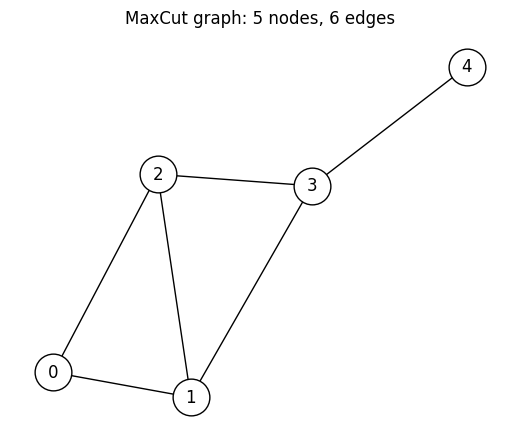
Building the QAOA ansatz with @qkernel
We write the sampling QAOA ansatz as reusable qkernels. The recipe is the same as in the QAOA for MaxCut tutorial. After preparing a uniform superposition in the computational basis, we alternately apply cost and mixer layers times, then measure in the computational basis.
@qmc.qkernel
def superposition(n: qmc.UInt) -> qmc.Vector[qmc.Qubit]:
    q = qmc.qubit_array(n, name="q")
    for i in qmc.range(n):
        q[i] = qmc.h(q[i])
    return q


@qmc.qkernel
def cost_layer(
    quad: qmc.Dict[qmc.Tuple[qmc.UInt, qmc.UInt], qmc.Float],
    linear: qmc.Dict[qmc.UInt, qmc.Float],
    q: qmc.Vector[qmc.Qubit],
    gamma: qmc.Float,
) -> qmc.Vector[qmc.Qubit]:
    for (i, j), Jij in quad.items():
        q[i], q[j] = qmc.rzz(q[i], q[j], angle=Jij * gamma)
    for i, hi in linear.items():
        q[i] = qmc.rz(q[i], angle=hi * gamma)
    return q


@qmc.qkernel
def mixer_layer(
    q: qmc.Vector[qmc.Qubit],
    beta: qmc.Float,
) -> qmc.Vector[qmc.Qubit]:
    n = q.shape[0]
    for i in qmc.range(n):
        q[i] = qmc.rx(q[i], angle=2.0 * beta)
    return q


@qmc.qkernel
def qaoa_ansatz(
    p: qmc.UInt,
    quad: qmc.Dict[qmc.Tuple[qmc.UInt, qmc.UInt], qmc.Float],
    linear: qmc.Dict[qmc.UInt, qmc.Float],
    n: qmc.UInt,
    gammas: qmc.Vector[qmc.Float],
    betas: qmc.Vector[qmc.Float],
) -> qmc.Vector[qmc.Bit]:
    q = superposition(n)
    for layer in qmc.range(p):
        q = cost_layer(quad, linear, q, gammas[layer])
        q = mixer_layer(q, betas[layer])
    return qmc.measure(q)
qaoa_ansatz.draw(...) renders the Qamomile circuit diagram.
We pass concrete values for the arguments that determine the problem structure (p, quad, linear, n) so the layered shape is visible.
Meanwhile, gammas / betas are left as parameters whose values are supplied later.
docs_test_mode = os.environ.get("QAMOMILE_DOCS_TEST") == "1"
p = 1 if docs_test_mode else 3  # number of QAOA layers
qaoa_ansatz.draw(
    p=p,
    quad=spin_model.quad,
    linear=spin_model.linear,
    n=num_nodes,
)
Transpile to CUDA-Q
CudaqTranspiler is used with transpile() the same way as any other quantum SDK.
We bind the arguments that determine the problem structure and keep gammas / betas as runtime parameters.
transpiler = CudaqTranspiler()
executor = CudaqExecutor()

executable = transpiler.transpile(
    qaoa_ansatz,
    bindings={
        "p": p,
        "quad": spin_model.quad,
        "linear": spin_model.linear,
        "n": num_nodes,
    },
    parameters=["gammas", "betas"],
)
executable.get_first_circuit() returns Qamomile’s generated CUDA-Q artifact, CudaqKernelArtifact.
This is a Qamomile-side wrapper for the generated @cudaq.kernel function, not a type from the upstream cudaq Python package.
The artifact keeps an inspectable Python source string for the generated CUDA-Q kernel. The QAOA angles (gammas[0..p-1], betas[0..p-1]) remain available as named runtime parameters.
We can confirm that with type(...), the qubit count, and the parameter count, then inspect the generated source.
This source string is useful when you want to see exactly what Qamomile handed to CUDA-Q, including gate decompositions such as the rzz layer below.
cudaq_artifact = executable.get_first_circuit()
assert cudaq_artifact is not None  # transpile() always emits one quantum segment here
# `num_qubits` and `param_count` are fully determined by the problem setting:
# one qubit per graph node, and one runtime parameter per (gamma | beta) per layer.
assert cudaq_artifact.num_qubits == num_nodes
assert cudaq_artifact.param_count == 2 * p
assert cudaq_artifact.execution_mode == ExecutionMode.STATIC
assert len(executable.parameter_names) == 2 * p
print(type(cudaq_artifact).__name__)
print("execution_mode :", cudaq_artifact.execution_mode.value)
print("num_qubits     :", cudaq_artifact.num_qubits)
print("param_count    :", cudaq_artifact.param_count)
print("parameter_names:", executable.parameter_names)

assert "@cudaq.kernel" in cudaq_artifact.source
assert "x.ctrl" in cudaq_artifact.source
assert "rz(" in cudaq_artifact.source
print(cudaq_artifact.source)
CudaqKernelArtifact
execution_mode : static
num_qubits : 5
param_count : 6
parameter_names: ['gammas[0]', 'gammas[1]', 'gammas[2]', 'betas[0]', 'betas[1]', 'betas[2]']
@cudaq.kernel
def _qamomile_kernel(thetas: list[float]):
q = cudaq.qvector(5)
__b0 = False
__b1 = False
__b2 = False
__b3 = False
__b4 = False
h(q[0])
h(q[1])
h(q[2])
h(q[3])
h(q[4])
x.ctrl(q[0], q[1])
rz((1.0) * (thetas[0]), q[1])
x.ctrl(q[0], q[1])
x.ctrl(q[0], q[2])
rz((1.0) * (thetas[0]), q[2])
x.ctrl(q[0], q[2])
x.ctrl(q[1], q[2])
rz((1.0) * (thetas[0]), q[2])
x.ctrl(q[1], q[2])
x.ctrl(q[1], q[3])
rz((1.0) * (thetas[0]), q[3])
x.ctrl(q[1], q[3])
x.ctrl(q[2], q[3])
rz((1.0) * (thetas[0]), q[3])
x.ctrl(q[2], q[3])
x.ctrl(q[3], q[4])
rz((1.0) * (thetas[0]), q[4])
x.ctrl(q[3], q[4])
rx((thetas[3]) * (2.0), q[0])
rx((thetas[3]) * (2.0), q[1])
rx((thetas[3]) * (2.0), q[2])
rx((thetas[3]) * (2.0), q[3])
rx((thetas[3]) * (2.0), q[4])
x.ctrl(q[0], q[1])
rz((1.0) * (thetas[1]), q[1])
x.ctrl(q[0], q[1])
x.ctrl(q[0], q[2])
rz((1.0) * (thetas[1]), q[2])
x.ctrl(q[0], q[2])
x.ctrl(q[1], q[2])
rz((1.0) * (thetas[1]), q[2])
x.ctrl(q[1], q[2])
x.ctrl(q[1], q[3])
rz((1.0) * (thetas[1]), q[3])
x.ctrl(q[1], q[3])
x.ctrl(q[2], q[3])
rz((1.0) * (thetas[1]), q[3])
x.ctrl(q[2], q[3])
x.ctrl(q[3], q[4])
rz((1.0) * (thetas[1]), q[4])
x.ctrl(q[3], q[4])
rx((thetas[4]) * (2.0), q[0])
rx((thetas[4]) * (2.0), q[1])
rx((thetas[4]) * (2.0), q[2])
rx((thetas[4]) * (2.0), q[3])
rx((thetas[4]) * (2.0), q[4])
x.ctrl(q[0], q[1])
rz((1.0) * (thetas[2]), q[1])
x.ctrl(q[0], q[1])
x.ctrl(q[0], q[2])
rz((1.0) * (thetas[2]), q[2])
x.ctrl(q[0], q[2])
x.ctrl(q[1], q[2])
rz((1.0) * (thetas[2]), q[2])
x.ctrl(q[1], q[2])
x.ctrl(q[1], q[3])
rz((1.0) * (thetas[2]), q[3])
x.ctrl(q[1], q[3])
x.ctrl(q[2], q[3])
rz((1.0) * (thetas[2]), q[3])
x.ctrl(q[2], q[3])
x.ctrl(q[3], q[4])
rz((1.0) * (thetas[2]), q[4])
x.ctrl(q[3], q[4])
rx((thetas[5]) * (2.0), q[0])
rx((thetas[5]) * (2.0), q[1])
rx((thetas[5]) * (2.0), q[2])
rx((thetas[5]) * (2.0), q[3])
rx((thetas[5]) * (2.0), q[4])
Each runtime parameter remains unbound until execution time.
That means binding gammas / betas is treated as a parameter-value update on the CUDA-Q side rather than a circuit rebuild.
The problem structure, such as the Ising coefficients, qubit count, and number of layers, is fixed when the circuit is transpiled, leaving only the variational angles as runtime inputs.
Sampling QAOA with CudaqExecutor
executable.sample(executor, bindings=..., shots=...) returns a SampleJob.
Calling .result() gives a SampleResult, which BinaryModel.decode_from_sampleresult decodes into a BinarySampleSet of spin variables .
This lets us count cut edges without any additional conversion.
rng = np.random.default_rng(42)
init_params = rng.uniform(-np.pi / 2, np.pi / 2, 2 * p)
init_gammas = list(init_params[:p])
init_betas = list(init_params[p:])
sample_shots = 1 if docs_test_mode else 2000
maxiter = 4 if docs_test_mode else 100

# Sample the parameterized executable and decode bitstrings to Ising energies.
sample_result = executable.sample(
    executor,
    bindings={"gammas": init_gammas, "betas": init_betas},
    shots=sample_shots,
).result()

decoded = spin_model.decode_from_sampleresult(sample_result)
print(f"Mean energy at random init: {decoded.energy_mean():+.4f}")
Mean energy at random init: -0.5890
Optimizing the QAOA parameters
A QAOA optimization loop reuses the same executable across many (gammas, betas) vectors.
Call transpiler.transpile() once, then call executable.sample() many times.
In this example, we define the sampling and decoding work as cost_fn() and optimize it with SciPy’s minimize function.
The classical optimizer updates (gammas, betas) while lowering the mean sampled Ising energy.
Each iteration reuses the same executable and CudaqExecutor.
# Reuse one executable inside the classical objective function.
cost_history: list[float] = []


def cost_fn(params: np.ndarray) -> float:
    result = executable.sample(
        executor,
        bindings={"gammas": list(params[:p]), "betas": list(params[p:])},
        shots=sample_shots,
    ).result()
    energy = spin_model.decode_from_sampleresult(result).energy_mean()
    cost_history.append(energy)
    return energy


# Optimize the sampled mean energy with COBYLA.
res = minimize(cost_fn, init_params, method="COBYLA", options={"maxiter": maxiter})

opt_gammas = list(res.x[:p])
opt_betas = list(res.x[p:])
print(f"Optimized mean energy: {res.fun:+.4f}")
print(f"Optimal gammas       : {[round(float(v), 4) for v in opt_gammas]}")
print(f"Optimal betas        : {[round(float(v), 4) for v in opt_betas]}")
Optimized mean energy: -2.4640
Optimal gammas : [0.8664, -0.1324, 1.1053]
Optimal betas : [0.6689, -1.0023, 1.4188]
# Plot the objective values collected during optimization.
plt.figure(figsize=(8, 4))
plt.plot(cost_history, color="#2696EB")
plt.xlabel("Iteration")
plt.ylabel("Cost (mean Ising energy)")
plt.title("QAOA optimization on CUDA-Q via `CudaqExecutor`")
plt.tight_layout()
plt.show()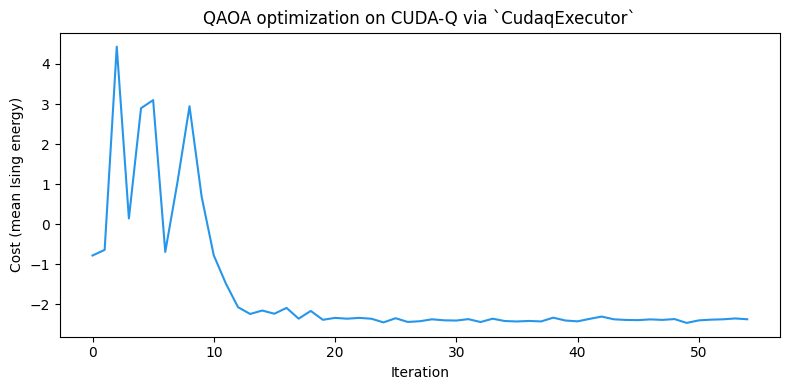
Sampling is probabilistic, and different CUDA-Q targets can use different simulator implementations.
Because of that, the optimization trajectory and final sampled energy may vary slightly across runs.
The optimizer should still converge close to the ground-state energy of on this 5-node graph.
The optimized parameters from this run (opt_gammas, opt_betas) are reused throughout the rest of this page.
Expectation values
In Qamomile, you write expectation values in a qkernel with qmc.expval(...).
When this is transpiled to CUDA-Q, it becomes an executable object that can be called with ExecutableProgram.run(executor, bindings=...).
For CUDA-Q, run() uses Qamomile’s recorded parameter information to bind runtime parameters before calling CUDA-Q’s observe API.
We first use Qamomile’s run() path, then open the lower-level path that passes the generated CUDA-Q artifact directly to executor.estimate(...).
run()
First build a Qamomile Hamiltonian for .
Then transpile the expectation-value qkernel and evaluate it at the optimized QAOA parameters.
cost_hamiltonian = qm_o.Hamiltonian()
for (i, j), Jij in spin_model.quad.items():
    cost_hamiltonian.add_term(
        (qm_o.PauliOperator(qm_o.Pauli.Z, i), qm_o.PauliOperator(qm_o.Pauli.Z, j)),
        Jij,
    )
for i, hi in spin_model.linear.items():
    cost_hamiltonian.add_term((qm_o.PauliOperator(qm_o.Pauli.Z, i),), hi)

# Define the expectation-value qkernel.
@qmc.qkernel
def qaoa_expval(
    p: qmc.UInt,
    quad: qmc.Dict[qmc.Tuple[qmc.UInt, qmc.UInt], qmc.Float],
    linear: qmc.Dict[qmc.UInt, qmc.Float],
    n: qmc.UInt,
    gammas: qmc.Vector[qmc.Float],
    betas: qmc.Vector[qmc.Float],
    obs: qmc.Observable,
) -> qmc.Float:
    q = superposition(n)
    for layer in qmc.range(p):
        q = cost_layer(quad, linear, q, gammas[layer])
        q = mixer_layer(q, betas[layer])
    return qmc.expval(q, obs)


# Transpile the expectation-value qkernel and evaluate it with `run()`.
expval_executable = transpiler.transpile(
    qaoa_expval,
    bindings={
        "p": p,
        "quad": spin_model.quad,
        "linear": spin_model.linear,
        "n": num_nodes,
        "obs": cost_hamiltonian,
    },
    parameters=["gammas", "betas"],
)
energy_from_run = expval_executable.run(
    executor,
    bindings={"gammas": opt_gammas, "betas": opt_betas},
).result()

print(f"ExecutableProgram.run: {energy_from_run:+.10f}")
assert np.isfinite(energy_from_run)
ExecutableProgram.run: -2.4026377899
ExecutableProgram.run(...) is the recommended route when you work through the Qamomile API.
The observable and named runtime parameter bindings are managed by Qamomile’s ExecutableProgram.
The next section opens the lower-level path and passes the CUDA-Q artifact emitted by transpile() directly to executor.estimate(...).
cudaq.observe
For STATIC CUDA-Q artifacts, CudaqExecutor.estimate(circuit, hamiltonian, params=...) calls cudaq.observe() under the hood.
The measured QAOA ansatz above is still usable as a state-preparation circuit because Qamomile does not write terminal measurements into the generated CUDA-Q kernel for STATIC artifacts.
Sampling handles the final measurement separately, so the same emitted artifact can also be used by cudaq.observe().
In a QAOA optimizer, you can keep the same circuit and replace ExecutableProgram.sample() plus decoding with executor.estimate(circuit, hamiltonian, params=...).
When calling executor.estimate(...) directly, you provide the flat parameter order expected by the CUDA-Q artifact yourself.
unbound_circuit = executable.get_first_circuit()
assert unbound_circuit is not None
assert unbound_circuit.execution_mode == ExecutionMode.STATIC
print(f"artifact type       : {type(unbound_circuit).__name__}")
print(f"artifact param_count: {unbound_circuit.param_count}")

# CUDA-Q requires the runtime parameters as a flat list in the order
# they were registered on the artifact, which is the first-use order during
# circuit emission. For QAOA that means gammas[0], betas[0], gammas[1], betas[1],
# ..., interleaved per layer, NOT all gammas followed by all betas.
# Read the order from the `ExecutableProgram` and build the flat list by lookup so
# we never have to guess the convention.
named_values = {f"gammas[{i}]": opt_gammas[i] for i in range(p)}
named_values.update({f"betas[{i}]": opt_betas[i] for i in range(p)})
flat_params = [named_values[name] for name in executable.parameter_names]
# The runtime parameter set is the 2p QAOA angles.
assert len(executable.parameter_names) == 2 * p
assert len(flat_params) == 2 * p
print(f"artifact parameter order: {executable.parameter_names}")

energy_via_estimate = executor.estimate(
    unbound_circuit, cost_hamiltonian, params=flat_params
)
print(f"executor.estimate: {energy_via_estimate:+.10f}")
assert np.isclose(energy_from_run, energy_via_estimate, atol=1e-10)
artifact type : CudaqKernelArtifact
artifact param_count: 6
artifact parameter order: ['gammas[0]', 'gammas[1]', 'gammas[2]', 'betas[0]', 'betas[1]', 'betas[2]']
executor.estimate: -2.4026377899
The run() and executor.estimate(...) paths agree to numerical precision.
They evaluate the same QAOA state against the same Ising cost Hamiltonian.
The resulting noise-free expectation value at the optimized parameters should also match the sample-mean energy printed earlier within shot noise.
Choosing CUDA-Q targets: Using the GPU target
A CUDA-Q target is the execution target CUDA-Q uses for kernel calls, such as the qpp-cpu CPU simulator, the nvidia GPU simulator, or a configured QPU target.
CudaqExecutor() uses the currently selected CUDA-Q target. If you do not choose a target explicitly, CUDA-Q uses its default target, so the examples above run in a local CPU-only environment without extra configuration.
CudaqExecutor(target=...) or CudaqTranspiler.executor(target=...) selects a target explicitly.
The custom executor can be used anywhere executor appeared above.
Changing the CUDA-Q target does not require re-transpiling the kernel.
The ExecutableProgram carries the emitted CUDA-Q artifact, while the executor chooses the target used at execution time.
The list of simulator targets you can select is maintained in CUDA-Q’s Circuit Simulation documentation, and CUDA-Q’s Running on a GPU section shows the same qpp-cpu / nvidia target pattern directly.
As a concrete example, we sample the same optimized QAOA ExecutableProgram on the CPU and GPU targets.
Both runs below are noise-free: we do not install a CUDA-Q noise model, and each target uses the same QAOA circuit and the same parameter vector.
We also set the same CUDA-Q random seed before each sampling call.
The finite-shot samples are still produced by each target’s simulator, so we compare the sampled mean energies with a tolerance and plot the energy histograms rather than relying on identical raw shot ordering.
We also time the sampling call on each target.
benchmark_shots = 1 if docs_test_mode else 100_000
benchmark_seed = 13


def cpu_backend_info() -> str:
    processor = platform.processor() or platform.machine() or "unknown processor"
    if os.path.exists("/proc/cpuinfo"):
        with open("/proc/cpuinfo", encoding="utf-8") as cpuinfo:
            for line in cpuinfo:
                if line.startswith("model name"):
                    processor = line.split(":", maxsplit=1)[1].strip()
                    break
    return f"{processor}; logical CPUs: {os.cpu_count()}"


def gpu_backend_info() -> str:
    try:
        completed = subprocess.run(
            ["nvidia-smi", "--query-gpu=name", "--format=csv,noheader"],
            check=True,
            capture_output=True,
            text=True,
            timeout=5,
        )
    except (
        FileNotFoundError,
        subprocess.CalledProcessError,
        subprocess.TimeoutExpired,
    ):
        return f"{cudaq.num_available_gpus()} CUDA-Q GPU(s) available"

    names = [line.strip() for line in completed.stdout.splitlines() if line.strip()]
    return ", ".join(names) if names else "NVIDIA GPU detected"


def timed_qaoa_sample(target_name: str):
    cudaq.set_target(target_name)
    cudaq.set_random_seed(benchmark_seed)
    start = time.perf_counter()
    result = executable.sample(
        CudaqExecutor(),
        bindings={"gammas": opt_gammas, "betas": opt_betas},
        shots=benchmark_shots,
    ).result()
    return result, time.perf_counter() - start
# CPU target (qpp-cpu)
target_runs = []
cpu_result, cpu_seconds = timed_qaoa_sample("qpp-cpu")
cpu_decoded = spin_model.decode_from_sampleresult(cpu_result)
cpu_energy = cpu_decoded.energy_mean()
target_runs.append(("qpp-cpu", cpu_decoded, cpu_energy, cpu_seconds, "#2696EB"))
print("CPU backend target : qpp-cpu")
print(f"CPU hardware : {cpu_backend_info()}")
print(f"CPU qpp-cpu mean energy: {cpu_energy:+.4f}")
print(f"CPU qpp-cpu sample time: {cpu_seconds:.4f} s")CPU backend target : qpp-cpu
CPU hardware : arm; logical CPUs: 8
CPU qpp-cpu mean energy: -2.3950
CPU qpp-cpu sample time: 0.0258 s
# GPU target (nvidia)
if cudaq.num_available_gpus() > 0 and cudaq.has_target("nvidia"):
    gpu_result, gpu_seconds = timed_qaoa_sample("nvidia")
    gpu_decoded = spin_model.decode_from_sampleresult(gpu_result)
    gpu_energy = gpu_decoded.energy_mean()
    target_runs.append(("nvidia GPU", gpu_decoded, gpu_energy, gpu_seconds, "#FF8A3D"))
    print("GPU backend target  : nvidia")
    print(f"GPU hardware        : {gpu_backend_info()}")
    print(f"GPU nvidia mean energy: {gpu_energy:+.4f}")
    print(f"GPU nvidia sample time: {gpu_seconds:.4f} s")
    print(f"CPU/GPU time ratio    : {cpu_seconds / gpu_seconds:.2f}x")
else:
    gpu_decoded = None
    print(
        "No NVIDIA GPU was detected. Run this notebook in a Google Colab GPU "
        "runtime to execute the `nvidia` target."
    )

cudaq.reset_target()
No NVIDIA GPU was detected. Run this notebook in a Google Colab GPU runtime to execute the `nvidia` target.
When a GPU is available, the CPU and GPU samples should describe the same QAOA output distribution. The helper below visualizes the sampled energy histograms and checks that the mean energies remain close. The tolerances are deliberately finite-shot tolerances, not exact-equality checks; the common seed makes the comparison reproducible for each target implementation.
def energy_distribution(decoded_samples):
    counts: Counter[float] = Counter()
    for energy, occ in zip(decoded_samples.energy, decoded_samples.num_occurrences):
        counts[energy] += occ
    energies = sorted(counts.keys())
    return energies, [counts[energy] for energy in energies]


if gpu_decoded is not None:
    energy_delta = abs(cpu_energy - gpu_energy)
    print(f"mean-energy difference: {energy_delta:.4f}")
    assert np.isfinite(cpu_energy) and np.isfinite(gpu_energy)
    if not docs_test_mode:
        assert energy_delta < 0.15

fig, axes = plt.subplots(
    1,
    len(target_runs),
    figsize=(5.5 * len(target_runs), 4),
    sharey=True,
)
if len(target_runs) == 1:
    axes = [axes]
for ax, (target_name, decoded_samples, mean_energy, elapsed, color) in zip(
    axes, target_runs
):
    energies, counts = energy_distribution(decoded_samples)
    ax.bar(energies, counts, width=0.6, color=color)
    ax.axvline(
        mean_energy,
        color="#2B2B2B",
        linestyle="--",
        linewidth=1.5,
        label=f"mean = {mean_energy:+.3f}",
    )
    ax.set_xticks(energies)
    ax.set_title(f"{target_name} ({elapsed:.3f} s)")
    ax.set_xlabel("Ising energy")
    ax.legend()

axes[0].set_ylabel("Frequency")
fig.suptitle(f"QAOA samples by CUDA-Q target ({benchmark_shots} shots)")
fig.tight_layout()
plt.show()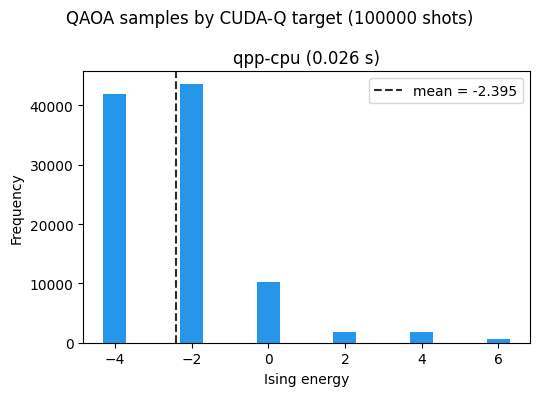
When Kernels Include Classical Control Flow: STATIC and RUNNABLE artifacts
Most variational circuits, including the QAOA ansatz above, transpile to ExecutionMode.STATIC.
STATIC artifacts have no explicit terminal measurement in the generated CUDA-Q source, so they are compatible with CUDA-Q’s sample and observe APIs.
Qamomile quantum kernels are designed with hardware-level execution in mind and can express classical control flow based on mid-circuit measurement results (see Classical Flow Patterns for details).
For this reason, if a quantum kernel contains control flow that depends on runtime measurements, such as if branches or while loops, the CUDA-Q integration emits an ExecutionMode.RUNNABLE artifact instead.
RUNNABLE artifacts use explicit mz(...) measurements in the generated source and execute through cudaq.run().
The following tiny feed-forward circuit demonstrates that path.
@qmc.qkernel
def measurement_feed_forward() -> qmc.Bit:
    q0 = qmc.qubit("q0")
    q1 = qmc.qubit("q1")
    q0 = qmc.x(q0)
    bit = qmc.measure(q0)
    if bit:
        q1 = qmc.x(q1)
    return qmc.measure(q1)


runnable_executable = transpiler.transpile(measurement_feed_forward)
runnable_circuit = runnable_executable.get_first_circuit()
assert runnable_circuit is not None
assert runnable_circuit.execution_mode == ExecutionMode.RUNNABLE
assert "mz(" in runnable_circuit.source
assert "if " in runnable_circuit.source

print("execution_mode:", runnable_circuit.execution_mode.value)
print(runnable_circuit.source)
execution_mode: runnable
@cudaq.kernel
def _qamomile_kernel() -> list[bool]:
q = cudaq.qvector(2)
__b0 = [False]
__b1 = [False]
x(q[0])
__b0[0] = mz(q[0])
if __b0[0]:
x(q[1])
else:
pass
__b1[0] = mz(q[1])
return [__b0[0], __b1[0]]
ExecutableProgram.sample(...) still works for RUNNABLE artifacts, but the executor calls cudaq.run() rather than cudaq.sample().
The example above is deterministic: the first measurement is always 1, so the branch flips q1 and the returned bit is always 1.
runnable_shots = 1 if docs_test_mode else 128
runnable_sample = runnable_executable.sample(executor, shots=runnable_shots).result()
print(runnable_sample.results)
assert sum(count for _, count in runnable_sample.results) == runnable_shots
assert all(value == 1 for value, _ in runnable_sample.results)
[(1, 128)]
The trade-off is that RUNNABLE artifacts are not compatible with CUDA-Q’s observe API.
Qamomile surfaces that distinction as a TypeError when estimate() is called on a RUNNABLE artifact.
try:
    executor.estimate(runnable_circuit, qm_o.Z(0))
except TypeError as exc:
    print(type(exc).__name__, exc)
else:
    raise AssertionError("RUNNABLE CUDA-Q circuits must reject observe()")
TypeError Expectation-value estimation is not available for this CUDA-Q circuit. The kernel uses mid-circuit measurement or measurement-dependent control flow (e.g. `if bit:` / `while bit:`), so it is emitted in RUNNABLE mode and executed with `cudaq.run()`. CUDA-Q's expectation-value primitive `cudaq.observe()` only accepts static state-preparation kernels and cannot consume a RUNNABLE kernel. To estimate an expectation value, express the state preparation as a static kernel without measurement-dependent control flow; expectation values cannot be computed for measurement-conditioned circuits on the CUDA-Q engine.
Summary
In this tutorial, we transpiled a MaxCut QAOA quantum kernel to CUDA-Q, then exercised sampling, expectation-value estimation, CPU/GPU target selection, and execution of a circuit with classical control flow.
The CUDA-Q artifact emitted by
CudaqTranspilerkeeps inspectable Python source and can be reused with runtime parameters.The same
ExecutableProgramcan run on theqpp-cputarget or thenvidiaGPU target, with target selection handled by the executor.CudaqExecutorsupports both QAOA-style sampling and noise-free expectation values through CUDA-Q’sobserveAPI.Quantum kernels with classical control flow that depends on runtime measurements are emitted as
ExecutionMode.RUNNABLEartifacts and execute throughcudaq.run().
See also
QURI Parts Support covers the same MaxCut QAOA workflow with QURI Parts.
Qiskit Support covers the same workflow on Qiskit, including Aer simulators, Qiskit primitives, and native Qiskit circuit features.