タグ: integration optimization variational
このページでは、具体的な最適化問題を通して、QamomileのQiskit量子SDK連携を紹介します。
Qiskit連携はオプションです。QiskitTranspilerとQiskitExecutorを使うにはqiskit extraをインストールします。
このチュートリアルでは、小さなMaxCutインスタンスに対するQAOA最適化を例に、Qamomileの量子カーネルをQiskit回路へトランスパイルし、Qiskitシミュレータ上でサンプリングと期待値評価を行います。
さらに、Qiskitの高度な回路機能と、同じQiskitExecutorのAPIによるIBM Quantum実行も紹介します。
# 最新のQamomileをpipからインストールします。
# 以下で使うQiskitエンジンと回路描画の依存関係をインストールします。
# !pip install "qamomile[qiskit,visualization]"
import os
import matplotlib.pyplot as plt
import networkx as nx
import numpy as np
from qiskit_aer import AerSimulator
from qiskit_aer.noise import NoiseModel, depolarizing_error
from scipy.optimize import minimize
import qamomile.circuit as qmc
import qamomile.observable as qm_o
from qamomile.optimization.binary_model import BinaryModel
from qamomile.qiskit import QiskitTranspilerMaxCut問題
Qiskit連携の説明に集中するため、MaxCutに対するQAOAチュートリアルと同じ5ノードの小さなグラフを使います。
の最大化は、定数項を除けば、反強磁性Isingハミルトニアンの最小化に対応します。
重みなしのMaxCutでは、すべての、なので、これらの係数をそのままBinaryModel.from_isingに渡します。
# MaxCutグラフを作り、Ising形式のBinaryModelへ変換します。
G = nx.Graph()
G.add_edges_from([(0, 1), (0, 2), (1, 2), (1, 3), (2, 3), (3, 4)])
num_nodes = G.number_of_nodes()

ising_quad: dict[tuple[int, int], float] = {
    tuple(sorted((i, j))): 1.0 for i, j in G.edges()
}
ising_linear: dict[int, float] = {}
spin_model = BinaryModel.from_ising(linear=ising_linear, quad=ising_quad)
# 問題の構造はグラフから一意に決まります。重みなしMaxCutでは、quad項は辺と
# 1対1に対応し、linear項は存在しません。
assert len(spin_model.quad) == G.number_of_edges()
assert len(spin_model.linear) == 0

pos = nx.spring_layout(G, seed=42)
plt.figure(figsize=(5, 4))
nx.draw(
    G,
    pos,
    with_labels=True,
    node_color="white",
    node_size=700,
    edgecolors="black",
)
plt.title(f"MaxCut graph: {num_nodes} nodes, {G.number_of_edges()} edges")
plt.show()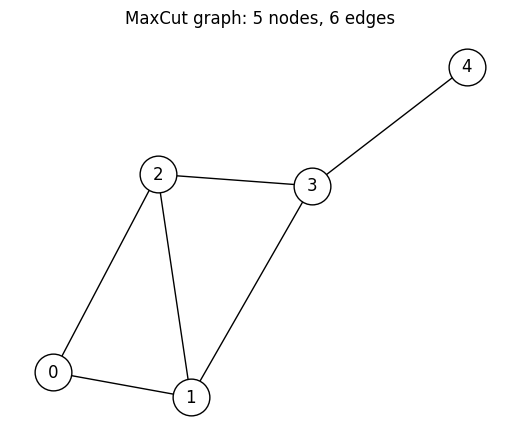
@qkernelによるQAOAアンザッツの構築
MaxCutを解くためのQAOA回路を@qkernelとして記述します。
レシピはMaxCutに対するQAOAチュートリアルと同じです。
計算基底の一様な重ね合わせ状態を準備した後、コスト層とミキサー層を回交互に適用し、最後に計算基底で測定します。
期待値計算用の量子カーネルは後のrun()セクションで定義します。こうしておくと、下の回路図では状態準備用のラッパーではなく、サンプリング用アンザッツそのものを確認できます。
# グラフの全ノードに対応する一様重ね合わせを準備します。
@qmc.qkernel
def superposition(n: qmc.UInt) -> qmc.Vector[qmc.Qubit]:
    q = qmc.qubit_array(n, name="q")
    for i in qmc.range(n):
        q[i] = qmc.h(q[i])
    return q

@qmc.qkernel
def cost_layer(
    quad: qmc.Dict[qmc.Tuple[qmc.UInt, qmc.UInt], qmc.Float],
    linear: qmc.Dict[qmc.UInt, qmc.Float],
    q: qmc.Vector[qmc.Qubit],
    gamma: qmc.Float,
) -> qmc.Vector[qmc.Qubit]:
    for (i, j), Jij in quad.items():
        q[i], q[j] = qmc.rzz(q[i], q[j], angle=Jij * gamma)
    for i, hi in linear.items():
        q[i] = qmc.rz(q[i], angle=hi * gamma)
    return q

@qmc.qkernel
def mixer_layer(
    q: qmc.Vector[qmc.Qubit],
    beta: qmc.Float,
) -> qmc.Vector[qmc.Qubit]:
    n = q.shape[0]
    for i in qmc.range(n):
        q[i] = qmc.rx(q[i], angle=2.0 * beta)
    return q

@qmc.qkernel
def qaoa_ansatz(
    p: qmc.UInt,
    quad: qmc.Dict[qmc.Tuple[qmc.UInt, qmc.UInt], qmc.Float],
    linear: qmc.Dict[qmc.UInt, qmc.Float],
    n: qmc.UInt,
    gammas: qmc.Vector[qmc.Float],
    betas: qmc.Vector[qmc.Float],
) -> qmc.Vector[qmc.Bit]:
    q = superposition(n)
    for layer in qmc.range(p):
        q = cost_layer(quad, linear, q, gammas[layer])
        q = mixer_layer(q, betas[layer])
return qmc.measure(q)qaoa_ansatz.draw(...)でQamomileの回路図を描画できます。
問題の構造を決める引数(p、quad、linear、n)に値を渡し、層の数とグラフの構造を回路図に反映させます。
一方、gammas / betasには値を渡さず、後で決めるパラメータとして残します。
docs_test_mode = os.environ.get("QAMOMILE_DOCS_TEST") == "1"
p = 1 if docs_test_mode else 3  # QAOAの層数
qaoa_ansatz.draw(
    p=p,
    quad=spin_model.quad,
    linear=spin_model.linear,
    n=num_nodes,
)
Qiskitへのトランスパイル
Qamomileの量子カーネルで定義した回路は、QiskitTranspilerでQiskitのQuantumCircuitへトランスパイルできます。
QiskitTranspilerは、他の量子SDKと同じようにtranspile()で使えます。
問題の構造を決める引数はbindingsで固定し、gammas / betasはランタイムパラメータとして残します。
チュートリアルの出力を再現できるように、固定シードとmax_parallel_threads=1を設定したAerSimulatorを使います。
SEED = 42

def make_seeded_backend() -> AerSimulator:
    return AerSimulator(seed_simulator=SEED, max_parallel_threads=1)

transpiler = QiskitTranspiler()

executable = transpiler.transpile(
    qaoa_ansatz,
    bindings={
        "p": p,
        "quad": spin_model.quad,
        "linear": spin_model.linear,
        "n": num_nodes,
    },
    parameters=["gammas", "betas"],
)executable.get_first_circuit()で内部のQiskitQuantumCircuitを取り出せます。
個のQAOA角度(gammas[0..p-1]、betas[0..p-1])は、実行時までQiskitのParameterオブジェクトとして残ります。
ここでは、トランスパイルされたQuantumCircuitをQiskitのテキストdrawerで確認します。
# 出力された回路を確認し、パラメータが未バインドのまま残っていることを確認します。
qiskit_circuit = executable.get_first_circuit()
assert qiskit_circuit is not None

# QAOAでは、グラフの各ノードに1つの量子ビットと1つの最終古典ビットを使います。
# ランタイムパラメータは、各層にgammaとbetaが1つずつです。
assert qiskit_circuit.num_qubits == num_nodes
assert qiskit_circuit.num_clbits == num_nodes
assert qiskit_circuit.num_parameters == 2 * p
assert set(executable.parameter_names) == {
    *(f"gammas[{i}]" for i in range(p)),
    *(f"betas[{i}]" for i in range(p)),
}
print(type(qiskit_circuit).__name__)
print("num_qubits    :", qiskit_circuit.num_qubits)
print("num_clbits    :", qiskit_circuit.num_clbits)
print("num_parameters:", qiskit_circuit.num_parameters)
print("parameters    :", sorted(str(param) for param in qiskit_circuit.parameters))

print(qiskit_circuit.draw(output="text", fold=120))
QuantumCircuit
num_qubits : 5
num_clbits : 5
num_parameters: 6
parameters : ['betas[0]', 'betas[1]', 'betas[2]', 'gammas[0]', 'gammas[1]', 'gammas[2]']
┌───┐ ┌────────────────┐ »
q_0: ┤ H ├─■───────────────■──────────────┤ Rx(2*betas[0]) ├────────────────────────────────────■───────────────»
├───┤ │ZZ(gammas[0]) │ └────────────────┘ ┌────────────────┐ │ZZ(gammas[1]) »
q_1: ┤ H ├─■───────────────┼────────────────■────────────────■──────────────┤ Rx(2*betas[0]) ├──■───────────────»
├───┤ │ZZ(gammas[0]) │ZZ(gammas[0]) │ └────────────────┘┌────────────────┐»
q_2: ┤ H ├─────────────────■────────────────■────────────────┼────────────────■───────────────┤ Rx(2*betas[0]) ├»
├───┤ │ZZ(gammas[0]) │ZZ(gammas[0]) └────────────────┘»
q_3: ┤ H ├───────────────────────────────────────────────────■────────────────■─────────────────■───────────────»
├───┤ │ZZ(gammas[0]) »
q_4: ┤ H ├──────────────────────────────────────────────────────────────────────────────────────■───────────────»
└───┘ »
c: 5/═══════════════════════════════════════════════════════════════════════════════════════════════════════════»
»
« ┌────────────────┐ »
«q_0: ──■───────────────┤ Rx(2*betas[1]) ├────────────────────────────────────■─────────────────■───────────────»
« │ └────────────────┘ ┌────────────────┐ │ZZ(gammas[2]) │ »
«q_1: ──┼─────────────────■────────────────■──────────────┤ Rx(2*betas[1]) ├──■─────────────────┼───────────────»
« │ZZ(gammas[1]) │ZZ(gammas[1]) │ └────────────────┘┌────────────────┐ │ZZ(gammas[2]) »
«q_2: ──■─────────────────■────────────────┼────────────────■───────────────┤ Rx(2*betas[1]) ├──■───────────────»
« ┌────────────────┐ │ZZ(gammas[1]) │ZZ(gammas[1]) └────────────────┘┌────────────────┐»
«q_3: ┤ Rx(2*betas[0]) ├───────────────────■────────────────■─────────────────■───────────────┤ Rx(2*betas[1]) ├»
« ├────────────────┤ │ZZ(gammas[1]) ├────────────────┤»
«q_4: ┤ Rx(2*betas[0]) ├──────────────────────────────────────────────────────■───────────────┤ Rx(2*betas[1]) ├»
« └────────────────┘ └────────────────┘»
«c: 5/══════════════════════════════════════════════════════════════════════════════════════════════════════════»
« »
« ┌────────────────┐ ┌─┐
«q_0: ┤ Rx(2*betas[2]) ├────────────────┤M├──────────────────────────────────────────────────────────────────
« └────────────────┘ └╥┘┌────────────────┐ ┌─┐
«q_1: ──■────────────────■───────────────╫─┤ Rx(2*betas[2]) ├──────────────────┤M├───────────────────────────
« │ZZ(gammas[2]) │ ║ └────────────────┘┌────────────────┐└╥┘ ┌─┐
«q_2: ──■────────────────┼───────────────╫───■───────────────┤ Rx(2*betas[2]) ├─╫───────────────────┤M├──────
« │ZZ(gammas[2]) ║ │ZZ(gammas[2]) └────────────────┘ ║ ┌────────────────┐└╥┘┌─┐
«q_3: ───────────────────■───────────────╫───■─────────────────■────────────────╫─┤ Rx(2*betas[2]) ├─╫─┤M├───
« ║ │ZZ(gammas[2]) ║ ├────────────────┤ ║ └╥┘┌─┐
«q_4: ───────────────────────────────────╫─────────────────────■────────────────╫─┤ Rx(2*betas[2]) ├─╫──╫─┤M├
« ║ ║ └────────────────┘ ║ ║ └╥┘
«c: 5/═══════════════════════════════════╩══════════════════════════════════════╩════════════════════╩══╩══╩═
« 0 1 2 3 4
各ランタイムパラメータは、実行時まで未バインドのまま残ります。
gammas / betasのバインドは、ExecutableProgram.sample(...)やExecutableProgram.run(...)からQiskitのassign_parametersを通して行われるため、Qiskit回路を一度生成すれば、多くのパラメータベクトルで再利用できます。
Ising係数、量子ビット数、層数といった問題構造はトランスパイル時に固定され、ランタイム入力として残るのは変分角度だけです。
QiskitExecutorによるQAOAサンプリング
executable.sample(executor, bindings=..., shots=...)はSampleJobを返します。
.result()で得られるSampleResultは、BinaryModel.decode_from_sampleresultでスピン変数のBinarySampleSetへデコードできます。
これにより、追加の変換をせずにカット辺を数えられます。
qiskit-aerがインストールされている環境では、QiskitExecutor()はデフォルトでAerSimulatorを使います。ここでは上で作ったシード付きシミュレータを使います。
rng = np.random.default_rng(SEED)
init_params = rng.uniform(-np.pi / 2, np.pi / 2, 2 * p)
init_gammas = list(init_params[:p])
init_betas = list(init_params[p:])
sample_shots = 1 if docs_test_mode else 2000
maxiter = 4 if docs_test_mode else 100

# パラメータ化されたexecutableをサンプリングし、ビット列をIsingエネルギーへデコードします。
executor = transpiler.executor(backend=make_seeded_backend())
sample_result = executable.sample(
    executor,
    bindings={"gammas": init_gammas, "betas": init_betas},
    shots=sample_shots,
).result()

decoded = spin_model.decode_from_sampleresult(sample_result)
print(f"Mean energy at random init: {decoded.energy_mean():+.4f}")
assert sample_result.shots == sample_shots
Mean energy at random init: -0.6840
QAOAパラメータの最適化
同じexecutableを異なる(gammas, betas)で繰り返し呼び出すのが、QAOAの最適化ループの基本形です。
transpiler.transpile()を1回呼び、その後はexecutable.sample()を何度も呼び出します。
この例では、サンプリングとデコードの処理をcost_fn()として定義し、SciPyのminimize関数で最適化します。
古典最適化関数は(gammas, betas)を更新しながら、サンプリングされたIsingエネルギーの平均を下げていきます。
各反復では、同じexecutableとQiskitExecutorを再利用します。
# 1つのexecutableを古典目的関数の中で再利用します。
cost_history: list[float] = []

def cost_fn(params: np.ndarray) -> float:
    result = executable.sample(
        executor,
        bindings={"gammas": list(params[:p]), "betas": list(params[p:])},
        shots=sample_shots,
    ).result()
    energy = spin_model.decode_from_sampleresult(result).energy_mean()
    cost_history.append(energy)
    return energy

# COBYLAでサンプリング平均エネルギーを最適化します。
res = minimize(cost_fn, init_params, method="COBYLA", options={"maxiter": maxiter})

opt_gammas = list(res.x[:p])
opt_betas = list(res.x[p:])
print(f"Optimized mean energy: {res.fun:+.4f}")
print(f"Optimal gammas       : {[round(float(v), 4) for v in opt_gammas]}")
print(f"Optimal betas        : {[round(float(v), 4) for v in opt_betas]}")
assert cost_history
Optimized mean energy: -2.8810
Optimal gammas : [0.8678, -0.4364, 1.562]
Optimal betas : [0.4086, -0.8709, 2.9557]
# 最適化の過程における目的関数の変化をプロットします。
plt.figure(figsize=(8, 4))
plt.plot(cost_history, color="#2696EB")
plt.xlabel("Iteration")
plt.ylabel("Cost (mean Ising energy)")
plt.title("QAOA optimization on Aer via `QiskitExecutor`")
plt.tight_layout()
plt.show()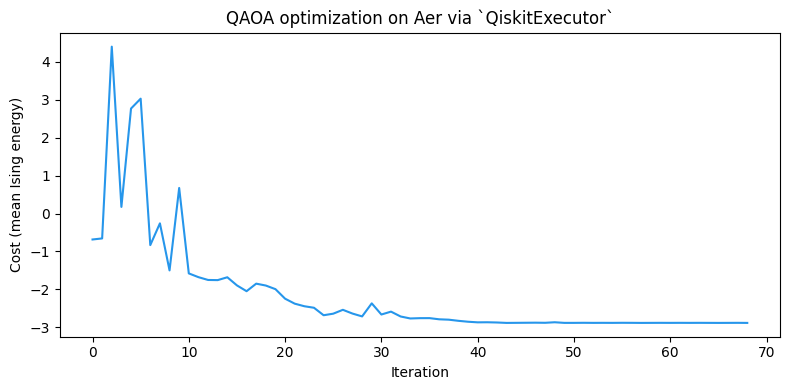
上のAerSimulatorは固定のseed_simulatorで構築しているため、同じ回路列に対して再現可能なサンプリング列が得られます。
この5ノードグラフでは、の基底状態エネルギー付近まで収束するはずです。
ここで得た最適パラメータ(opt_gammas、opt_betas)を、以降の例でも使います。
run()による期待値計算
Qamomileでは、量子回路の出力に対する期待値を量子カーネル内のqmc.expval(...)で記述します。
これをQiskitへトランスパイルすると、ExecutableProgram.run(executor, bindings=...)で呼び出せる実行可能オブジェクトになります。
run()はQamomileのパラメータ情報を使ってランタイムパラメータをバインドし、そのうえでQiskitのestimatorを呼び出します。
まずをQamomileのHamiltonianとして組み立てます。
その後、期待値計算用の量子カーネルをトランスパイルし、最適化済みQAOAパラメータで評価します。
# MaxCutのIsingコストに対応するQamomile Hamiltonianを組み立てます。
cost_hamiltonian = qm_o.Hamiltonian()
for (i, j), Jij in spin_model.quad.items():
    cost_hamiltonian.add_term(
        (qm_o.PauliOperator(qm_o.Pauli.Z, i), qm_o.PauliOperator(qm_o.Pauli.Z, j)),
        Jij,
    )
for i, hi in spin_model.linear.items():
    cost_hamiltonian.add_term((qm_o.PauliOperator(qm_o.Pauli.Z, i),), hi)

# 期待値計算用の量子カーネルを定義します。
@qmc.qkernel
def qaoa_expval(
    p: qmc.UInt,
    quad: qmc.Dict[qmc.Tuple[qmc.UInt, qmc.UInt], qmc.Float],
    linear: qmc.Dict[qmc.UInt, qmc.Float],
    n: qmc.UInt,
    gammas: qmc.Vector[qmc.Float],
    betas: qmc.Vector[qmc.Float],
    obs: qmc.Observable,
) -> qmc.Float:
    q = superposition(n)
    for layer in qmc.range(p):
        q = cost_layer(quad, linear, q, gammas[layer])
        q = mixer_layer(q, betas[layer])
    return qmc.expval(q, obs)


# 期待値計算用の量子カーネルをトランスパイルし、`run()`で評価します。
expval_executable = transpiler.transpile(
    qaoa_expval,
    bindings={
        "p": p,
        "quad": spin_model.quad,
        "linear": spin_model.linear,
        "n": num_nodes,
        "obs": cost_hamiltonian,
    },
    parameters=["gammas", "betas"],
)
energy_via_run = expval_executable.run(
    executor,
    bindings={"gammas": opt_gammas, "betas": opt_betas},
).result()

print(f"Executable.run() expectation: {energy_via_run:+.10f}")
print(f"sample mean energy          : {res.fun:+.4f}")
assert np.isfinite(energy_via_run)
Executable.run() expectation: -2.8538574303
sample mean energy : -2.8810
QamomileのAPIだけで扱う場合は、ExecutableProgram.run(...)を使うのがおすすめです。
Qiskit回路を自分で扱いたい場合にはexecutor.estimate(...)も使えますが、その場合はQiskitのパラメータ順や回路のバインド状態をユーザー側で管理する必要があります。
ローカル実行では、QiskitExecutorは利用可能な場合にデフォルトでQiskitのStatevectorEstimatorを生成するため、現在のQiskit環境ではV2 primitiveインターフェースを使います。
カスタムestimatorや古いQiskit / AerのestimatorがV2形式のrun([(circuit, observable, params)])呼び出しを受け付けない場合、QamomileはV1形式のrun(circuits, observables, parameter_values)へフォールバックします。
Qiskitの高度な機能
Qamomileでは、オプションのQiskit連携を利用できます。 Qiskitが持つ高度な回路機能を活用するための入口も用意しています。
このセクションでは、生成した回路をQiskitの実行対象へ渡すときに便利な機能を3つ示します。
動的回路のためのネイティブ古典制御フロー(
for_loop、if_else、while_loop)パラメトリックな時間発展
qmc.pauli_evolve(...)をQiskitネイティブなPauliEvolutionGateとして直接出力QamomileのコンポジットQFT操作向けのネイティブ
QFTGate/ 逆QFTGate
古典制御フローとランタイム古典式
Qiskit連携は、Qamomileの古典制御フローやランタイム古典式を、Qiskitの動的回路命令や古典式に直接変換できます。
qmc.range(...)ループは、Qiskitのfor_loopになります。
測定結果に基づくif / elseとwhileは、Qiskitの動的回路命令になります。
a & bのような条件式は、qiskit.circuit.classical.exprを通してQiskitの古典式に直接変換できます。
# ネイティブ制御フローの出力を確認する小さな量子カーネルを3つ定義します。

# qmc.rangeによるforループは、Qiskitの`for_loop`になります。
@qmc.qkernel
def native_for_demo(reps: qmc.UInt) -> qmc.Bit:
    q = qmc.qubit("q")
    for _ in qmc.range(reps):
        q = qmc.h(q)
    return qmc.measure(q)

# 測定結果に基づくif分岐は、Qiskitの`if_else`になります。
@qmc.qkernel
def runtime_branch_demo() -> qmc.Bit:
    a = qmc.qubit("a")
    b = qmc.qubit("b")
    target = qmc.qubit("target")

    a = qmc.x(a)
    b = qmc.x(b)
    ma = qmc.measure(a)
    mb = qmc.measure(b)

    if ma & mb:
        target = qmc.x(target)
    else:
        target = qmc.h(target)

    return qmc.measure(target)

# 測定結果に基づくwhileループは、Qiskitの`while_loop`になります。
@qmc.qkernel
def repeat_until_zero_once() -> qmc.Bit:
    q0 = qmc.qubit("q0")
    q0 = qmc.x(q0)
    bit = qmc.measure(q0)
    while bit:
        q1 = qmc.qubit("q1")
        bit = qmc.measure(q1)
    return bit

# 各demoをトランスパイルし、出力されたQiskitの操作名を確認します。
for_circuit = transpiler.to_circuit(native_for_demo, bindings={"reps": 3})
branch_circuit = transpiler.to_circuit(runtime_branch_demo)
while_circuit = transpiler.to_circuit(repeat_until_zero_once)

for_ops = [inst.operation.name for inst in for_circuit.data]
branch_ops = [inst.operation.name for inst in branch_circuit.data]
while_ops = [inst.operation.name for inst in while_circuit.data]

print("native_for_demo ops       :", for_ops)
print("runtime_branch_demo ops   :", branch_ops)
print("repeat_until_zero_once ops:", while_ops)
assert "for_loop" in for_ops
assert "if_else" in branch_ops
assert "while_loop" in while_ops

if_op = next(inst.operation for inst in branch_circuit.data if inst.operation.name == "if_else")
print("if_else condition:", if_op.condition)
native_for_demo ops : ['for_loop', 'measure']
runtime_branch_demo ops : ['x', 'x', 'measure', 'measure', 'if_else', 'measure']
repeat_until_zero_once ops: ['x', 'measure', 'while_loop']
if_else condition: Binary(Binary.<Op.LOGIC_AND: 4>, Var(<Clbit register=(3, "c"), index=0>, Bool()), Var(<Clbit register=(3, "c"), index=1>, Bool()), Bool())
Qiskitの古典式システムは現在、Qamomileが扱うことのできる多くの論理演算、比較演算、算術演算に対応しています。
ただし、FLOORDIVとPOWには対応するQiskitの古典式がないため、どちらかが回路実行時に評価する式として残ると、Qiskit回路を構築する前のtarget legality検証でTargetCapabilityErrorが発生します。
これらが必要な場合は、トランスパイル前に具体値として決まる形にしてください。
ネイティブPauliEvolutionGate
qmc.pauli_evolve(q, H, gamma)は、Qamomileの中間表現ではを表します。
Qiskit連携は、use_native_pauli_evolution=True(デフォルト)の場合、この操作をPauliEvolutionGateとして出力します。
未バインドのgammaはQiskitのParameterになるため、同じ回路を変分パラメータを変えながら評価する用途に再利用できます。
# Pauli発展の量子カーネルを出力し、Qiskitでネイティブ表現が保たれることを確認します。
@qmc.qkernel
def pauli_evolve_demo(
    n: qmc.UInt,
    H: qmc.Observable,
    gamma: qmc.Float,
) -> qmc.Vector[qmc.Bit]:
    # Hamiltonianによる時間発展を適用する前に、単純な入力状態を準備します。
    q = qmc.qubit_array(n, "q")
    for i in qmc.range(n):
        q[i] = qmc.h(q[i])
    q = qmc.pauli_evolve(q, H, gamma)
    return qmc.measure(q)

# 出力された操作を確認しやすいよう、小さなHamiltonianを使います。
evolution_hamiltonian = qm_o.Z(0) * qm_o.Z(1) + 0.5 * qm_o.X(0)
evolution_executable = transpiler.transpile(
    pauli_evolve_demo,
    bindings={"n": evolution_hamiltonian.num_qubits, "H": evolution_hamiltonian},
    parameters=["gamma"],
)
evolution_circuit = evolution_executable.get_first_circuit()
assert evolution_circuit is not None
evolution_ops = [inst.operation.name for inst in evolution_circuit.data]
print(evolution_ops)
assert "PauliEvolution" in evolution_ops
assert {str(param) for param in evolution_circuit.parameters} == {"gamma"}
['h', 'h', 'PauliEvolution', 'measure', 'measure']
量子SDKに依存しないゲート分解を確認したい場合は、QiskitTranspiler(use_native_pauli_evolution=False)を渡します。
このフラグが制御するのはPauli発展だけです。ネイティブQFT/IQFT出力はuse_native_compositeで独立に制御します。
ネイティブQFTGate
Qamomileには、QFTや逆QFTをqmc.qft(...) / qmc.iqft(...)で表す高水準の操作があります。
Qiskit連携では、これらの量子カーネルを量子ゲートへ分解せず、QiskitネイティブなQFTGateとして直接出力できます。
use_native_composite=Falseでは、移植可能なfallback本体を持つ名前付きQiskitゲートが残ります。H/controlled-phase/SWAPの実装を確認したい場合は、Qiskitのdecompose()を呼び出します。
# QiskitのネイティブQFTゲートと、ゲート分解された回路を比較します。
@qmc.qkernel
def qft_demo(n: qmc.UInt) -> qmc.Vector[qmc.Bit]:
    q = qmc.qubit_array(n, "q")
    q = qmc.qft(q)
    return qmc.measure(q)


qft_native = QiskitTranspiler(use_native_composite=True).to_circuit(
    qft_demo,
    bindings={"n": 3},
)
qft_decomposed = QiskitTranspiler(use_native_composite=False).to_circuit(
    qft_demo,
    bindings={"n": 3},
)
native_ops = [inst.operation.name for inst in qft_native.data]
decomposed_ops = [
    inst.operation.name for inst in qft_decomposed.decompose(reps=1).data
]
print("native QFT ops    :", native_ops)
print("decomposed QFT ops:", decomposed_ops)
assert any("qft" in name.lower() for name in native_ops)
assert "cp" in decomposed_ops
assert len(qft_native.data) < len(decomposed_ops)
native QFT ops : ['qft', 'measure', 'measure', 'measure']
decomposed QFT ops: ['h', 'cp', 'h', 'cp', 'cp', 'h', 'swap', 'measure', 'measure', 'measure']
他のQiskit実行対象の利用
QiskitExecutorでは、トランスパイル済み回路と、それを実行するQiskitの実行対象を分けて扱います。
そのため、transpiler.executor(backend=...)でQiskitの実行対象を差し替えるだけで、同じ回路をさまざまなQiskit実行対象で実行できます。
例えば、ノイズなしのローカルシミュレータ、Aerノイズモデル、後述するIBM Quantumの実機を、同じQiskitExecutorで利用できます。
ここでは、脱分極ノイズを持つAerノイズモデルを作り、AerSimulatorへ渡す例を示します。
同じ最適化済みパラメータで、ノイズなしとノイズありのサンプル平均エネルギーを比較します。
# 1量子ビットゲートと2量子ビットゲートの脱分極ノイズを持つAerノイズモデルを作ります。
noise_model = NoiseModel()
one_qubit_error = depolarizing_error(0.01, 1)
two_qubit_error = depolarizing_error(0.02, 2)
noise_model.add_all_qubit_quantum_error(one_qubit_error, ["h", "rx", "rz"])
noise_model.add_all_qubit_quantum_error(two_qubit_error, ["rzz"])

noisy_backend = AerSimulator(
    noise_model=noise_model,
    seed_simulator=SEED,
    max_parallel_threads=1,
)
noisy_executor = transpiler.executor(backend=noisy_backend)

# 同じexecutableを、ノイズなしとノイズありの実行対象で実行します。
clean_result = executable.sample(
    executor,
    bindings={"gammas": opt_gammas, "betas": opt_betas},
    shots=sample_shots,
).result()
noisy_result = executable.sample(
    noisy_executor,
    bindings={"gammas": opt_gammas, "betas": opt_betas},
    shots=sample_shots,
).result()

# 両方のサンプル集合をデコードし、平均Isingエネルギーを比較します。
clean_energy = spin_model.decode_from_sampleresult(clean_result).energy_mean()
noisy_energy = spin_model.decode_from_sampleresult(noisy_result).energy_mean()
print(f"noiseless Aer mean energy: {clean_energy:+.4f}")
print(f"noisy Aer mean energy: {noisy_energy:+.4f}")
assert clean_result.shots == sample_shots
assert noisy_result.shots == sample_shots
assert np.isfinite(clean_energy)
assert np.isfinite(noisy_energy)
noiseless Aer mean energy: -2.8810
noisy Aer mean energy: -2.1370
IBM Quantum実機での実行
pip install "qamomile[qiskit]"でQiskit用のextraをインストールすると、実機実行用のQiskit IBM Runtimeも導入されます。デバイス名、IBM QuantumのAPI key、instance CRNをtranspiler.executor(...)へ渡します。
ローカルシミュレーションと同じQiskitExecutorが返ります。引数を省略するとローカルのAerを使い、IBMのデバイス名を渡すとQiskit IBM Runtimeで認証して、そのバックエンドをexecutable.sample()とexecutable.run()の実行先にします。
以下の例は手動で実行するとリモートジョブを送信します。このノートブックの実行対象には含まれません。
import os

from qamomile.qiskit import QiskitExecutionOptions

hardware_options = QiskitExecutionOptions(
    max_execution_time=300,
    resilience_level=1,
)
hardware_executor = transpiler.executor(
    backend="your_backend_name",
    api_key=os.environ["IBM_QUANTUM_API_KEY"],
    instance_crn=os.environ["IBM_QUANTUM_INSTANCE_CRN"],
    options=hardware_options,
)
runtime_bindings = {"gammas": opt_gammas, "betas": opt_betas}

hardware_job = executable.sample(
    hardware_executor,
    bindings=runtime_bindings,
    shots=1024,
)
print(hardware_job.status())
snapshot_data = hardware_job.snapshot().to_dict()
hardware_result = hardware_job.result()
この例を実行する前に、2つの環境変数へAPI keyとinstance CRNを設定します。同じ引数でQiskitExecutor(backend=..., api_key=..., instance_crn=..., options=hardware_options)を直接作ることもできます。
QiskitExecutionOptionsを使うと、SDKのオプションクラスをimportせずにQamomileからRuntimeを設定できます。max_execution_timeはサンプリングと期待値計算の量子実行時間を秒単位で制限します。キュー待ち時間や、ローカルで結果を待つ.result(timeout=...)の待機時間とは別の設定です。resilience_level(0、1、2)は期待値計算に適用されます。これらの設定にはRuntimeの実行対象が必要です。
Qamomileはibm_quantum_platformのchannelを指定してQiskitRuntimeServiceへ認証情報を渡し、そのinstance内で指定した名前のバックエンドを取得します。そのアカウントとinstanceからバックエンドを利用できない場合、Executorの作成時にQiskitのエラーが発生します。別のデバイスやシミュレータへは切り替わりません。
api_keyとinstance_crnには空でない文字列を指定し、必ずバックエンド名と一緒に両方を渡します。認証情報が片方だけの場合はValueErrorが発生します。Executorは認証情報をディスクへ保存しません。
Qiskit IBM Runtimeですでに保存済みアカウントを設定している場合は、認証情報を両方省略してtranspiler.executor(backend="your_backend_name")を使えます。
IBMバックエンドを指定したQiskitExecutorはランタイムパラメータに値を設定し、選んだバックエンドの命令セットへ回路をトランスパイルしてからRuntime V2プリミティブに送信します。
期待値計算では、observableもトランスパイル後の物理量子ビットの配置に合わせて変換するため、実機上の配置が変わっても意図したobservableを評価できます。
サンプリングと期待値計算のジョブでは、status()、cancel()、snapshot()が使えます。.result()は結果が得られるまで待機します。
後からジョブを取得するには、snapshot_dataをJSONとして保存します。同じexecutableと元のバックエンド用Executorを再作成し、元のランタイムbindingsを渡すと、量子カーネルの戻り値の型を保った結果を復元できます。
from qamomile.circuit.transpiler.job import JobSnapshot

restored_job = executable.restore(
    hardware_executor,
    JobSnapshot.from_dict(snapshot_data),
    bindings=runtime_bindings,
)
restored_result = restored_job.result()
snapshotにはproviderのジョブ識別子、取得済みのローカル値、結果のメタデータが含まれます。認証情報とランタイムbindingsは呼び出し側で管理します。
定数observableや空回路のようにローカルで結果が確定する処理も、リモートジョブを含むグループと一緒に保存・復元できます。
サービス側のジョブ識別子からの復元には、Executorの認証時に作成したRuntime serviceを使います。すでにQiskitRuntimeServiceを管理している場合は、api_keyとinstance_crnの代わりにservice=serviceとバックエンド名を渡すか、そのserviceのIBMBackendオブジェクトをbackendへ渡せます。
上で作った期待値計算のexecutableもRuntimeで使えます。1回の評価で絶対的な目標精度を指定するには、TargetPrecisionを使います。
from qamomile.circuit.transpiler.execution_request import TargetPrecision

energy_job = expval_executable.run(
    hardware_executor,
    bindings=runtime_bindings,
    estimation=TargetPrecision(0.05),
)
hardware_energy = energy_job.result()サンプリングのshotsと期待値計算のTargetPrecisionは、引き続き実行ごとに指定します。TargetPrecisionを省略するとRuntime estimatorの設定済みデフォルト値を使います。
その他のRuntime設定は、QiskitExecutionOptionsを作る際にsampler_optionsとestimator_optionsへ辞書で渡せます。Executorのsampler_options=...とestimator_options=...へネイティブのオプションを直接渡す方法も使えますが、options=...とは併用できません。実機向けトランスパイルを調整する場合は、そのバックエンド用のpass_manager=...を渡せます。
既存のRuntimeSessionやBatchを使うには、mode=...に渡し、設定済みの同じバックエンドオブジェクトをbackend=...に指定します。バックエンド名とmodeは併用できません。そのcontextと有効期間は呼び出し側で管理し、Executorは作成や終了を行いません。
まとめ
QiskitTranspiler().transpile(kernel, bindings=..., parameters=[...])は量子カーネルをExecutableProgram[QuantumCircuit]に変換します。Qiskitエコシステム内で扱いたい場合は、to_circuit(...)で生のQiskitQuantumCircuitを取得できます。QiskitExecutorは、測定を返す量子カーネル向けのexecutable.sample()と、期待値向けのexecutable.run()/executor.estimate(...)の両方をサポートし、デフォルトではAerSimulatorを使います。IBMのバックエンド名とapi_key、instance_crn、または既存のIBMBackendを渡すと、同じAPIでRuntime V2による実行ができます。Qiskit連携は、Qiskitが高い抽象度の回路命令を持つ箇所では、回路途中の測定、動的
for_loop/if_else/while_loop、ランタイム古典式、PauliEvolutionGate、QFTGateをネイティブに出力します。AerからIBM Quantumへ切り替える際もQamomileのexecutableを再利用できます。
QiskitExecutorが実機向けトランスパイル、observableの配置変換、非同期ジョブの復元を扱います。
関連ページ
CUDA-Qサポートでは、同じMaxCut QAOAの流れをCUDA-Q連携で扱い、CUDA-Q targetや
observeも確認します。QURI Partsサポートでは、同じ流れをQURI Partsで扱い、Qulacs samplerやQURI Parts estimatorの経路も確認します。