Tags: tutorial
qmc.control turns any Qamomile gate (a built-in like qmc.rx,
or a user-defined @qmc.qkernel) into its controlled version.
This tutorial develops that API from a single control through
value-activated controls, symbolic control widths, and reusable sub-kernels.
qmc.control has two modes: concrete (the number of control
qubits is a Python int) and symbolic (the number is a
qmc.UInt kernel parameter, or an expression that contains one,
resolved at transpile time). Most features — power=, default
args, sub-kernels that take Vector[Qubit], reordering classical
kwargs — work the same way in both modes. What differs between
the modes is how the control arguments are passed and a small
set of mode-specific extras, handled in later sections.
# Install the latest Qamomile from pip.
# !pip install "qamomile[qiskit,visualization]"
import math
import os
import qamomile.circuit as qmc
from qamomile.circuit.transpiler.errors import UnreturnedBorrowError
from qamomile.qiskit import QiskitTranspiler
transpiler = QiskitTranspiler()
docs_test_mode = os.environ.get("QAMOMILE_DOCS_TEST") == "1"
sample_shots = 1 if docs_test_mode else 2561. The minimal example: controlled-RX
The simplest, most practical use of qmc.control is to make a
controlled version of one of the gates Qamomile provides. For
example, below we pass the one-qubit gate qmc.rx(q, angle) to
qmc.control to obtain a two-qubit controlled-RX gate.
# Define the controlled-RX gate.
crx = qmc.control(qmc.rx)
@qmc.qkernel
def crx_control_off() -> qmc.Bit:
c = qmc.qubit(name="c")
t = qmc.qubit(name="t")
# The control stays |0>, so the controlled rotation does NOT fire.
c, t = crx(c, t, angle=math.pi)
return qmc.measure(t)
crx_control_off.draw()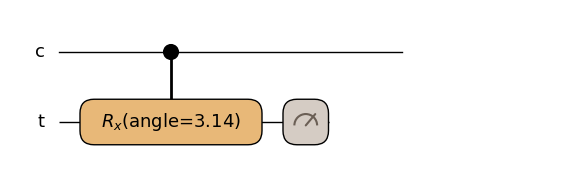
@qmc.qkernel
def crx_control_on() -> qmc.Bit:
    c = qmc.qubit(name="c")
    t = qmc.qubit(name="t")
    # Drive the control to |1>, so the controlled rotation fires.
    c = qmc.x(c)
    c, t = crx(c, t, angle=math.pi)
    return qmc.measure(t)


crx_control_on.draw()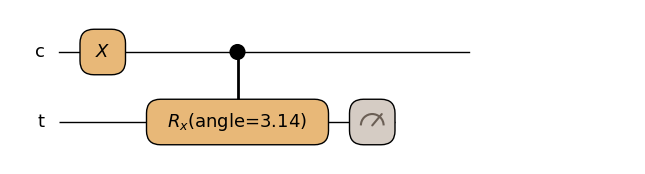
To confirm the control actually takes effect, we transpile both
kernels to Qiskit, run them on the simulator, and check the
target measurement. With angle=math.pi, RX(pi) maps |0> to
|1>, so the target ends up |1> on every shot when the control is
|1>, and stays |0> otherwise.
off_counts = dict(
    transpiler.transpile(crx_control_off)
    .sample(transpiler.executor(), shots=sample_shots)
    .result()
    .results
)
on_counts = dict(
    transpiler.transpile(crx_control_on)
    .sample(transpiler.executor(), shots=sample_shots)
    .result()
    .results
)
print("control |0> ->", off_counts)
assert off_counts == {0: sample_shots}
print("control |1> ->", on_counts)
assert on_counts == {1: sample_shots}
control |0> -> {0: 256}
control |1> -> {1: 256}
A few points to note:
You can write
crx = qmc.control(qmc.rx)either inside or outside a qkernel. Either way the returned value is reusable; bind it to a name and call it as many times as you like.When you call
crx(c, t, angle=...), the control qubits come first as positional arguments, then the targets, then any classical keyword arguments. The order mirrors theqmc.rx(q, angle)signature of the gate being controlled, with a control prefixed.The keyword name for the classical parameter is whatever the controlled gate uses (
angleforqmc.rx,thetaforqmc.p, etc.) —qmc.controldoes not rename it.
2. Two modes at a glance
qmc.control has two modes. Which one you are in is decided
entirely by the type you pass for num_controls: a Python
int puts you in concrete mode, a qmc.UInt handle (or any
UInt expression like n - 1) puts you in symbolic mode.
Everything else about the call follows from that choice.
| Aspect | Concrete | Symbolic |
|---|---|---|
num_controls= | Python int (default 1) | qmc.UInt handle, or any UInt expression |
| Control argument(s) | one or more positional args (Qubit, VectorView, or Vector[Qubit]) whose qubit counts sum to num_controls | one positional Vector[Qubit] / VectorView pool (single-pool form, with optional control_indices), or several positional args mixing Qubit / VectorView / Vector[Qubit] |
control_indices | not accepted | optional — picks which slots of the pool are active |
control_value | optional Python int — activates on that LSB-first register value | only the default None; construct qmc.control with a concrete Python int width for any other value |
| Control count resolved at | when qmc.control(...) is evaluated (module-load or tracing time) | transpile time (from bindings) |
Most of qmc.control’s features (power=, default values,
classical-kwarg reordering, sub-kernels that take
Vector[Qubit], the multi-argument control shapes, ...) behave
identically in both modes; 3. Patterns that work in BOTH modes collects those. 4. Concrete-mode-only patterns
covers the features that require concrete mode, and
5. Symbolic-mode patterns the symbolic-mode-specific features.
3. Patterns that work in BOTH modes
Each feature in this section behaves the same way in either mode.
The cells below use concrete mode for brevity, but the same
feature is available in symbolic mode too — the only differences
are that num_controls is a UInt expression and the
qubit-count match is checked at transpile time. 5. Symbolic-mode patterns covers
the symbolic-only argument shapes.
3.1 Controlling any callable
qmc.control accepts either a built-in gate function (qmc.rx,
qmc.h, qmc.p, ...) or any user-defined @qmc.qkernel. The
example below uses two controlled operations in one kernel: ch
(the controlled qmc.h) and cg (the controlled user-defined
_h_then_rx).
@qmc.qkernel
def _h_then_rx(q: qmc.Qubit, theta: qmc.Float) -> qmc.Qubit:
    q = qmc.h(q)
    q = qmc.rx(q, theta)
    return q


ch = qmc.control(qmc.h)
cg = qmc.control(_h_then_rx)
@qmc.qkernel
def control_any_callable_demo() -> qmc.Vector[qmc.Bit]:
# q[0] is the shared control; q[1] / q[2] are the two targets.
q = qmc.qubit_array(3, "q")
q[0] = qmc.x(q[0])
q[0], q[1] = ch(q[0], q[1])
q[0], q[2] = cg(q[0], q[2], theta=math.pi / 4)
return qmc.measure(q)
control_any_callable_demo.draw()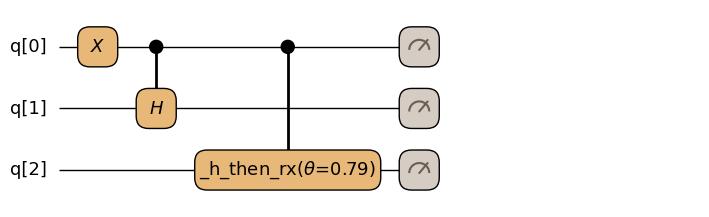
3.2 Sub-kernel taking Vector[Qubit]
A controlled kernel may take a Vector[Qubit] argument. The
caller passes a Vector or a VectorView of the matching
length.
@qmc.qkernel
def _vec_h(qs: qmc.Vector[qmc.Qubit]) -> qmc.Vector[qmc.Qubit]:
    qs[0] = qmc.h(qs[0])
    qs[1] = qmc.h(qs[1])
    return qs


cg = qmc.control(_vec_h, num_controls=1)
@qmc.qkernel
def vec_target_demo() -> qmc.Vector[qmc.Bit]:
qs = qmc.qubit_array(3, "qs")
qs[0] = qmc.x(qs[0])
qs[0], qs[1:3] = cg(qs[0], qs[1:3])
return qmc.measure(qs)
vec_target_demo.draw()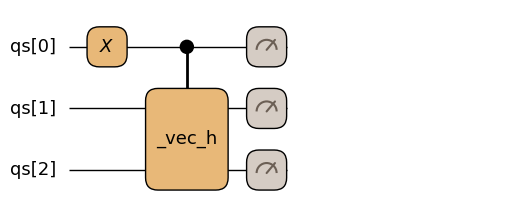
3.3 Default values from the controlled kernel’s signature
When the controlled kernel declares a Python default for a classical parameter, the caller may omit that keyword.
@qmc.qkernel
def _phase(
    q: qmc.Qubit,
    # Runtime: ``_create_bound_input`` accepts a raw ``float`` default for
    # a ``qmc.Float`` parameter and wraps it as a constant ``Float`` handle.
    # Static signature: declares the actual handle type; ``# type: ignore``
    # acknowledges that the default literal is intentionally not a ``Float``
    # instance.
    theta: qmc.Float = math.pi / 2,  # type: ignore[assignment]
) -> qmc.Qubit:
    return qmc.rx(q, theta)


cg = qmc.control(_phase)
@qmc.qkernel
def default_arg_demo() -> qmc.Bit:
c = qmc.qubit(name="c")
t = qmc.qubit(name="t")
c = qmc.x(c)
c, t = cg(c, t) # theta defaults to math.pi / 2
return qmc.measure(t)
default_arg_demo.draw()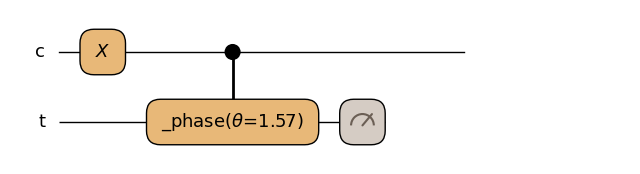
# Same `_phase` kernel, this time controlled with a symbolic
# `num_controls=n - 1`.  The `theta=math.pi / 2` default still
# applies even though the caller never names it.  Replace the
# omitted `theta` with a positional override at the call site
# (`cg(q[0 : n - 1], q[n - 1], math.pi / 4)`) when you want a
# different angle without switching to a kwarg.
@qmc.qkernel
def default_arg_demo_symbolic(n: qmc.UInt) -> qmc.Vector[qmc.Bit]:
    q = qmc.qubit_array(n, "q")
    q[0 : n - 1] = qmc.x(q[0 : n - 1])  # drive every control slot to |1>
    cg = qmc.control(_phase, num_controls=n - 1)  # symbolic num_controls
    q[0 : n - 1], q[n - 1] = cg(q[0 : n - 1], q[n - 1])
    return qmc.measure(q)


default_arg_demo_symbolic.draw(n=3, fold_loops=False)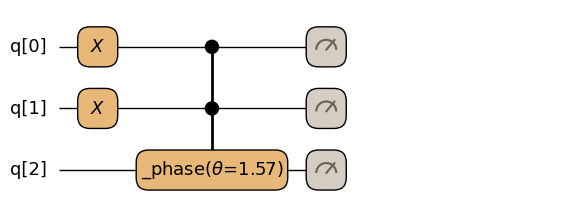
3.4 Controlling U^k with power=
Passing power=k controls the k-th power U^k instead of U
itself. power accepts a Python int (resolved at compile
time) or a qmc.UInt handle (resolved at transpile time from
bindings), and works regardless of whether num_controls is
concrete or symbolic. The resolved value must be a strictly positive integer;
zero, negative values, and bool are rejected. A symbolic power changes
circuit structure, so supply it through bindings, not runtime parameters.
cg = qmc.control(qmc.rx) # num_controls = 1 (concrete)@qmc.qkernel
def power_demo_concrete() -> qmc.Bit:
c = qmc.qubit(name="c")
t = qmc.qubit(name="t")
c = qmc.x(c)
c, t = cg(c, t, angle=math.pi / 4, power=3) # power is a Python int
return qmc.measure(t)
power_demo_concrete.draw()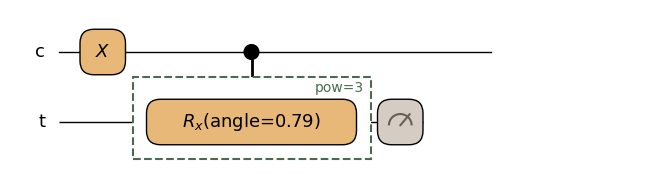
Global phase becomes observable under coherent control
Multiplying an otherwise standalone operation by exp(1j * phi) does not
change ordinary measurement probabilities. Qamomile nevertheless keeps the
phase as part of the current lexical circuit region. When a reversible
region is coherently controlled, the same factor becomes a relative phase on
the all-active control subspace. This matters whenever an algorithm stores
information in a subroutine’s phase rather than only in its measurement
probabilities.
Qamomile provides two related ways to attach this phase:
qmc.global_phase(fn, phi)invokesfnnormally, preserves all of its outputs, and then attachesexp(1j * phi)to the surrounding region.qmc.control(fn)(..., global_phase=phi)attaches the phase at that controlled call site.
The ordinary qmc.global_phase wrapper does not require fn to be
reversible: fn may measure, reset, allocate qubits, return classical
values, or be entirely classical. Reversibility is checked only if a
containing qkernel is later compiled through qmc.control, qmc.inverse, or
another reversible transform. For a reversible operation U, the precise
controlled-call meaning is control((exp(1j * phi) * U) ** power).
Therefore power=k repeats the phase k times, while an inverse negates the
phase together with inverting U. global_phase is a reserved call-site
keyword; if the target callable also has an ordinary parameter named
global_phase, pass that parameter positionally.
A scalar body whose formal target is Qubit can be called with a
Vector[Qubit] or VectorView[Qubit]. Qamomile then broadcasts the complete
scalar unitary to every element, exactly like an explicit loop. If
and the target has elements, the result is
; power=k also multiplies
that phase by . To attach one phase to the register as a whole, define the
controlled body with a Vector[Qubit] parameter and attach the phase to that
vector body, so it remains one logical call.
A phase attached inside a runtime if branch or while body stays in that
branch or iteration. It is not moved to the top-level circuit or discarded.
A target that cannot preserve the requested scoped or standalone phase fails
explicitly during capability verification or materialization.
@qmc.qkernel
def _identity_for_phase(q: qmc.Qubit) -> qmc.Qubit:
    return q


controlled_phased_identity = qmc.control(_identity_for_phase)


@qmc.qkernel
def phase_kickback_demo() -> qmc.Bit:
    control = qmc.h(qmc.qubit("control"))
    target = qmc.qubit("target")
    control, target = controlled_phased_identity(
        control,
        target,
        global_phase=math.pi,
    )
    control = qmc.h(control)
    return qmc.measure(control)


phase_counts = dict(
    transpiler.transpile(phase_kickback_demo)
    .sample(transpiler.executor(), shots=sample_shots)
    .result()
    .results
)
assert phase_counts == {1: sample_shots}3.5 Multiple separate positional control args (CCX style)
With num_controls=2, the call site lists each control qubit
as its own positional argument before the target. The example
below is the canonical CCX (Toffoli): two controls c0, c1
and a target t. The same pattern extends to num_controls=3
(CCCX), num_controls=4, etc., as long as you have that many
distinct Qubit handles to pass in.
ccx = qmc.control(qmc.x, num_controls=2)@qmc.qkernel
def toffoli_demo() -> qmc.Bit:
c0 = qmc.qubit(name="c0")
c1 = qmc.qubit(name="c1")
t = qmc.qubit(name="t")
c0 = qmc.x(c0)
c1 = qmc.x(c1)
c0, c1, t = ccx(c0, c1, t)
return qmc.measure(t)
toffoli_demo.draw()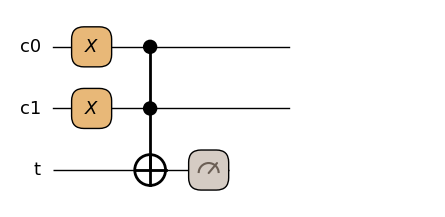
3.6 Mixing scalar Qubit and VectorView controls
The positional control prefix may freely mix scalar Qubit
handles, VectorView slices, and whole Vector[Qubit]s, as
long as the total qubit count adds up to num_controls. Here
the three controls for a num_controls=3 controlled-H come from
qs[0] (a scalar Qubit, 1 qubit) plus qs[1:3] (a
VectorView, 2 qubits).
cg = qmc.control(qmc.h, num_controls=3)@qmc.qkernel
def mixed_controls_demo() -> qmc.Vector[qmc.Bit]:
qs = qmc.qubit_array(5, "qs")
qs[0] = qmc.x(qs[0])
qs[1] = qmc.x(qs[1])
qs[2] = qmc.x(qs[2])
qs[0], qs[1:3], qs[3] = cg(qs[0], qs[1:3], qs[3])
return qmc.measure(qs)
mixed_controls_demo.draw()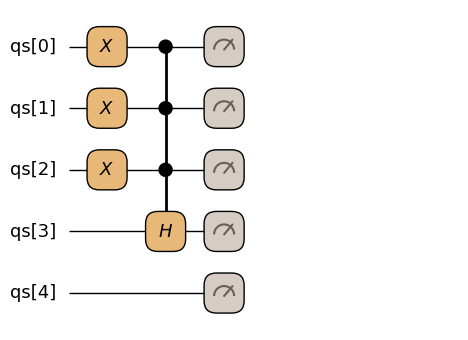
4. Concrete-mode-only patterns
Almost every control-argument shape works in both modes (3. Patterns that work in BOTH modes), and symbolic mode adds its own features (5. Symbolic-mode patterns). Concrete mode additionally supports a single scalar control and activation on a specified computational-basis value.
4.1 A single scalar control
A single scalar Qubit as the lone control requires concrete mode. In
symbolic mode a single control argument is read as the pool form and must
be a Vector / VectorView; a control whose count is fixed at one has no
reason to be symbolic anyway. This is exactly the minimal controlled-RX of
1. The minimal example: controlled-RX; the controlled-X (CNOT) below has the same shape.
cx = qmc.control(qmc.x) # num_controls defaults to 1 (concrete)@qmc.qkernel
def cnot_demo() -> qmc.Bit:
c = qmc.qubit(name="c")
t = qmc.qubit(name="t")
c = qmc.x(c) # drive the control to |1> so the X fires
c, t = cx(c, t)
return qmc.measure(t)
cnot_demo.draw()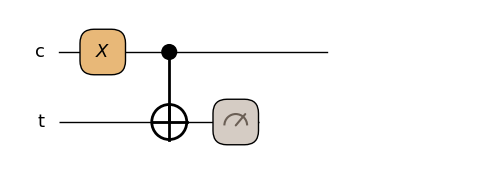
4.2 Activating on a control-register value
Ordinary coherent control activates when every control is 1.
control_value=v instead activates when the flattened control register
represents the concrete integer v. Flattening follows call order; each
Vector / VectorView contributes elements from index zero upward, and the
first flattened control is bit zero (LSB). Thus control_value=2 over two
controls means (bit_0, bit_1) = (0, 1).
Qamomile represents this as one value-activated controlled operation. Its
portable lowering is equivalent to applying X before and after the control
on every zero-valued bit, so those temporary X gates cancel on the returned
controls. The example deliberately mixes a scalar control and a one-element
VectorView to make the flattening order explicit.
control_on_two = qmc.control(qmc.x, num_controls=2, control_value=2)
control_on_zero = qmc.control(qmc.x, num_controls=1, control_value=0)
@qmc.qkernel
def control_value_two_demo() -> qmc.Bit:
qs = qmc.qubit_array(3, "qs")
qs[1] = qmc.x(qs[1]) # flattened controls are (qs[0], qs[1]) = (0, 1)
qs[0], qs[1:2], qs[2] = control_on_two(qs[0], qs[1:2], qs[2])
return qmc.measure(qs[2])
@qmc.qkernel
def control_value_zero_demo() -> qmc.Bit:
control = qmc.qubit("control") # remains |0>
target = qmc.qubit("target")
control, target = control_on_zero(control, target)
return qmc.measure(target)control_value_two_counts = dict(
transpiler.transpile(control_value_two_demo)
.sample(transpiler.executor(), shots=sample_shots)
.result()
.results
)
control_value_zero_counts = dict(
transpiler.transpile(control_value_zero_demo)
.sample(transpiler.executor(), shots=sample_shots)
.result()
.results
)
assert control_value_two_counts == {1: sample_shots}
assert control_value_zero_counts == {1: sample_shots}control_value=None is the default all-ones control. Supplying the explicit
all-ones value 2**num_controls - 1 is canonicalized to that same default.
Any other value must satisfy 0 <= control_value < 2**num_controls.
Non-default control_value is intentionally concrete-only. To activate on a
value other than all ones, construct qmc.control with a concrete Python
int width rather than a qmc.UInt. This keeps the activation bit pattern
unambiguous when the operation is created.
5. Symbolic-mode patterns
This section covers what you get when num_controls is a
qmc.UInt handle (or any UInt expression like n - 1): the
number of active controls is decided at transpile time from
bindings, not at the moment qmc.control(..., num_controls=...)
is evaluated. 5.5 Multi-arg control prefix also shows the symbolic counterpart of
3.5 Multiple separate positional control args (CCX style) / 3.6 Mixing scalar Qubit and VectorView controls.
Two call-site shapes are supported for the control side:
Single-pool form (5.1
num_controls = nover a whole pool – 5.4control_indiceswithUIntentries): oneVector[Qubit]orVectorViewis passed as the control argument, and the entire pool — or the subset chosen bycontrol_indices— acts as the active controls.Multi-arg form (5.5 Multi-arg control prefix): the control prefix is several positional arguments (scalar
Qubit,VectorView,Vector[Qubit], or a mix) whose qubit counts sum tonum_controls. This is what concrete mode already does (3.5 Multiple separate positional control args (CCX style) / 3.6 Mixing scalar Qubit andVectorViewcontrols), lifted to a symbolicnum_controls.
The control_indices keyword is symbolic-mode only; it picks
which slots of a single-pool argument wire in as active controls
(the rest pass through untouched). control_indices is valid
only with the single-pool form; combining it with the multi-arg
form is rejected.
5.1 num_controls = n over a whole pool
The simplest symbolic shape: num_controls=n with the entire
pool (length n) used as the active controls. The parameter n
is made concrete at transpile time via bindings.
@qmc.qkernel
def symbolic_pool(n: qmc.UInt) -> qmc.Vector[qmc.Bit]:
    ctrls = qmc.qubit_array(n, "ctrls")
    tgt = qmc.qubit(name="tgt")
    ctrls = qmc.x(ctrls)  # drive all controls to |1>
    cg = qmc.control(qmc.x, num_controls=n)  # symbolic n as the control count
    ctrls, tgt = cg(ctrls, tgt)
    return qmc.measure(ctrls)


symbolic_pool.draw(n=3, fold_loops=False)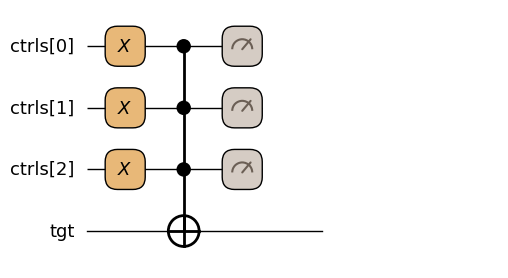
5.2 Canonical n - 1 multi-controlled form
A frequent shape in multi-controlled-X designs: the first
n - 1 qubits of a register become controls, the last one
becomes the target. The bound on num_controls is the symbolic
expression n - 1, and the control argument is the slice
qs[0:n - 1].
@qmc.qkernel
def mcx_demo(n: qmc.UInt) -> qmc.Vector[qmc.Bit]:
    qs = qmc.qubit_array(n, "qs")
    qs[0 : n - 1] = qmc.x(qs[0 : n - 1])  # drive the control part to |1>
    mcx = qmc.control(qmc.x, num_controls=n - 1)
    qs[0 : n - 1], qs[n - 1] = mcx(qs[0 : n - 1], qs[n - 1])
    return qmc.measure(qs)


mcx_demo.draw(n=4, fold_loops=False)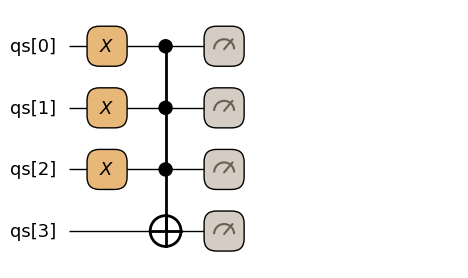
5.3 Selecting a subset with control_indices
When the control pool is wider than the number of active
controls you want, the control_indices keyword (symbolic mode
only) picks which pool slots are wired in. The remaining slots
are left untouched. The indices do not have to be contiguous.
@qmc.qkernel
def subset_pool(n: qmc.UInt, k_ctrls: qmc.UInt) -> qmc.Vector[qmc.Bit]:
    pool = qmc.qubit_array(n, "pool")
    tgt = qmc.qubit(name="tgt")
    pool[0] = qmc.x(pool[0])
    pool[1] = qmc.x(pool[1])
    pool[3] = qmc.x(pool[3])  # pool[2] left at |0> — it is the inactive slot
    cg = qmc.control(qmc.x, num_controls=k_ctrls)
    pool, tgt = cg(pool, tgt, control_indices=[0, 1, 3])
    return qmc.measure(pool)


subset_pool.draw(n=4, k_ctrls=3)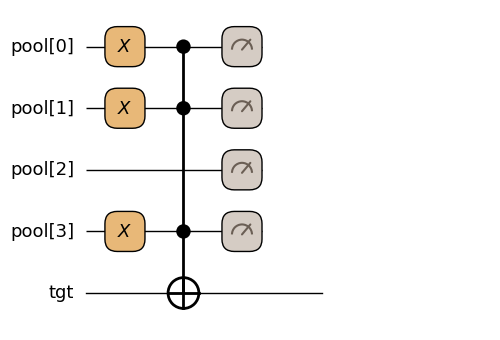
5.4 control_indices with UInt entries
Each entry inside control_indices may be a Python int
literal, a qmc.UInt handle, or any arithmetic expression over
UInt values. Cheap structural checks on literal int entries
(rejecting bool, negative values, and entries that duplicate
another literal int in the list) are done at compose time;
everything else — length agreement with num_controls, range
against the pool size, and any check that depends on a UInt
resolving to a concrete value — is deferred to transpile time
once bindings make the parameters concrete.
@qmc.qkernel
def subset_pool_with_uint(n: qmc.UInt, k_ctrls: qmc.UInt) -> qmc.Vector[qmc.Bit]:
    pool = qmc.qubit_array(n, "pool")
    tgt = qmc.qubit(name="tgt")
    pool[0] = qmc.x(pool[0])
    pool[1] = qmc.x(pool[1])
    pool[3] = qmc.x(pool[3])
    cg = qmc.control(qmc.x, num_controls=k_ctrls)
    pool, tgt = cg(pool, tgt, control_indices=[0, 1, n - 1])
    return qmc.measure(pool)


subset_pool_with_uint.draw(n=4, k_ctrls=3)
5.5 Multi-arg control prefix
When you want to split the controls across several positional
arguments — typically because you want some slots of a single
Vector to be active controls and another slot to be the
target — symbolic mode accepts the same multi-arg shape concrete
mode does (3.5 Multiple separate positional control args (CCX style) / 3.6 Mixing scalar Qubit and VectorView controls). Several slots taken from
the same Vector[Qubit] may sit in the control prefix as long
as they are disjoint (non-overlapping). The qubit counts of the
control-prefix args are matched against num_controls at
transpile time.
Note that control_indices cannot be used with the multi-arg
form (see the reject case in 6. Rejected and edge-case patterns). If you need subset
selection, use the single-pool form (5.3 Selecting a subset with control_indices / 5.4 control_indices with UInt entries);
if you need the multi-arg flexibility, treat the whole prefix as
active.
@qmc.qkernel
def controlled_increment_demo(
    n: qmc.UInt, control_index: qmc.UInt
) -> qmc.Vector[qmc.Bit]:
    q = qmc.qubit_array(n, "q")
    q[control_index] = qmc.x(q[control_index])
    # ``q.shape[0]`` is typed as ``int | UInt``; rebinding ``n`` would
    # widen the parameter's narrow ``qmc.UInt`` annotation, so introduce
    # a fresh local instead.
    n_shape = q.shape[0]
    for k in qmc.range(n_shape - 1):
        target_idx = n - 2 - k
        ctrl_main = q[control_index]
        prefix = q[0:target_idx]
        tgt = q[target_idx]
        cg = qmc.control(qmc.x, num_controls=target_idx + 1)
        ctrl_main, prefix, tgt = cg(ctrl_main, prefix, tgt)
        q[control_index] = ctrl_main
        q[0:target_idx] = prefix
        q[target_idx] = tgt
    return qmc.measure(q)


controlled_increment_demo.draw(n=4, control_index=3, fold_loops=False)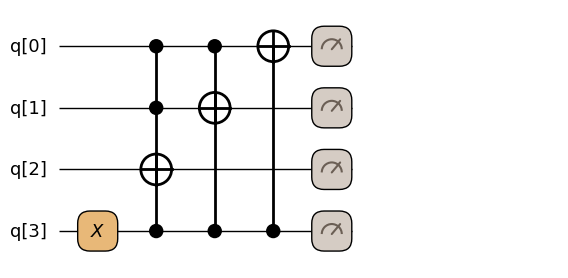
6. Rejected and edge-case patterns
This section walks through rejected call shapes one at a time,
asserting the expected exception with a small expect_error
helper. It ends with a concrete sliced-QFT case that is supported
and worth keeping as a regression example for nested controlled
emission on engines that can convert the nested block to a gate
(Qiskit in this tutorial).
| Case | Mode | Exception |
|---|---|---|
| 6.1 control qubit count crosses an argument boundary | concrete | ValueError |
6.2 control_indices in concrete mode | concrete | ValueError |
6.3 symbolic-length VectorView in concrete | concrete | ValueError |
| 6.4 same-pool slot reused as target | symbolic | UnreturnedBorrowError |
6.5 multi-arg control prefix + control_indices | symbolic | ValueError |
| 6.6 single scalar control in symbolic mode | symbolic | ValueError |
6.7 controlled QFT over a sub-kernel UInt slice | concrete | supported when block-to-gate conversion succeeds |
def expect_error(label: str, exc_type: type[BaseException], body) -> None:
    """Assert that ``body`` raises an exception of ``exc_type``.

    The helper only catches the *expected* exception class.  Any
    other exception propagates out untouched so a regression that
    swaps the exception type surfaces with a normal traceback in
    the cell.  Missing the exception entirely raises an
    ``AssertionError``.
    """
    try:
        body()
    except exc_type as exc:
        print(f"[{type(exc).__name__}] {label}: {exc}")
        return
    raise AssertionError(
        f"{label}: expected {exc_type.__name__}, but no exception was raised"
    )
6.1 Control qubit count crosses an argument boundary (concrete)
Concrete mode walks the positional arguments in order, folding
each one into the control list until the running total reaches
num_controls. If a VectorView or Vector pushes the running
total past num_controls, the call is rejected.
def case_count_mismatch() -> None:
    @qmc.qkernel
    def kernel() -> qmc.Bit:
        qs = qmc.qubit_array(6, "qs")
        cg = qmc.control(qmc.x, num_controls=3)
        view, t = cg(qs[0:5], qs[5])  # 5 qubits supplied, 3 expected
        qs[0:5] = view
        return qmc.measure(qs[5])

    _ = kernel.block


expect_error("control count mismatch", ValueError, case_count_mismatch)
[ValueError] control count mismatch: concrete num_controls=3: positional argument #0 would push the control qubit count from 0 to 5, crossing the control / sub-kernel boundary mid-argument. Split the argument so the boundary falls between args.
6.2 control_indices in concrete mode (concrete)
control_indices only makes sense when there is a control
pool to select from, which is a symbolic-mode concept.
Supplying it alongside a concrete num_controls raises
ValueError at compose time.
def case_control_indices_in_concrete() -> None:
    @qmc.qkernel
    def kernel() -> qmc.Bit:
        c = qmc.qubit(name="c")
        t = qmc.qubit(name="t")
        cg = qmc.control(qmc.x)  # num_controls defaults to 1 (concrete)
        c, t = cg(c, t, control_indices=[0])
        return qmc.measure(t)

    _ = kernel.block


expect_error(
    "control_indices in concrete mode",
    ValueError,
    case_control_indices_in_concrete,
)
[ValueError] control_indices in concrete mode: control_indices is only valid in symbolic mode (num_controls=UInt). Got concrete num_controls; concrete-mode controls are positional and have no selection step.
6.3 Symbolic-length VectorView in concrete mode (concrete)
Concrete mode must determine each control argument’s qubit count
at compile time. A slice whose length depends on a UInt is not
supported in concrete mode and raises ValueError before ownership moves.
def case_symbolic_view_in_concrete() -> None:
    @qmc.qkernel
    def kernel(m: qmc.UInt) -> qmc.Bit:
        qs = qmc.qubit_array(m, "qs")
        cg = qmc.control(qmc.x, num_controls=3)
        view, q_out = cg(qs[0:m], qs[m - 1])
        qs[0:m] = view
        qs[m - 1] = q_out
        return qmc.measure(qs[m - 1])

    _ = kernel.block


expect_error(
    "symbolic-length VectorView in concrete mode",
    ValueError,
    case_symbolic_view_in_concrete,
)
[ValueError] symbolic-length VectorView in concrete mode: concrete num_controls=3: positional control argument #0 has symbolic length. Concrete control mode requires every control array length at compose time; use symbolic num_controls for a runtime-sized control register.
6.4 Same-pool slot reused as target — single-pool form (symbolic)
With the single-pool form (cg(pool, ...) combined with
control_indices), it is tempting to take one of the pool’s
inactive slots and pass it as the target — e.g.
cg(pool, pool[2], control_indices=[0, 1, 3]) so that pool[2]
becomes the target of the controlled-U. The call is rejected by
the linear-type borrow tracker: the pool is already consumed as
one argument while pool[2] is borrowed for another, which
surfaces as UnreturnedBorrowError at compose time.
Workarounds (preferred order):
Multi-arg symbolic form (5.5 Multi-arg control prefix). Pass each slot or sub-view as its own positional argument:
cg(pool[0], pool[1], pool[3], pool[2])(or the slice/scalar mix the controlled-increment example uses). Each argument is a separate borrow frompool, the borrow tracker checks disjointness, andnum_controlsmatches the qubit-count sum at transpile time.Concrete mode (3.6 Mixing scalar Qubit and
VectorViewcontrols). Ifnum_controlsis a Pythonint, the same multi-arg shape works without any symbolic plumbing.
def case_pool_slot_as_target() -> None:
    @qmc.qkernel
    def kernel(n: qmc.UInt, k_ctrls: qmc.UInt) -> qmc.Vector[qmc.Bit]:
        pool = qmc.qubit_array(n, "pool")
        cg = qmc.control(qmc.x, num_controls=k_ctrls)
        pool, q = cg(pool, pool[2], control_indices=[0, 1, 3])
        pool[2] = q
        return qmc.measure(pool)

    _ = kernel.block


expect_error(
    "same-pool slot reused as target",
    UnreturnedBorrowError,
    case_pool_slot_as_target,
)
[UnreturnedBorrowError] same-pool slot reused as target: Array 'pool' has unreturned borrowed elements.
Borrowed elements: pool[2]
Fix: Write back all borrowed elements before using the array:
q = pool[i]
q = qm.h(q)
pool[i] = q # Return the element
6.5 Multi-arg control prefix + control_indices (symbolic)
The two symbolic-mode features are mutually exclusive.
control_indices only makes sense over a single control pool
(one Vector argument); combining it with multiple positional
control args raises ValueError at compose time.
def case_multi_arg_with_control_indices() -> None:
    @qmc.qkernel
    def kernel(n: qmc.UInt, k: qmc.UInt) -> qmc.Vector[qmc.Bit]:
        q = qmc.qubit_array(n, "q")
        ctrl_main = q[0]
        prefix = q[1:k]
        tgt = q[k]
        cg = qmc.control(qmc.x, num_controls=k + 1)
        ctrl_main, prefix, tgt = cg(ctrl_main, prefix, tgt, control_indices=[0, 1, 2])
        q[0] = ctrl_main
        q[1:k] = prefix
        q[k] = tgt
        return qmc.measure(q)

    _ = kernel.block


expect_error(
    "multi-arg + control_indices",
    ValueError,
    case_multi_arg_with_control_indices,
)
[ValueError] multi-arg + control_indices: control_indices is only supported with a single Vector[Qubit] / VectorView[Qubit] control argument (the pool form). Combining control_indices with multiple positional control args is not supported.
6.6 Single scalar control in symbolic mode (symbolic)
A single scalar Qubit control is the one shape that needs
concrete mode. In symbolic mode a lone control argument is read
as the single-pool form, which requires a Vector /
VectorView.
def case_single_scalar_control_symbolic() -> None:
    @qmc.qkernel
    def kernel(n: qmc.UInt) -> qmc.Bit:
        c = qmc.qubit(name="c")
        t = qmc.qubit(name="t")
        cg = qmc.control(qmc.rx, num_controls=n)
        c, t = cg(c, t, angle=math.pi)
        return qmc.measure(t)

    _ = kernel.block


expect_error(
    "single scalar control in symbolic mode",
    ValueError,
    case_single_scalar_control_symbolic,
)
[ValueError] single scalar control in symbolic mode: When num_controls is symbolic (UInt), a single control argument must be a Vector[Qubit] / VectorView pool, not a scalar Qubit. A single fixed scalar control has no symbolic meaning (the count is one), so use concrete mode instead -- e.g. qmc.control(gate) with the default num_controls=1. To keep a scalar control in symbolic mode, pass it together with at least one more control argument (the multi-arg form).
6.7 Controlled QFT over a sub-kernel UInt slice (concrete)
A controlled sub-kernel may call qmc.qft / qmc.iqft on a
Vector[Qubit] argument whose size is known at the call site.
For example, controlled_qft = qmc.control(apply_qft) works
when apply_qft(q) applies QFT to all of q.
The same now holds for the narrower Qiskit-backed pattern below:
the wrapped sub-kernel receives a classical UInt argument and uses
it to form a q[:m] slice before calling QFT. Qamomile strips the
slice marker inside the nested controlled block after borrow
checking, so a controlled-U emitter whose block-to-gate conversion
succeeds can lower the sliced composite block. Engines without
block-to-gate conversion may still reject this multi-target fallback.
def case_controlled_qft_over_uint_slice() -> None:
    @qmc.qkernel
    def qft_prefix(q: qmc.Vector[qmc.Qubit], m: qmc.UInt) -> qmc.Vector[qmc.Qubit]:
        prefix = q[:m]
        prefix = qmc.qft(prefix)
        q[:m] = prefix
        return q

    @qmc.qkernel
    def kernel(n: qmc.UInt) -> qmc.Vector[qmc.Bit]:
        q = qmc.qubit_array(n + 1, "q")
        q[0] = qmc.x(q[0])
        controlled_qft = qmc.control(qft_prefix)
        q[0], targets = controlled_qft(q[0], q[1 : n + 1], n)
        q[1 : n + 1] = targets
        return qmc.measure(q)

    transpiler.transpile(kernel, bindings={"n": 2})


case_controlled_qft_over_uint_slice()
7. Summary
qmc.control(fn, num_controls=...) makes a controlled version
of any Qamomile built-in gate or user-defined kernel. It has two
modes, decided by the type of num_controls: a Python int
gives concrete mode, and a qmc.UInt (or a UInt expression
like n - 1) gives symbolic mode.
Concrete mode also supports control_value, including zero-controls, using
the same LSB-first order in which control arguments are flattened. In either
mode, power, global phase, scalar-to-vector broadcast, inverse, and nested
control preserve the complete controlled unitary. Invalid widths, overlapping
control and target wires, and unsupported reversible bodies fail explicitly.