Tags: tutorial
Tutorial 02 introduced how to build parameterized qkernels and how to broadcast single-qubit gates over a whole register. This chapter introduces slicing, a Qamomile feature that helps you write more complex qkernels.
# Install the latest Qamomile from pip.
# !pip install "qamomile[qiskit,visualization]"
import qamomile.circuit as qmc
from qamomile.circuit.transpiler.errors import (
AffineTypeError,
QubitBorrowConflictError,
UnreturnedBorrowError,
)Basic slice syntax
Indexing a Vector[Qubit] with a Python slice (start:stop:step) returns
a VectorView — a handle that refers to a sub-range of the parent vector.
In most situations you can use it just like an ordinary Vector[Qubit].
@qmc.qkernel
def demo() -> qmc.Vector[qmc.Bit]:
    q = qmc.qubit_array(6, name="q")
    # Pick out the even-indexed qubits via slicing.
    evens = q[0::2]
    # Pick out the odd-indexed qubits via slicing.
    odds = q[1::2]
    # Loop over the slice's shape and apply an H gate to each element.
    for i in qmc.range(evens.shape[0]):
        evens[i] = qmc.h(evens[i])
    # Broadcast X (a single-qubit gate) over the whole slice.
    odds = qmc.x(odds)
    # Return the slice views back to the original qubit array.
    q[0::2] = evens
    q[1::2] = odds
    return qmc.measure(q)


demo.draw(fold_loops=False)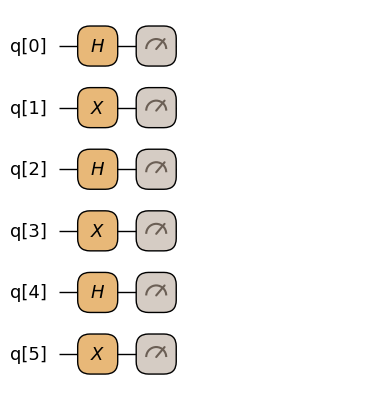
A few things to notice in demo:
evens = q[0::2]creates aVectorViewcovering the even-indexed qubits ofq. Similarly,odds = q[1::2]covers the odd-indexed qubits.The
evens[i] = qmc.h(evens[i])inside the loop follows the same affine pattern you saw in Tutorial 02 — each element is consumed and a new element handle replaces it.VectorViewcan be used in much the same way asVector[Qubit].
Inline shorthand
When the body is a single broadcastable operation, you don’t need to name
the VectorView. Borrow, transform, and return in one statement.
@qmc.qkernel
def demo_inline() -> qmc.Vector[qmc.Bit]:
    q = qmc.qubit_array(6, name="q")
    q[0::2] = qmc.h(q[0::2])
    q[1::2] = qmc.x(q[1::2])
    return qmc.measure(q)


demo_inline.draw(fold_loops=False)
Nested slices
A VectorView can itself be sliced again to produce another VectorView.
The result covers a sub-range of the parent VectorView. Each level borrows
from the one above, and each level must be returned to its immediate parent
before its grandparent can be touched.
Concretely: if outer = q[0::2] and inner = outer[1:3], the return order
is inner → outer → root. Return inner to outer first, then outer
to q.
@qmc.qkernel
def nested_slice() -> qmc.Vector[qmc.Bit]:
    q = qmc.qubit_array(6, name="q")
    outer = q[0::2]
    inner = outer[1:3]
    for i in qmc.range(inner.shape[0]):
        inner[i] = qmc.h(inner[i])
    outer[1:3] = inner
    q[0::2] = outer
    return qmc.measure(q)


nested_slice.draw(fold_loops=False)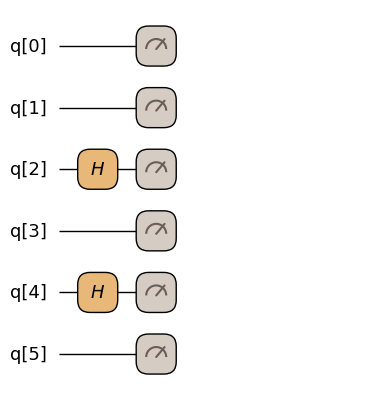
Passing a VectorView to a helper kernel
When a VectorView is passed to an external qkernel, it is treated the same
as a Vector[Qubit].
@qmc.qkernel
def h_all(v: qmc.Vector[qmc.Qubit]) -> qmc.Vector[qmc.Qubit]:
    return qmc.h(v)


@qmc.qkernel
def x_all(v: qmc.Vector[qmc.Qubit]) -> qmc.Vector[qmc.Qubit]:
    return qmc.x(v)


@qmc.qkernel
def demo_helper() -> qmc.Vector[qmc.Bit]:
    q = qmc.qubit_array(6, name="q")
    evens = q[0::2]
    odds = q[1::2]
    evens = h_all(evens)
    odds = x_all(odds)
    q[0::2] = evens
    q[1::2] = odds
    return qmc.measure(q)


demo_helper.draw(inline=True, fold_loops=False)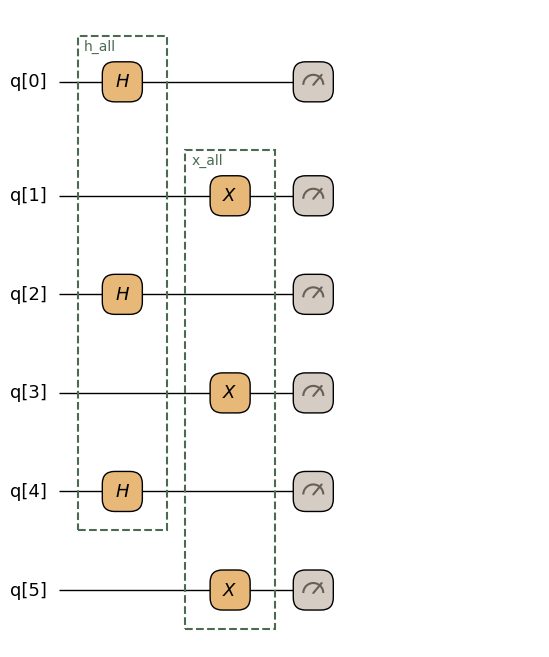
The same convention extends to the built-in helpers in
qamomile.circuit.stdlib. qmc.qft, qmc.iqft, and qmc.qpe all take a
Vector[Qubit] and work equally well on a VectorView.
@qmc.qkernel
def qft_on_window() -> qmc.Vector[qmc.Bit]:
    q = qmc.qubit_array(6, name="q")
    q[1:4] = qmc.qft(q[1:4])
    return qmc.measure(q)


qft_on_window.draw()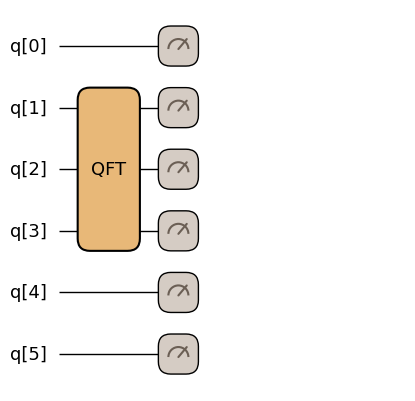
Splitting a qubit array via slicing
In Qamomile, you cannot directly split or merge the qubit array
Vector[Qubit] itself. Slicing, however, lets you extract several
VectorViews from one large qubit array, so you can write an algorithm as
if you had multiple registers. Below, we apply QFT to the whole register
and then apply QFT again to just a portion. Qamomile’s QFT (qmc.qft)
takes a Vector[Qubit] as input, so without slicing you would have to
write QFT from scratch inside your qkernel. With slicing, you can pull
out a portion of the qubit array and skip that work.
@qmc.qkernel
def demo_separation() -> qmc.Vector[qmc.Bit]:
    qs = qmc.qubit_array(6, name="qs")
    # Apply QFT to the whole register.
    qs = qmc.qft(qs)
    # Apply QFT again to just the front half.
    partial_qs = qs[0:3]
    partial_qs = qmc.qft(partial_qs)
    # Return the slice view back to the original qubit array.
    qs[0:3] = partial_qs
    return qmc.measure(qs)


demo_separation.draw(inline=True, fold_loops=False)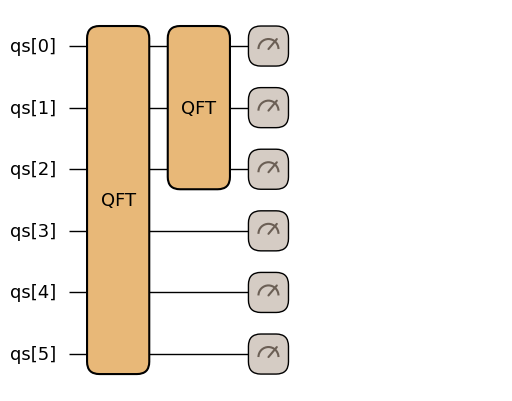
Error patterns with VectorView
A VectorView is created by borrowing the qubits specified by the
slice from its parent qubit array Vector[Qubit]. From the parent’s
perspective, those qubits are lent out; until they are returned, the
parent Vector[Qubit] cannot access them directly. For the same reason,
operations that consume the parent Vector[Qubit] as a whole are not
allowed either. To return the lent qubits, you must perform a slice
assignment.
Below we walk through error patterns where the lent qubits are accessed without first being returned.
@qmc.qkernel
def direct_parent_access() -> qmc.Vector[qmc.Bit]:
    q = qmc.qubit_array(6, name="q")
    v = q[1:3]
    q[1] = qmc.h(q[1])  # direct access to a lent qubit raises an error
    q[1:3] = v
    return qmc.measure(q)


try:
    direct_parent_access.draw()
except QubitBorrowConflictError as e:
    print(f"Error type: {type(e).__name__}")
    print(f"Error message: {e}")
else:
    raise AssertionError(
        "expected QubitBorrowConflictError, but draw() returned normally"
    )
Error type: QubitBorrowConflictError
Error message: Parent slot 'q[1]' is currently held by a VectorView slice.
Access it through the view, or let the view finish before touching the parent directly.
@qmc.qkernel
def forgot_return() -> qmc.Vector[qmc.Bit]:
    q = qmc.qubit_array(6, name="q")
    evens = q[0::2]
    for i in qmc.range(evens.shape[0]):
        evens[i] = qmc.h(evens[i])
    return qmc.measure(q)  # VectorView not returned — raises


try:
    forgot_return.draw()
except UnreturnedBorrowError as e:
    print(f"Error type: {type(e).__name__}")
    print(f"Error message: {e}")
else:
    raise AssertionError("expected UnreturnedBorrowError, but draw() returned normally")
Error type: UnreturnedBorrowError
Error message: Array 'q' has unreturned slice-view borrows from q[slice].
Borrowed slots: q[0] (held by slice view), q[2] (held by slice view), q[4] (held by slice view)
Fix: Return every active view via slice assignment before consuming the parent:
view = q[a:b:c]
# ... use view ...
q[a:b:c] = view # explicit return
@qmc.qkernel
def overlapping_views() -> qmc.Vector[qmc.Bit]:
    q = qmc.qubit_array(6, name="q")
    a = q[0:3]
    b = q[2:5]  # double-lending the qubits already lent to `a` — raises
    q[0:3] = a
    q[2:5] = b
    return qmc.measure(q)


try:
    overlapping_views.draw()
except QubitBorrowConflictError as e:
    print(f"Error type: {type(e).__name__}")
    print(f"Error message: {e}")
else:
    raise AssertionError(
        "expected QubitBorrowConflictError, but draw() returned normally"
    )
Error type: QubitBorrowConflictError
Error message: Parent slot 'q[2]' is already owned by another slice view 'q[slice]' and cannot be re-sliced while that view is live. Consume / release the existing view before slicing the same range again.
@qmc.qkernel
def invalid_nested_return() -> qmc.Vector[qmc.Bit]:
    q = qmc.qubit_array(6, name="q")
    outer = q[0::2]
    inner = outer[1:3]
    for i in qmc.range(inner.shape[0]):
        inner[i] = qmc.h(inner[i])
    q[0::2] = outer  # returning outer without first returning inner — raises
    return qmc.measure(q)


try:
    invalid_nested_return.draw()
except AffineTypeError as e:
    print(f"Error type: {type(e).__name__}")
    print(f"Error message: {e}")
else:
    raise AssertionError("expected AffineTypeError, but draw() returned normally")
Error type: AffineTypeError
Error message: Slice assignment RHS view 'q[slice]' no longer owns 'q[2]'; the parent's borrow record points at an unrelated view / element. This view was likely drained by a later overlapping slice; reconstruct the view before assigning it back.
Next: Controlled Gates — qmc.control
for built-in gates and sub-kernels, concrete vs symbolic control counts,
and the catalogue of patterns that do not compose.